
Symmetry as a Classical Design Principle: Proportion, Axis, Enfilade
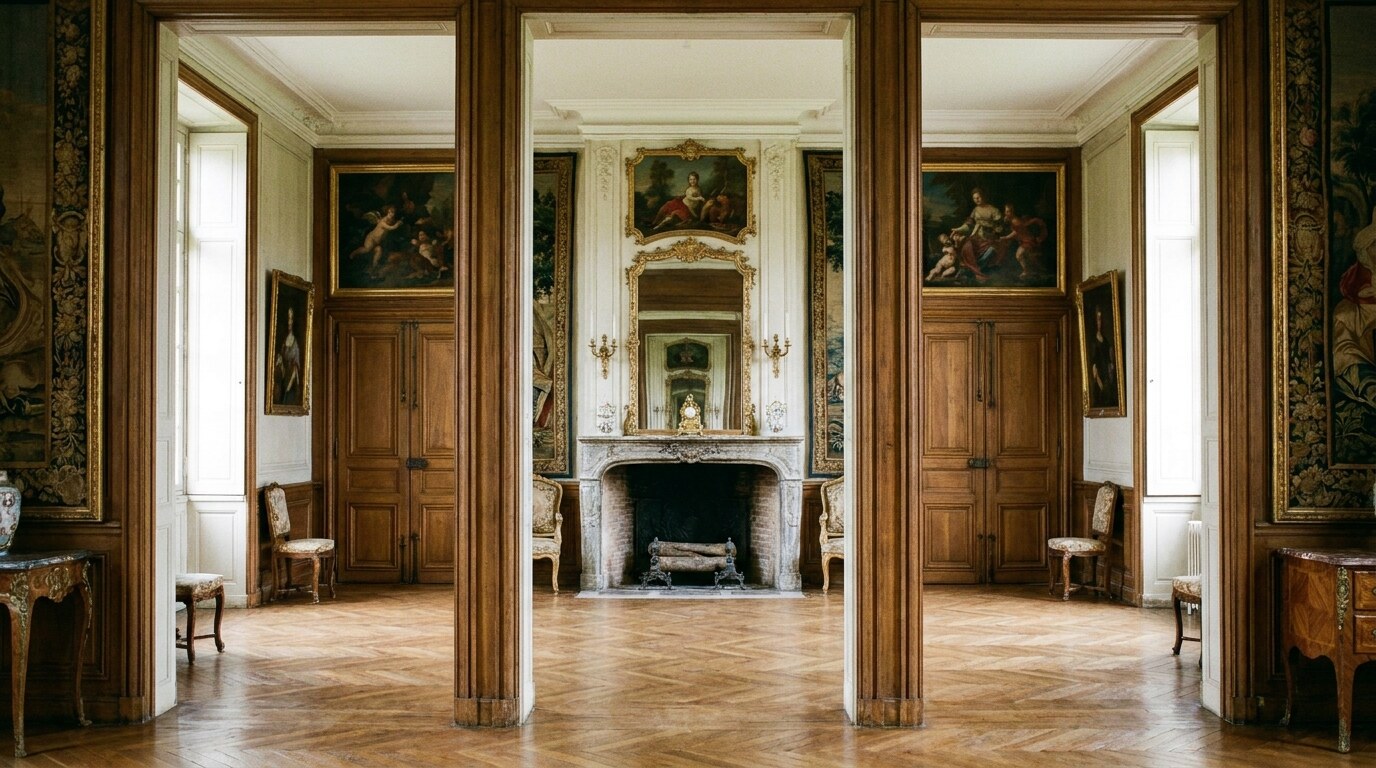
Symmetry in classical interior design refers to four specific compositional principles: bilateral mirror symmetry across a primary axis (the enfilade sight line), proportional symmetry in elevation (the orders applied vertically), centring of features on architectural axis points (chimneypieces, doors, windows), and the deliberate balancing of dissimilar elements through visual mass. These principles were codified by Vitruvius (De architectura, c. 30–15 BCE), Palladio (I quattro libri dell'architettura, 1570), and applied through the British Palladian and French classical traditions.
Four kinds of classical symmetry
Four distinct symmetry classes operate together in a successful classical interior. Bilateral symmetry mirrors a wall composition across a vertical axis (a chimneypiece centred on the long wall, with paired pictures, paired sconces, and paired chairs on either side). Proportional symmetry applies the proportions of the architectural orders (Doric, Ionic, Corinthian, Composite, Tuscan) to determine wall-zone heights (skirting, dado, frieze, cornice). Axial symmetry centres principal features on architectural axes (chimneypiece centred on the wall axis, doors centred on the room's axes). Compositional balance handles dissimilar elements (a door on one wall balanced by a window of equivalent visual weight on the opposite wall).
Vitruvius and the symmetria-eurythmia distinction
Vitruvius's De architectura (c. 30–15 BCE) defines symmetria as the proportional relationship of parts to one another and to the whole, distinct from eurythmia, which Vitruvius defines as the visual harmony arising from those proportions; the two terms are not interchangeable in classical theory. Renaissance translators (Cesare Cesariano's 1521 Italian edition, Daniele Barbaro's 1556 commentary) preserved the distinction, but English and French popular usage from the 18th century onward conflated symmetry with bilateral mirroring and lost the proportional dimension.
Palladian application
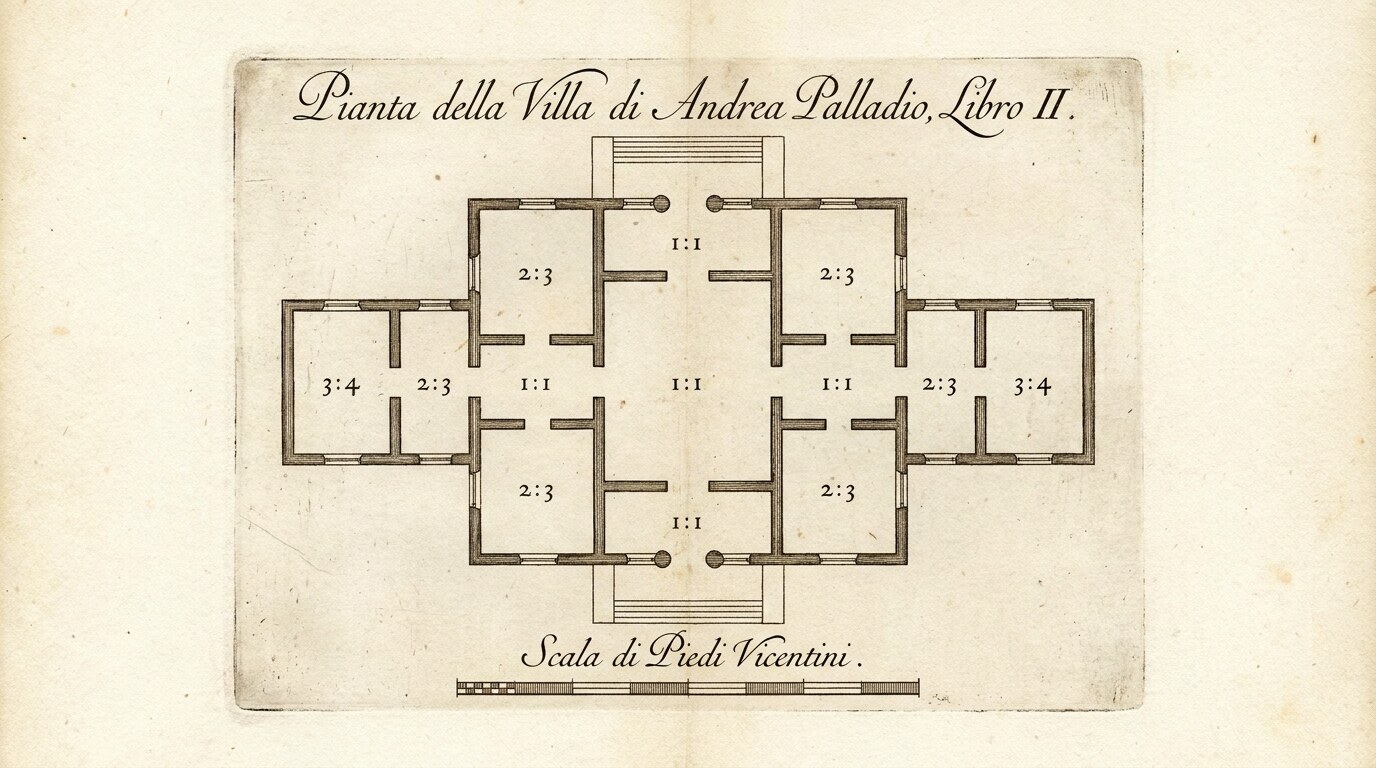
Andrea Palladio's I quattro libri dell'architettura was published in Venice in 1570 and translated into English by Giacomo Leoni (London, 1715, with engravings by Bernard Picart) and again by Isaac Ware (London, 1738), supplying the British Palladian movement with its working specification source. Palladio's room ratios (1:1 square, 2:3, 3:4, 3:5, and 1:2 double-square) became the standard British room-shape vocabulary from approximately 1715 to 1830, with Holkham Hall, Houghton Hall, and Stourhead all designed on Palladian ratios.
Enfilade planning explained
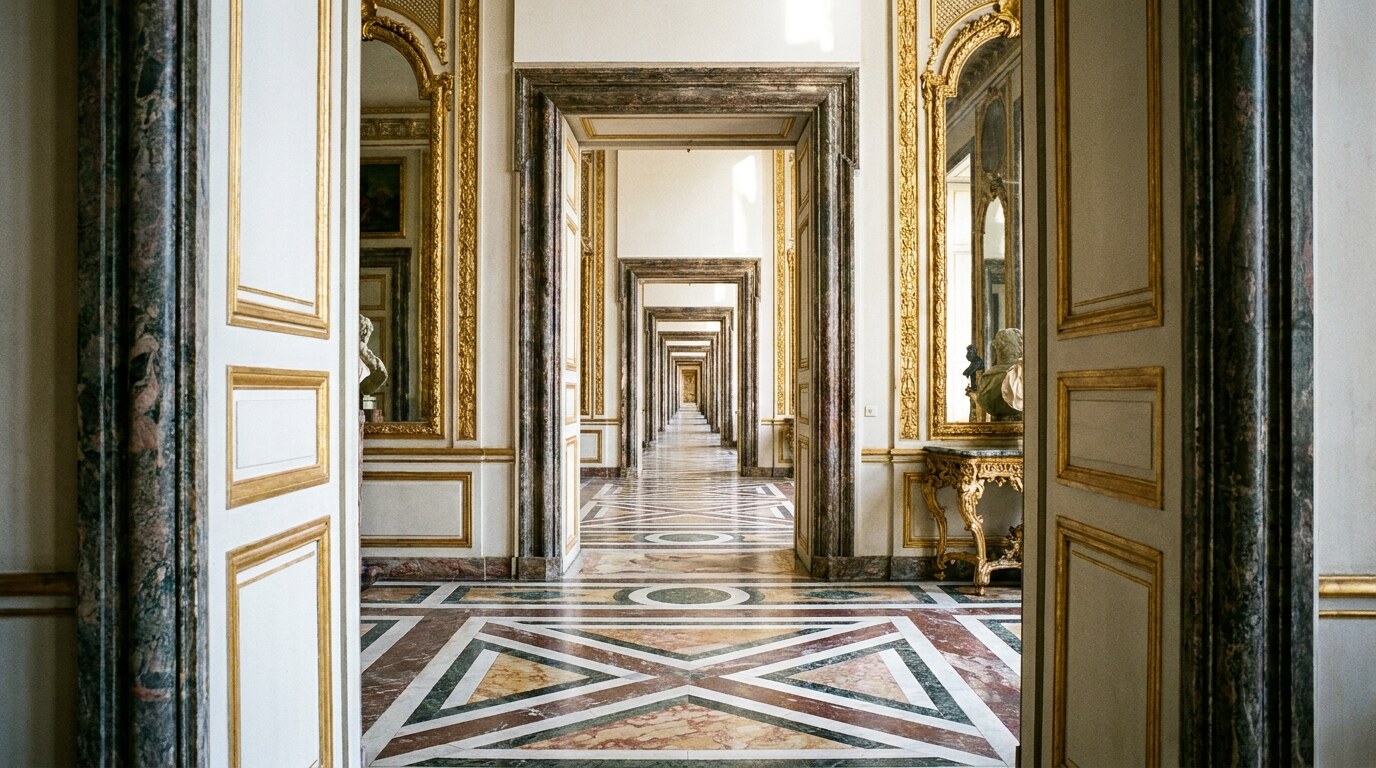
The enfilade is the sequence of aligned doorways that creates a sight line through successive rooms. Three case studies document the technique at scale. The enfilade at Versailles passes through 14 successive doorways from the Salon d'Hercule to the Salle de la Guerre, an axis approximately 240 metres long and the longest surviving 17th-century state-rooms enfilade in Europe. The Hôtel de Soubise, Paris, presents a Régence-period enfilade through its appartement de parade on the first floor. Holkham Hall (William Kent, 1734–1764) shows the British Palladian application: a single axis from the Marble Hall through the Saloon and Statue Gallery to the Long Library.
When to break symmetry
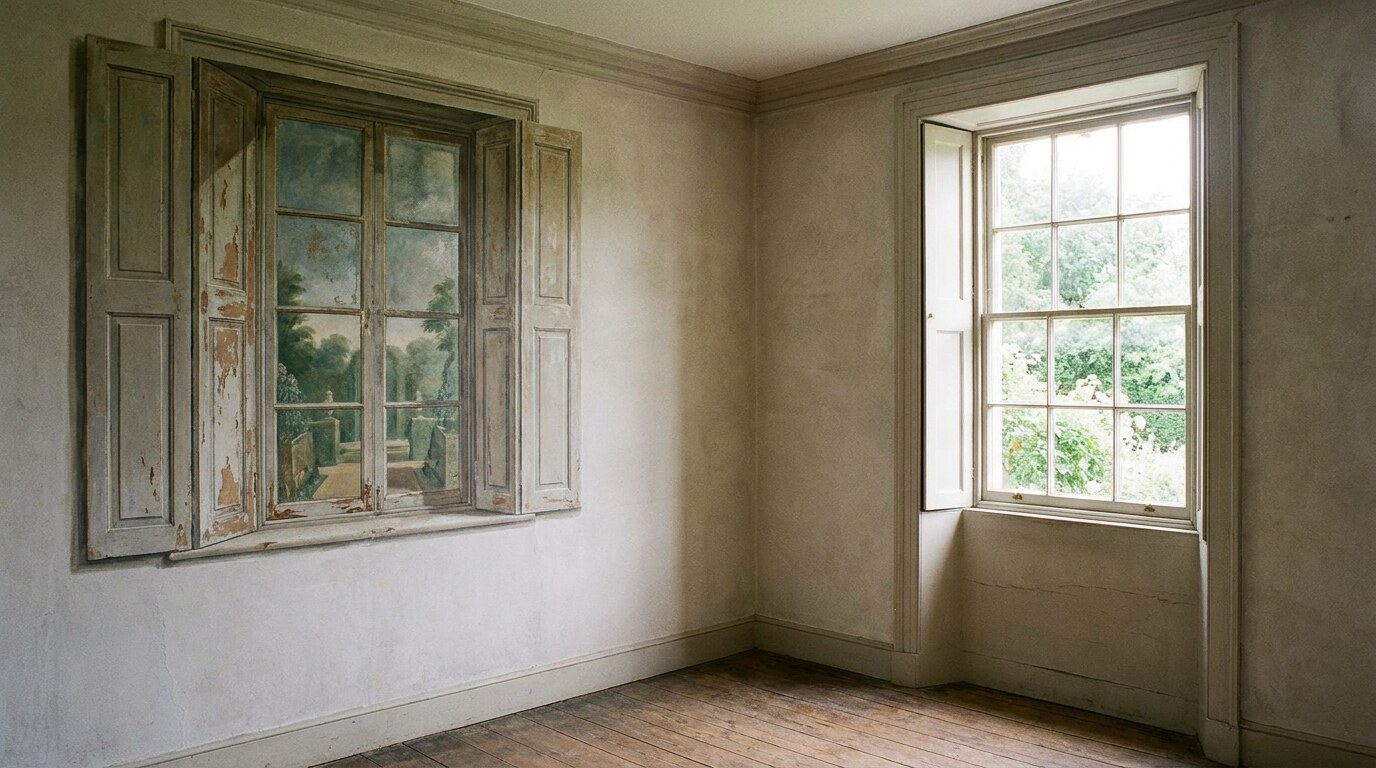
Classical practice tolerates two specific deviations from strict symmetry. The fausse-fenêtre ("false window") is a wall-painted or shutter-disguised feature inserted to balance a real window on a non-symmetric elevation, common in 18th-century French and English interiors where structural constraints prevented true window pairing. The fausse-porte is the equivalent for doors, often with the false door painted with a still-life or trompe-l'œil to disguise the absent opening. Both devices appear in published Adam, Soane, and Robert Mylne interiors.
Modern retrofit problems
Three modern-construction issues complicate the application of classical symmetry to existing buildings. Mechanical and electrical service runs (HVAC ducts, electrical risers, plumbing stacks) frequently disrupt the symmetric wall composition by requiring service doors or grilles in non-symmetric positions; designers either chase services within the wall thickness (adding 10 to 18% to budget) or relocate them in adjacent service zones. Modern fire-safety regulations require exit-marked fire doors in positions that may break enfilade alignments. Existing electrical layouts in renovations (sockets, switches) often require rewiring to remove visible asymmetry, since classical interiors do not show modern fittings on principal walls.
The forward research question for this journal is the published British 17th- and 18th-century writings on the philosophy of architectural symmetry, of which selective transcription has been undertaken but a comprehensive corpus across Inigo Jones, Roger Pratt, Sir Christopher Wren, and the Burlington circle remains incomplete.