
Robert Adam's Neoclassical Vocabulary, Defined: Britain 1758–1792
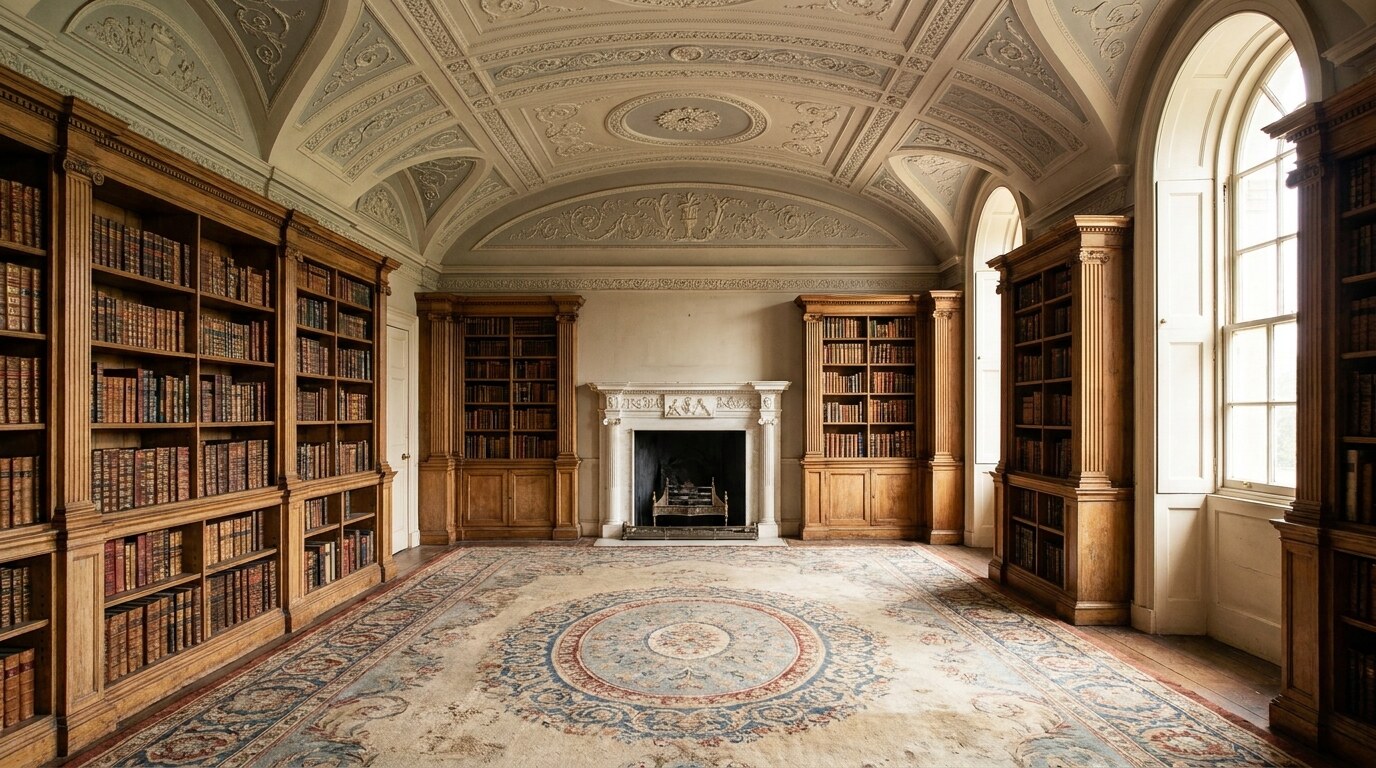
Adam style is the neoclassical idiom developed by the Scottish architect Robert Adam (1728–1792) with his brother James Adam between approximately 1758 and 1792, defined by the coordinated treatment of architecture, plasterwork, joinery, painted ornament, carpets, and metalwork drawn from Roman, Etruscan, and Pompeian sources Robert Adam studied during his Grand Tour of 1754–1758, and applied across more than 60 documented British country houses and London town houses.
Where the Adam style came from: Spalato, Rome, and the Grand Tour 1754–1758
Robert Adam developed the visual vocabulary later identified as Adam style during a four-year Grand Tour of France and Italy between November 1754 and January 1758. During the summer of 1757, Adam undertook a five-week expedition to Diocletian's palace at Spalato (today Split, Croatia) in the company of the French draughtsman Charles-Louis Clérisseau, returning with measured drawings he later published in 1764 as Ruins of the Palace of the Emperor Diocletian at Spalatro in Dalmatia. The portfolio established Adam's credentials as an antiquarian-architect distinct from the prevailing Burlingtonian Palladianism, which by 1755 had exhausted its referents and was repeating itself.
While in Rome between February 1755 and May 1757, Robert Adam studied with the engraver Giovanni Battista Piranesi, whose Vedute and Antichità Romane reshaped Adam's understanding of antique ornament as a vocabulary of fragments adaptable to new compositions. The drawings Adam produced during these years entered the working archive of his London office and remain accessible today at Sir John Soane's Museum, which holds approximately 9,000 sheets, the largest single collection of Adam office drawings.
Five vocabulary markers that identify an Adam interior at sight
Five visual markers identify a Robert Adam interior at sight, and a working specifier can apply them as a checklist. First, low-relief plasterwork executed in repeating motifs of arabesques, husk-chains, paterae, anthemia, and ribbon swags, almost always cast or run in lime plaster on lathwork, never carved. Second, apsidal recesses, niches, and screened columns dividing a single room into proportionally distinct zones, a Roman bath device adapted to British drawing rooms. Third, painted ceiling roundels and lunettes executed by the Venetian painter Antonio Zucchi (1726–1795) and the Swiss painter Angelica Kauffman (1741–1807), who married each other in 1781. Fourth, a polychrome palette of stone, oyster grey, dusty pink, terre verte, and lilac, applied flat over thinly sized grounds. Fifth, bespoke matched carpets (frequently supplied by the firm of Thomas Moore of Moorfields, London) designed to mirror the painted plaster overhead.
The five markers operate in combination. A room with the plaster but not the painted ceiling, or with the painted ceiling but not the matched carpet, indicates a partial Adam scheme, an Adam-influenced commission to a different architect, or a 19th-century revival.
Six houses to study: Syon, Kedleston, Osterley, Kenwood, Saltram, Harewood
Six surviving British houses retain coherent Adam interiors that a specifier can study in person and a curator can cite as reference. Each house is listed below with its Adam dates of involvement, the surviving rooms most worth visiting, and the institution that curates the property today.
| House | Adam dates | Rooms to see | Curated by |
|---|---|---|---|
| Syon House, Brentford | 1762–1769 | Anteroom, Dining Room, Red Drawing Room, Long Gallery | The Duke of Northumberland (private estate) |
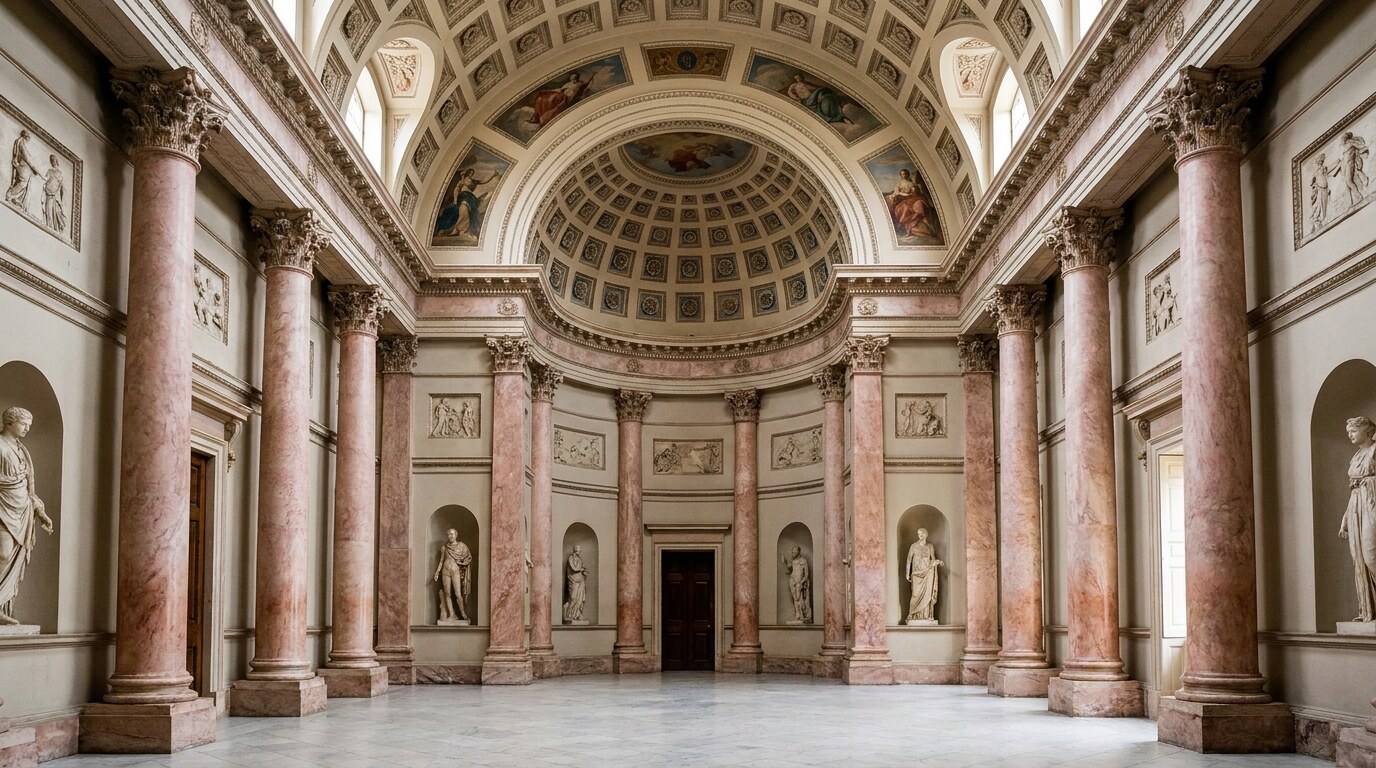
| Kedleston Hall, Derbyshire | 1759–1771 | Marble Hall, Saloon, State Dining Room | National Trust |
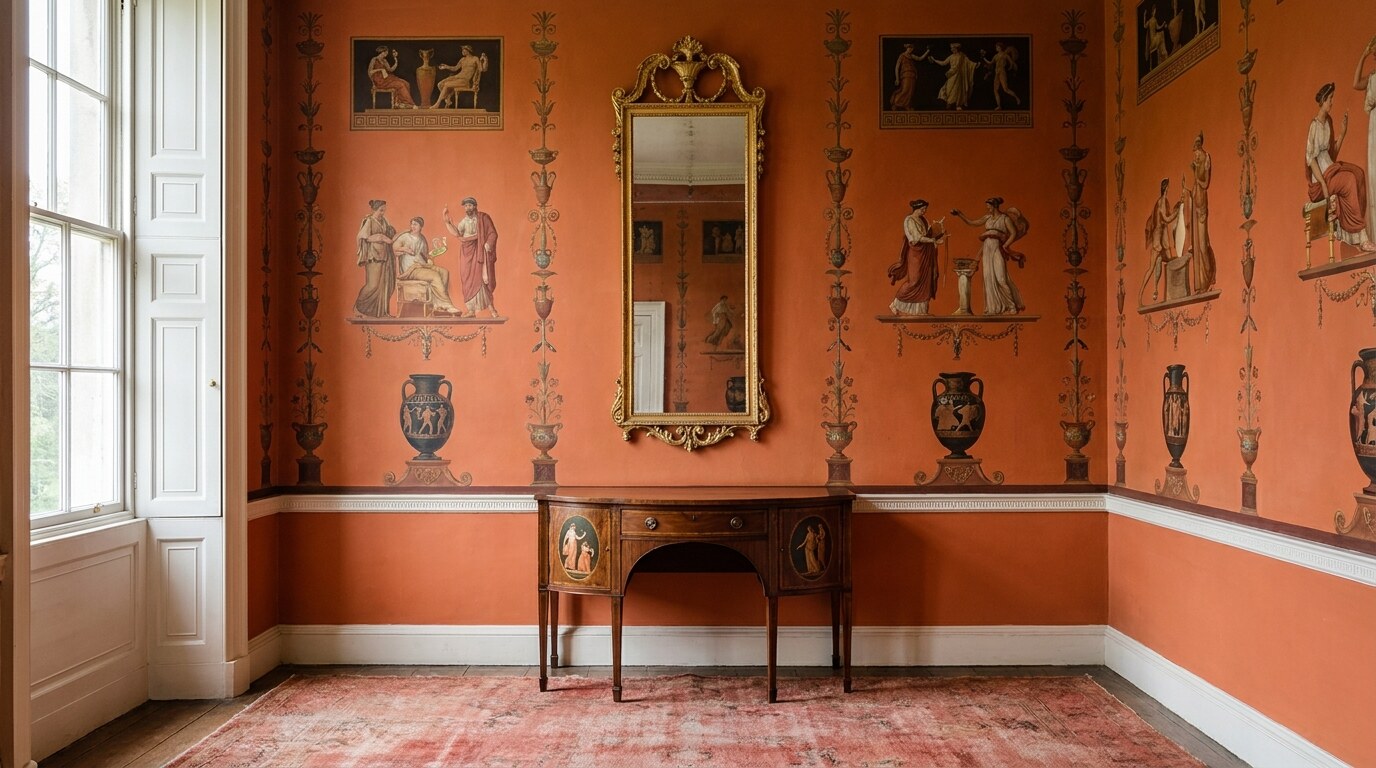
| Osterley Park, Middlesex | 1761–1780 | Etruscan Dressing Room, State Bedchamber, Library | National Trust |
| Kenwood House, Hampstead | 1764–1779 | Library (1767–1769), Music Room, Marble Entrance Hall | English Heritage |
| Saltram House, Devon | 1768–1780 | Saloon, Dining Room | National Trust |
| Harewood House, Yorkshire | 1758–1771 | Gallery, Music Room, State Bedroom | Harewood House Trust |
The Adam library at Kenwood House measures 60 ft by 22 ft, with plasterwork installed by Joseph Rose between 1767 and 1769, and was conservatively re-presented under English Heritage's £6 million restoration of 2012–2013, with a further interior conservation programme in 2018–2019. The Etruscan Dressing Room at Osterley Park, completed in 1779, is the most intact surviving example of Adam's Etruscan manner: terracotta-coloured walls painted by Pietro Maria Borgnis with figural reserves derived from antique vase decoration.
How Adam worked with his tradesmen: a production network
Robert Adam ran his practice as a coordinated production network drawn from a fixed roster of named tradesmen, with bills, contracts, and correspondence preserved in the Adam office accounts at Sir John Soane's Museum. The principal collaborators included the plasterer Joseph Rose the younger (1745–1799), the cabinet-maker Thomas Chippendale the elder (1718–1779) at Harewood and Nostell, the carpet manufacturer Thomas Moore of Moorfields (active c. 1755–1780), the metalworker Matthew Boulton (1728–1809) of the Soho Manufactory at Birmingham, and the scagliola specialist Pietro Mariano Bossi (active in London c. 1769–1785).
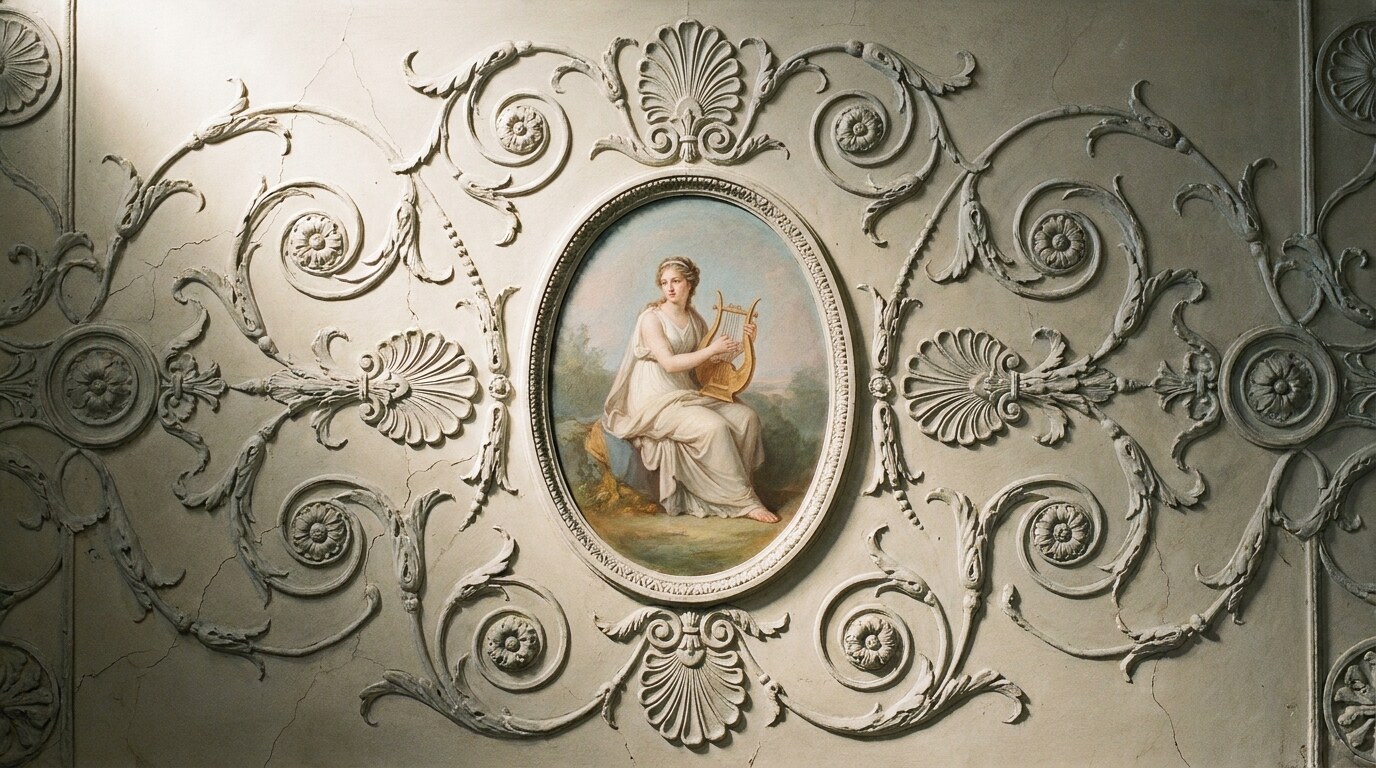
The division of labour ran through Adam's office in a sequence that a modern architect would recognise. Adam supplied the design drawings, which his draughtsmen developed into full-size details. Joseph Rose's plasterers produced run mouldings and cast ornaments on site, working from gelatine moulds taken in his Mortimer Street workshop. Thomas Moore wove the matched carpets in Moorfields against painted ceiling cartoons. Matthew Boulton supplied ormolu door furniture, candlesticks, and chimneypiece urns, with Boulton's documented Adam-pattern ormolu girandoles entering the Royal Collection during George III's reign.
How the style spread: subscription folios and the American Federal echo
The Works in Architecture of Robert and James Adam, the brothers' subscription folio of measured drawings, was issued in three volumes during and after their lifetimes. Volume I appeared in 1773, Volume II in 1779, and Volume III as a posthumous compilation in 1822 prepared by Robert Adam's executor. The folio reproduced engraved interiors, ornament details, and exterior elevations from commissions including Syon House, Kenwood, and the Adelphi development on the Strand, and circulated across British, French, and American libraries within a decade of publication.
The Adam vocabulary entered American building practice through architects working in the Federal style after 1790, notably Charles Bulfinch (1763–1844) in Boston, Samuel McIntire (1757–1811) in Salem, Massachusetts, and Asher Benjamin (1773–1845), whose The Country Builder's Assistant (1797) carried Adam-derived plasterwork patterns to provincial carpenters across New England. Surviving McIntire interiors at the Pingree House (1804) and the Gardner-Pingree House (1804–1805) in Salem document the transfer at a high level of finish and remain open to the public via the Peabody Essex Museum.
Adam in 2026: auction provenance, restoration practice, and market indicators
Documented Adam-attributed objects continue to clear at premium results in London and New York auction sales. Christie's London Out of the Ordinary sale of 19 March 2025 sold a pair of George III giltwood pier glasses attributed to John Linnell after a Robert Adam design, c. 1768, at £487,500 against a pre-sale estimate of £200,000 to £300,000. Sotheby's London The English Collection sale of 7 May 2024 included a Joseph Rose plaster panel section from a documented Adam interior demolished in 1937, sold at £58,800 against an estimate of £20,000 to £40,000.
Restoration of Adam interiors is concentrated in a small number of British conservation studios. The London firms Hare & Humphreys (founded 1981), Hesp & Jones (founded 1985), and Plowden & Smith (founded 1973) currently hold most National Trust and English Heritage Adam contracts; pricing typically runs £180 to £420 per square metre for ceiling plaster conservation as of 2026, before scaffold and access. Specifying restoration-grade plasterwork on a new build now routes through Locker & Riley of Loughton or Stevensons of Norwich, both of which carry Adam-pattern moulds from documented projects in their archives.
The forward research question for the journal is the location of Adam-attributed objects dispersed during the 1937 sale of contents at the demolished Lansdowne House (Berkeley Square). Records compiled by the Society of Antiquaries of London and the National Art Library at the V&A indicate that approximately 240 individual furnishings entered the trade between 1937 and 1942; readers with provenance leads on these pieces are invited to write to the journal at [email protected].
References and further reading
- Sir John Soane's Museum, Adam office drawings (collection essay).
- English Heritage, Kenwood House (visitor and history pages).
- National Trust, Osterley Park; Kedleston Hall; Saltram House.
- The British Museum, Piranesi prints (collection records).
- Peabody Essex Museum, Salem historic houses (Pingree, Gardner-Pingree).
- Christie's catalogue archive and Sotheby's results archive (lot-level provenance).