Water Gilding vs Oil Gilding: Materials, Process, Costs, and When to Specify Each
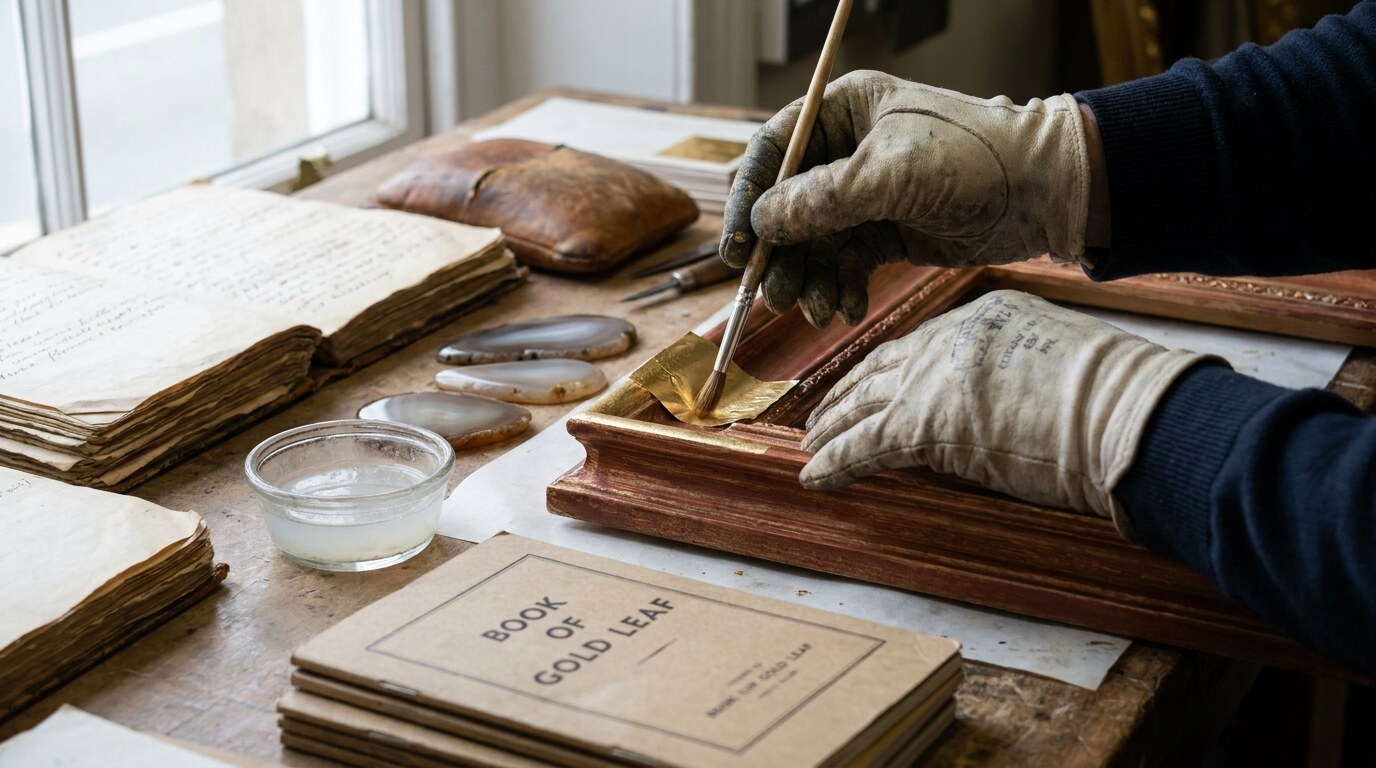
Water gilding (the traditional French à la détrempe) and oil gilding (or mixtion) are two distinct techniques for applying gold leaf to a prepared substrate. Water gilding requires 8 to 12 layers of gesso, three to five layers of bole, and water-applied 22 or 23 carat leaf that can be burnished to a mirror finish; oil gilding applies leaf onto an oil-based size and produces a matte, durable, but unburnishable finish. Water gilding costs roughly three to five times more per square metre and is the only acceptable specification for restoration of historic gilded interiors classed Monument Historique in France or Grade I listed in the United Kingdom.
Materials specified for each method
| Layer | Water gilding | Oil gilding |
|---|---|---|
| Substrate | Limewood or oak (carved); historic gesso | Any rigid substrate (timber, plaster, metal) |
| Ground | 8–12 layers rabbit-skin glue gesso, sanded | 1–2 coats of ground primer |
| Bole | 3–5 coats Armenian bole (yellow then red) | Not required |
| Adhesive | Water + alcohol "gilders' liquor" | Oil-based size (3-hour or 12-hour quick gold size) |
| Leaf | Loose-leaf 22ct or 23ct, 80×80mm | Transfer-leaf or loose-leaf, any carat |
| Finish | Burnished with agate stone or matte (left) | Matte only (cannot be burnished) |
Step sequence side by side
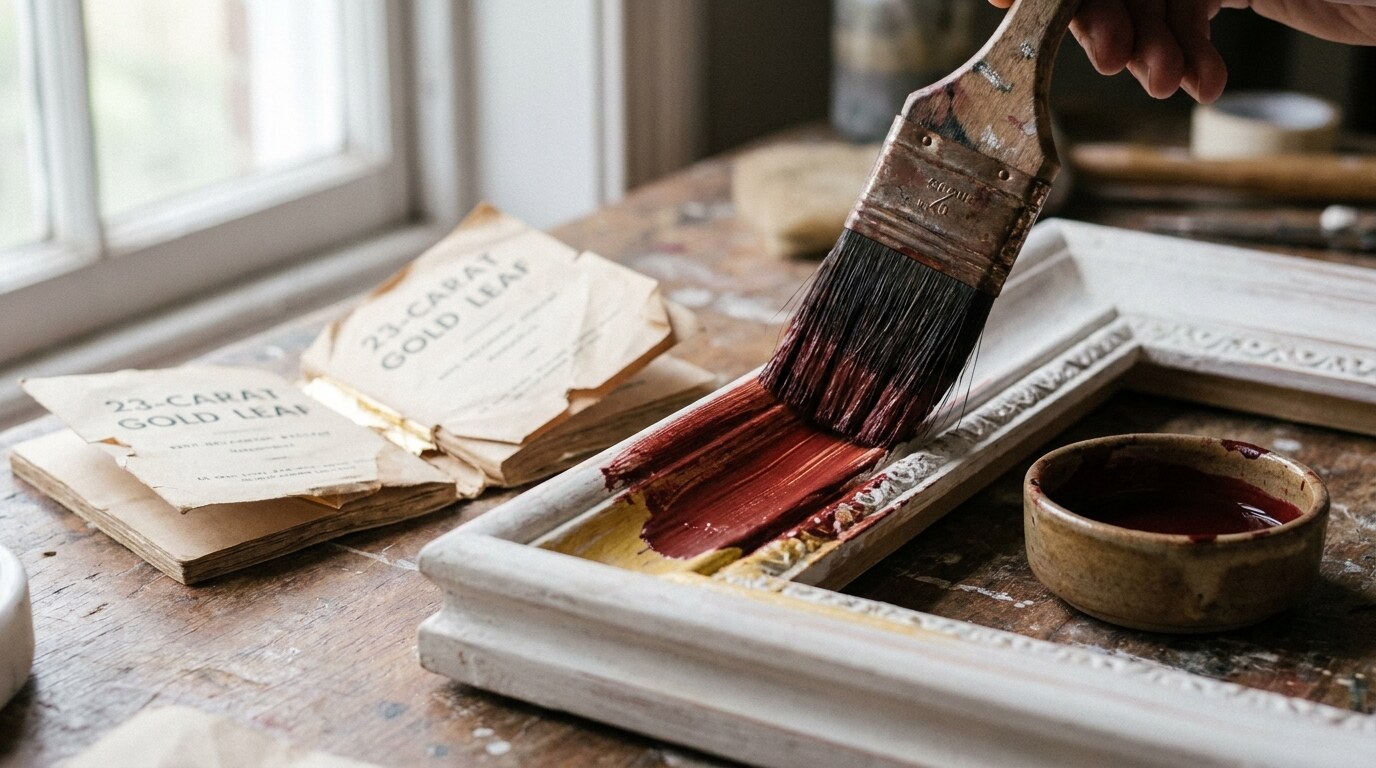
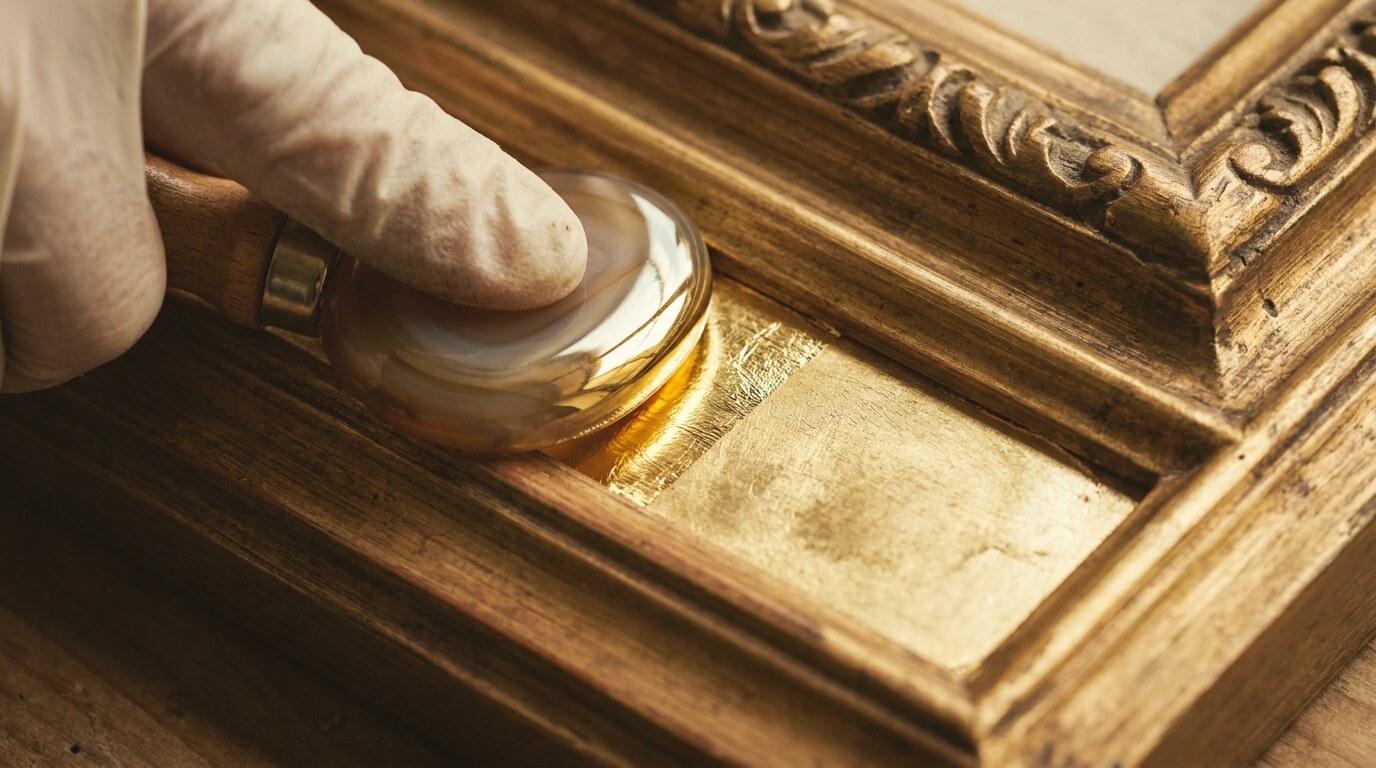
Water gilding requires 8 to 12 layers of rabbit-skin glue gesso, sanded between coats to a uniform 0.3 to 0.5 mm substrate, before any bole is laid. The bole layer (an extremely fine clay traditionally from Armenia, in yellow under-coat and red top-coat) is sanded to a near-mirror polish before water and alcohol is brushed on as the gilding adhesive. Loose-leaf 22 or 23 carat gold is then floated onto the wet bole with a gilder's tip; once dry, the leaf is burnished with a polished agate stone to produce the mirror finish unique to water gilding. Oil gilding's sequence is shorter: the substrate receives a single ground coat, oil-based gold size is brushed onto the area to be gilded, the size is left to "off-tack" (typically 3 hours for fast size, 12 hours for slow size), and the leaf is laid into the still-tacky surface with no burnishing.
When to use which
Three application classes determine the correct method. Burnished interior frames, mouldings, picked-out fillets on boiserie, and antique-restoration of fine carved ornament require water gilding; nothing else produces the mirror finish that historical specifications describe. Architectural exterior gilding (lantern caps, spire crosses, weather-exposed ornament), interior matte gilding on plaster (cornices, ceiling roses), and hardware gilding require oil gilding because water gilding cannot withstand exterior exposure or matte ground specification. Mixed schemes within a single room (burnished frame + matte cornice) often combine both methods on different elements.
Cost benchmarks (2026)
Per linear metre of cornice or frame moulding water gilding costs £180 to £420 in London ateliers as of 2026, oil gilding £45 to £110. Per square metre of flat surface (apsidal half-dome, octagonal entablature) water gilding runs £680 to £1,400 per m², oil gilding £160 to £320 per m². Lead times for new bespoke water gilding on a 30 m² apsidal vault commonly range 14 to 22 weeks; oil gilding the same area runs 4 to 7 weeks.
Recognised gilders working today
Three Paris ateliers and two London firms hold most of the world's restoration-grade water-gilding work. Ateliers Gohard, founded 1890 in Paris, executed the gilding of the Apollo dome at the Hôtel Salé and the gilded reliefs of the Marie-Antoinette apartments at Versailles, and currently holds the Mobilier National contract for periodic re-gilding at Versailles, Fontainebleau, and the Élysée Palace. Atelier Saint-Jacques (Paris, founded 1989) and Atelier de Ricou (Paris, founded 1968) are the two principal alternatives to Gohard for boiserie restoration. In London, Hesp & Jones (founded 1985) and Hare & Humphreys (founded 1981) hold most National Trust and English Heritage water-gilding contracts.
Ageing, retouch, and conservation
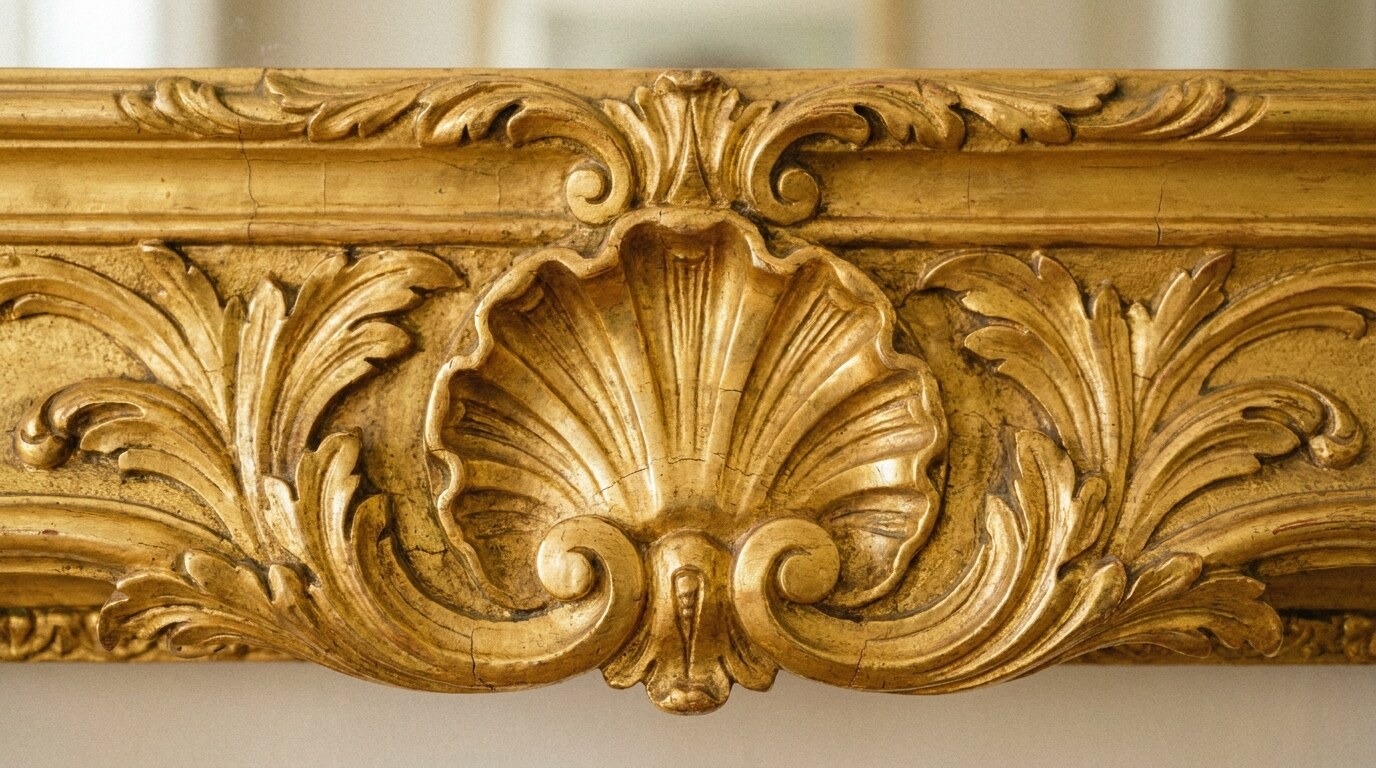
Water-gilded surfaces age slowly and visibly: the gold remains chemically stable for centuries (gold does not tarnish), but the underlying gesso shrinks at 0.5 to 1.2 mm per metre over 80 to 120 years, opening hairline cracks that show as fine red lines from the bole beneath. Restoration practice treats these cracks as evidence of authenticity and either leaves them visible or fills them with toned gesso and re-gilds locally. Oil-gilded surfaces fail at the size layer: yellow-brown bloom develops on the leaf surface as the size oxidises after 25 to 40 years, and re-gilding requires complete strip-down of size and leaf rather than spot repair.
The forward research question for this journal is the conservation history of water gilding on the carriage entrance gates of the Place de la Concorde (1790s, restored 2019–2021), the only surviving large-scale exterior water gilding executed at the end of the Ancien Régime, with stratigraphic analysis published only in part by the C2RMF.
References and further reading
- Ateliers Gohard, Paris.
- Atelier Saint-Jacques, Paris.
- Mobilier National, conservation manuals.
- Getty Conservation Institute (gilded surface conservation).
- ICOMOS (heritage gilding standards).