
Boiserie Explained: French Carved Wall Panelling from Versailles to Modern Specification
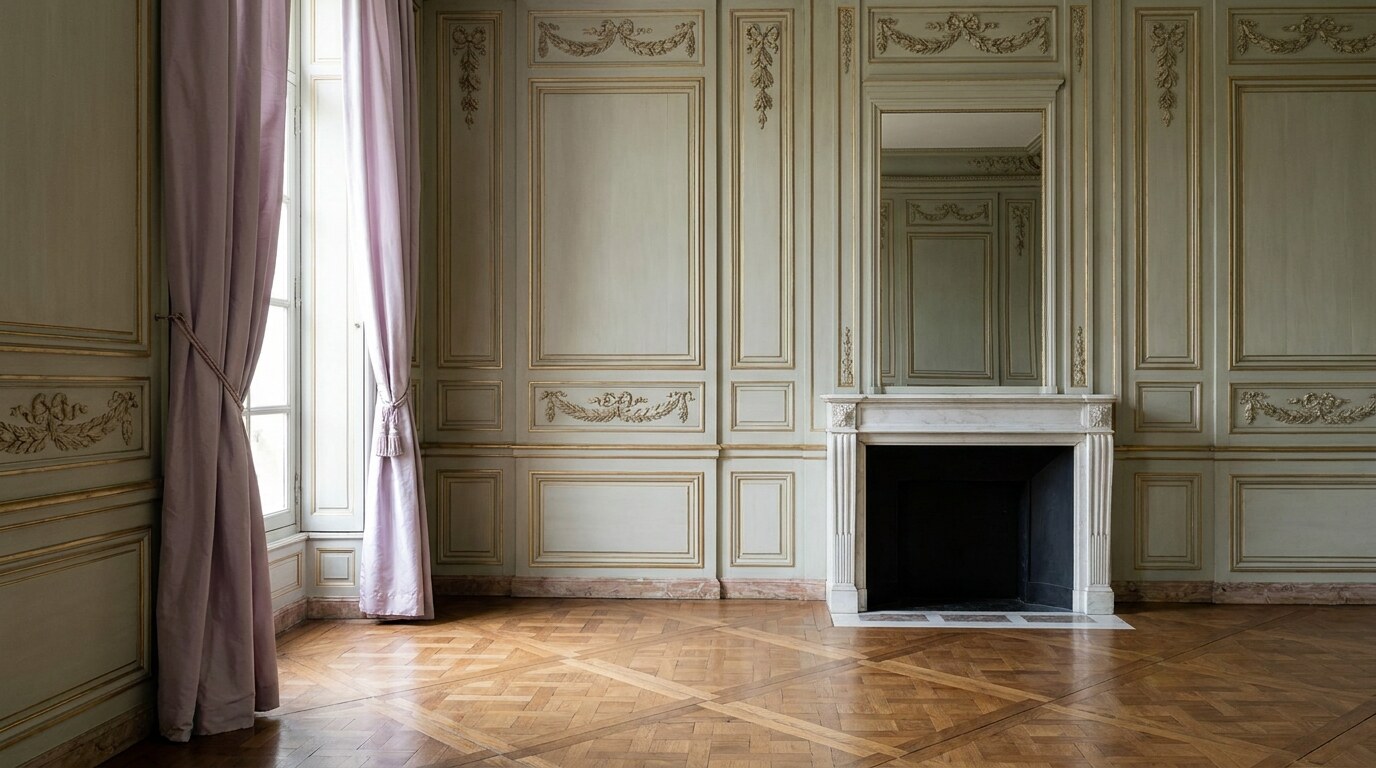
Boiserie is the French term for fitted carved wood wall panelling developed at the French court between 1650 and 1789, applied as floor-to-cornice ensembles of stiles, rails, fielded panels, mouldings, and overdoors, traditionally in oak or limewood, finished with multi-layer gesso, paint, and parcel-gilt leaf, and produced today by a short list of Paris ateliers including Féau Boiseries, Atelier Mériguet-Carrère, and Atelier de Ricou for installations costing approximately €4,000 to €18,000 per linear metre depending on carving load.
What "boiserie" means in French practice (and what it excludes)
Boiserie is not interchangeable with the English term wainscoting. Boiserie describes a full floor-to-cornice composition of stiles, rails, fielded panels, applied mouldings, and overdoors, treated as a single architectural ensemble; wainscoting in English usage typically refers only to dado-height timber lining below the chair rail. French practice further distinguishes boiserie de hauteur, the full-height treatment, from boiserie d'appui, panelling restricted to dado height only. The umbrella term lambris covers any timber wall lining, with or without elaborate carving; specifying boiserie sculptée in a contract document signals carved decoration as part of the scope.
A hundred and forty years of court boiserie: 1650 to 1789
Court boiserie passed through four formal phases between 1650 and 1789, each identifiable by ornament vocabulary and panel proportion. The Louis XIV phase, c. 1660–1715, codified the heavy rectilinear panel with bold raised mouldings and limited carving, exemplified by Pierre Lepautre's work at Versailles for Louis Le Vau and Jules Hardouin-Mansart. The Régence phase, 1715 to roughly 1730, introduced asymmetric cartouche frames and naturalistic palm-frond mouldings, transitioning toward the Rococo. The Louis XV Rococo high point, c. 1730–1755, produced the most carved-ornament-rich boiserie in court production, with Nicolas Pineau (1684–1754) and Jacques Verberckt (1704–1771) supplying the model carvings; Verberckt's boiserie for the Cabinet du Conseil at Versailles was installed in 1755 under Louis XV's direction, replacing earlier Louis XIV panelling. The Louis XVI phase, 1774–1789, returned to symmetrical antique vocabulary with garlands, urns, and laurel ribbons, codified in Richard Mique's interiors at the Petit Trianon (Salon de Compagnie completed 1779–1781).
Anatomy of a boiserie wall: eight parts to name in a specifier's brief
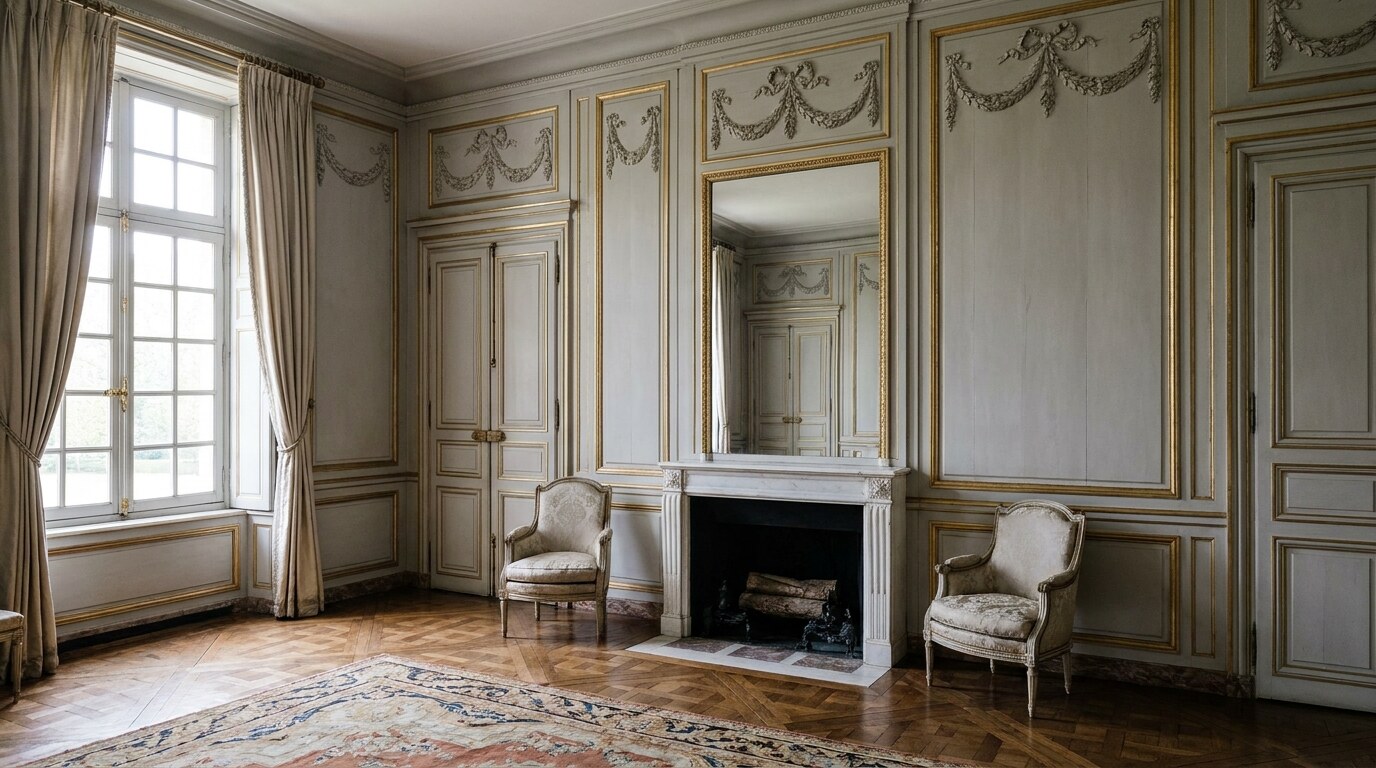
A boiserie elevation is composed of eight named parts, and a specifier's contract drawings should label each one. The plinth (plinthe) sits at floor level and runs continuously along the bottom edge, typically 150 mm to 250 mm tall in 18th-century French practice. The dado rail (cimaise d'appui) marks the chair-rail height, traditionally 900 mm above finished floor. Above the dado rail, the main field carries the principal panel (panneau), framed by stiles (montants) at left and right and rails (traverses) at top and bottom. The top rail under the cornice (traverse haute) closes the panel field. Above each opening, an overdoor (dessus-de-porte) carries either a carved cartouche, a painted reserve, or a sculpted relief panel, framed in continuation of the stile vocabulary. The cornice (corniche) and frieze (frise) cap the wall at ceiling level.
Materials and construction: oak, limewood, and the question of MDF
Historic boiserie used three principal species, each chosen for a specific role. French oak (chêne, Quercus robur) provided the structural carcass, framing, and field panels because of its dimensional stability and load-bearing capacity. Limewood (tilleul, Tilia europaea) carried all fine carved ornament, applied as separate carved sections glued to the oak ground; the close, even grain of limewood resists splitting at low-relief detail. Provincial work substituted fir (sapin) where economy mattered.
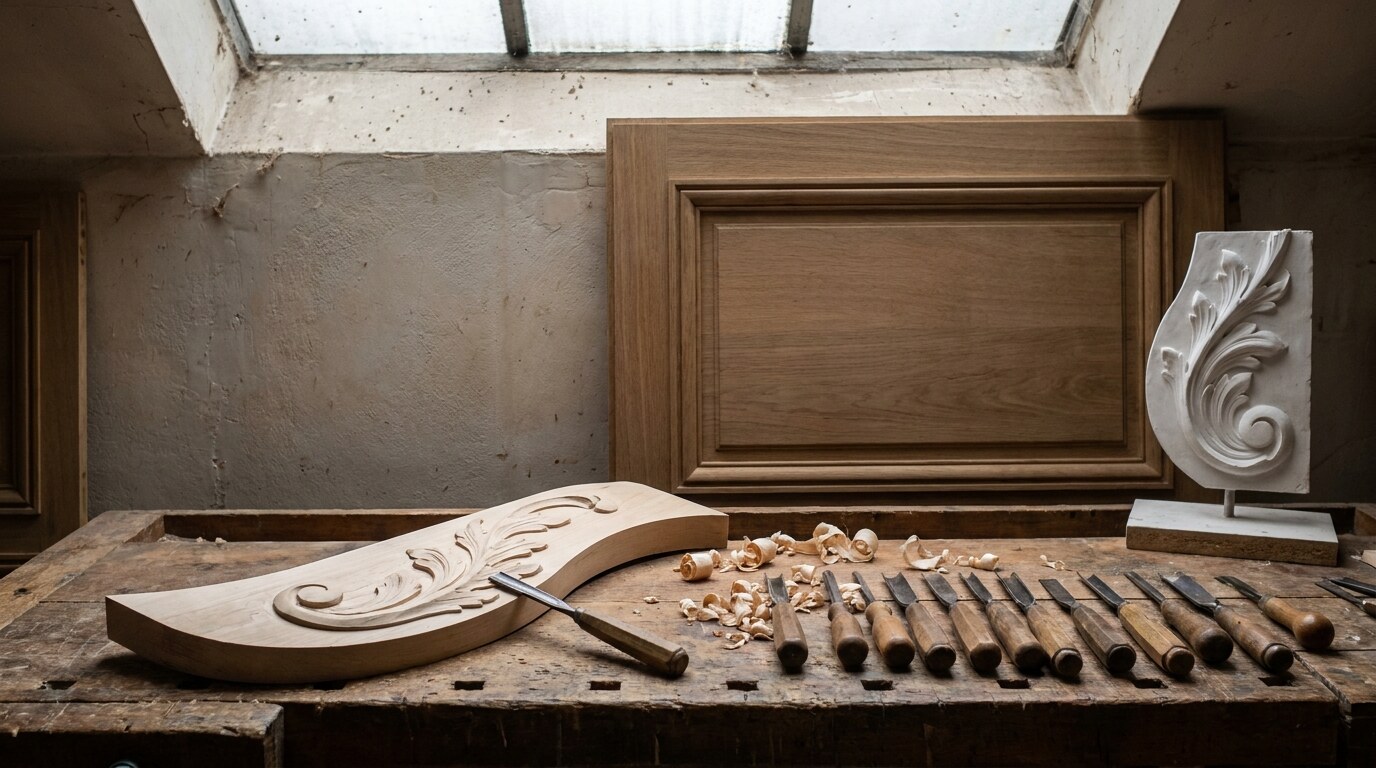
Modern atelier production preserves the same logic with one substitution. Many ateliers now build the field panels in MDF or a stable plywood substrate, applying carved limewood ornament as separate enrichments. The substitution carries technical risk: MDF moves differently from solid oak under humidity change, and paint films designed for solid timber crack at the joint between MDF panel and limewood carving where ambient humidity drops below 35%. Atelier de Ricou and Atelier Saint-Jacques both publish kiln-dried specifications: 9–12% moisture content target on oak framing, and a project-room conditioning period of 14 days minimum before installation.
Finishing layers: gesso, paint schemes, parcel-gilding
Traditional boiserie finishing applies a stratified sequence of preparation, ground, and decoration layers. The standard French sequence consists of 8 to 12 coats of rabbit-skin glue gesso, sanded between coats to a uniform 0.3 to 0.5 mm substrate, followed by an oil or distemper ground coat, two to three glaze layers, and finally water-gilded 22 or 23 carat gold leaf on selected mouldings. The historic palette combined chalky pale-stone or pale-grey ground with picked-out gilded fillets along the panel mouldings; the named court colours gris Trianon, vert d'eau, and bleu Wedgwood appear in inventory documents from the 1770s and 1780s. Modern paint matches with documented court provenance are published by Edward Bulmer Natural Paint (Pavilion Stone, Bone, Eel) and by Farrow & Ball (Skimming Stone, French Gray, Pavilion Gray).
Costs and lead times in 2026: what specifiers quote
Bespoke boiserie production in 2026 is concentrated in a small number of Paris ateliers, with consistent published rate ranges. Féau Boiseries (founded 1875), Atelier Mériguet-Carrère (founded 1960), Atelier de Ricou (founded 1968), and Atelier Saint-Jacques (founded 1989) quote new bespoke work at €4,000 to €18,000 per linear metre as of 2026, with carving load (panel surface area covered with sculpted enrichment) the dominant cost variable. Lead times range from 9 to 18 months for fully bespoke schemes; antique boiserie removed from châteaux and adapted to a new room runs 3 to 6 months from contract signature.
The antique panel market is brokered through three principal Paris dealers. Féau Boiseries holds the largest commercial reserve, with an archive of approximately 17,000 antique panel pieces drawn from demolitions and dispersals across France since 1875. Galerie Steinitz on rue Royale carries documented Louis XV and Louis XVI ensembles. Sotheby's Paris and Christie's Paris periodically catalogue full boiserie ensembles in their decorative-arts sales; Sotheby's Paris sold a complete Louis XVI grand salon ensemble of 18 panels at €1,140,000 in November 2024 against a pre-sale estimate of €600,000 to €900,000.
Specification pitfalls and conservation notes
Three specification pitfalls recur on contemporary boiserie projects. The first concerns underfloor heating: ambient humidity drops below 35% over a Paris winter heating season, opening joints at field-panel-to-stile interfaces and cracking gesso along carved enrichments. Specifiers commissioning new boiserie over underfloor heating should require humidification systems calibrated to a 45 to 55% relative humidity band, with hygrometer monitoring. The second concerns paint analysis: stripping a historic boiserie before commissioning a paint stratigraphy report destroys evidence that can be used to date the panelling, identify earlier schemes, and inform listed-building consent. Recognised UK practitioners include Patrick Baty at Papers and Paints; recognised conservation chemists include Catherine Hassall (London) and Allyson McDermott Conservation (Gloucestershire). The third concerns French Monuments Historiques consents on classified buildings, where any modification of historic boiserie requires approval from the regional Direction régionale des affaires culturelles (DRAC).
Three live reference projects to visit
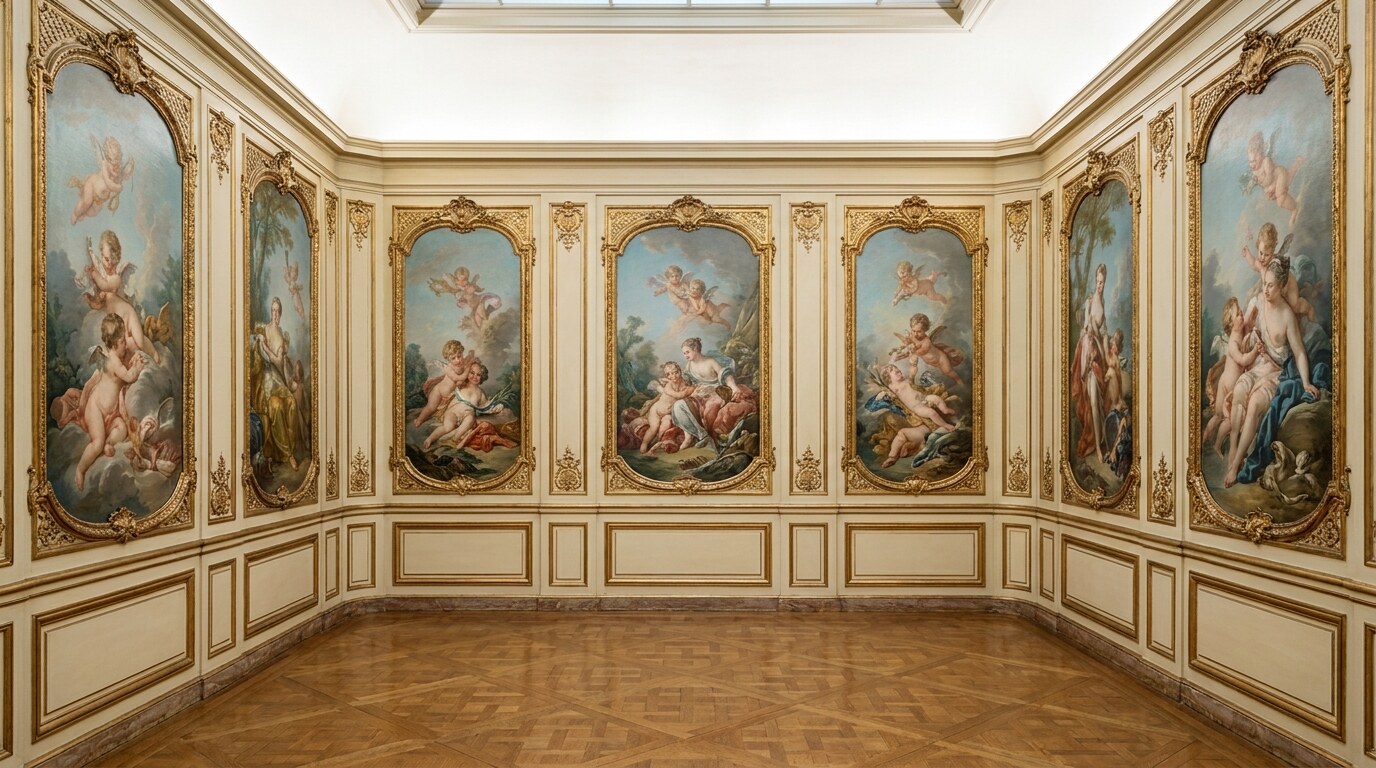
Three accessible reference projects allow specifiers to study current boiserie practice at the highest standard. The Hôtel de la Marine on Place de la Concorde reopened in June 2021 after a four-year, €132 million Mobilier National restoration that reinstated and restored Louis XVI boiserie ensembles in the appartements de l'Intendant. The Petit Trianon at Versailles displays Richard Mique's 1779–1781 Salon de Compagnie boiseries in their original locations, with restored 1780s polychrome paint schemes documented through stratigraphy by the Centre de Recherche et de Restauration des Musées de France (C2RMF). The Frick Collection's Boucher Room in New York contains eight boiserie panels installed 1750–1751 by François Boucher for the Marquise de Pompadour's apartments; the Frick acquired the ensemble in 1916, and the room reopened to the public after the museum's 2020–2024 renovation.
The forward research question for this journal is the location of dispersed Louis XV boiserie panels removed from the Hôtel de Soubise during 19th-century renovations. Inventories compiled by the Centre des monuments nationaux indicate at least 32 panels left France between 1830 and 1900, of which 11 are now documented in American museum collections; the location of the remaining 21 panels is undetermined as of 2026.
References and further reading
- Mobilier National (national French furniture and woven-textile archive).
- Château de Versailles, Petit Trianon.
- The Frick Collection, Boucher Room.
- Féau Boiseries, Paris.
- Atelier Mériguet-Carrère, Paris.
- Galerie Steinitz, Paris.
- Patrick Baty, Papers and Paints (paint stratigraphy).