
Plasterwork Cornice and Ceiling Roses: Georgian, Regency, Victorian Reference
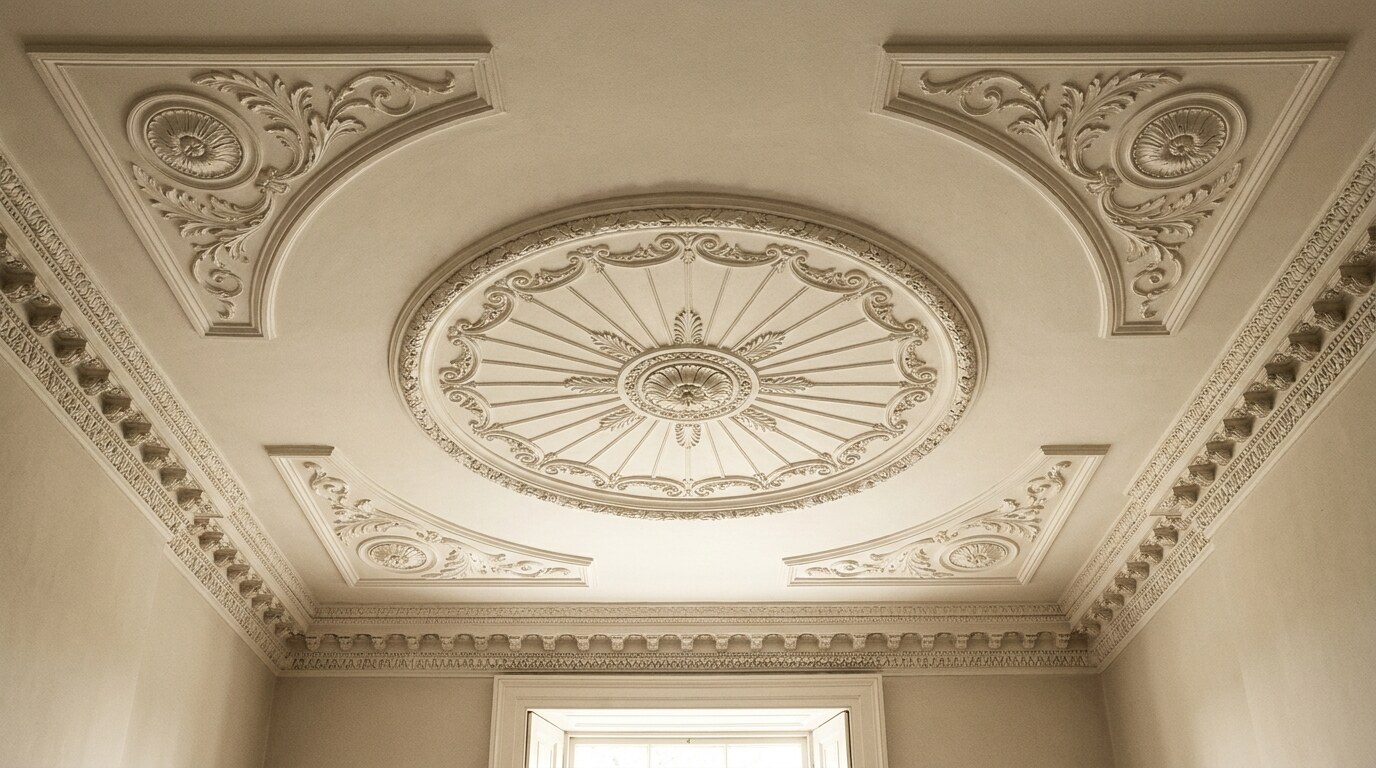
British decorative plasterwork from 1714 to 1901 falls into three identifiable periods: Georgian (1714–1830), typified by low-relief Neoclassical motifs in the Robert Adam manner; Regency (1811–1830), with deeper crisp geometry and Greek-revival ornament; and Victorian (1837–1901), marked by heavy high-relief leafwork and elaborate compound mouldings. The three styles are reproduced today by specialist workshops including Locker & Riley (Essex, founded 1903), Hayles & Howe (Bristol, founded 1989), and Stevensons of Norwich (founded 1922).
How to identify the three periods at sight
A specifier examining a British plaster ceiling can identify the period from three visual signals. Georgian plasterwork is low in relief (rarely exceeding 25 mm projection from the field), uses repeating Neoclassical ornament such as anthemia, paterae, husk-chains, and acanthus arabesques, and is most often run in plain lime plaster on lathwork ceilings; the Robert Adam library at Kenwood House (1767–1769) is the canonical example. Regency plasterwork is sharper-edged, often Greek-revival in its motifs (key fret, palmette, anthemion), and frequently includes architectural elements (fluted pilasters, dentil cornices) integrated into the run-mould. Victorian plasterwork is high in relief (commonly 60–110 mm projection), uses heavy leafwork in oak, vine, and acanthus, and is cast rather than run, in fibrous plaster from gelatine moulds.
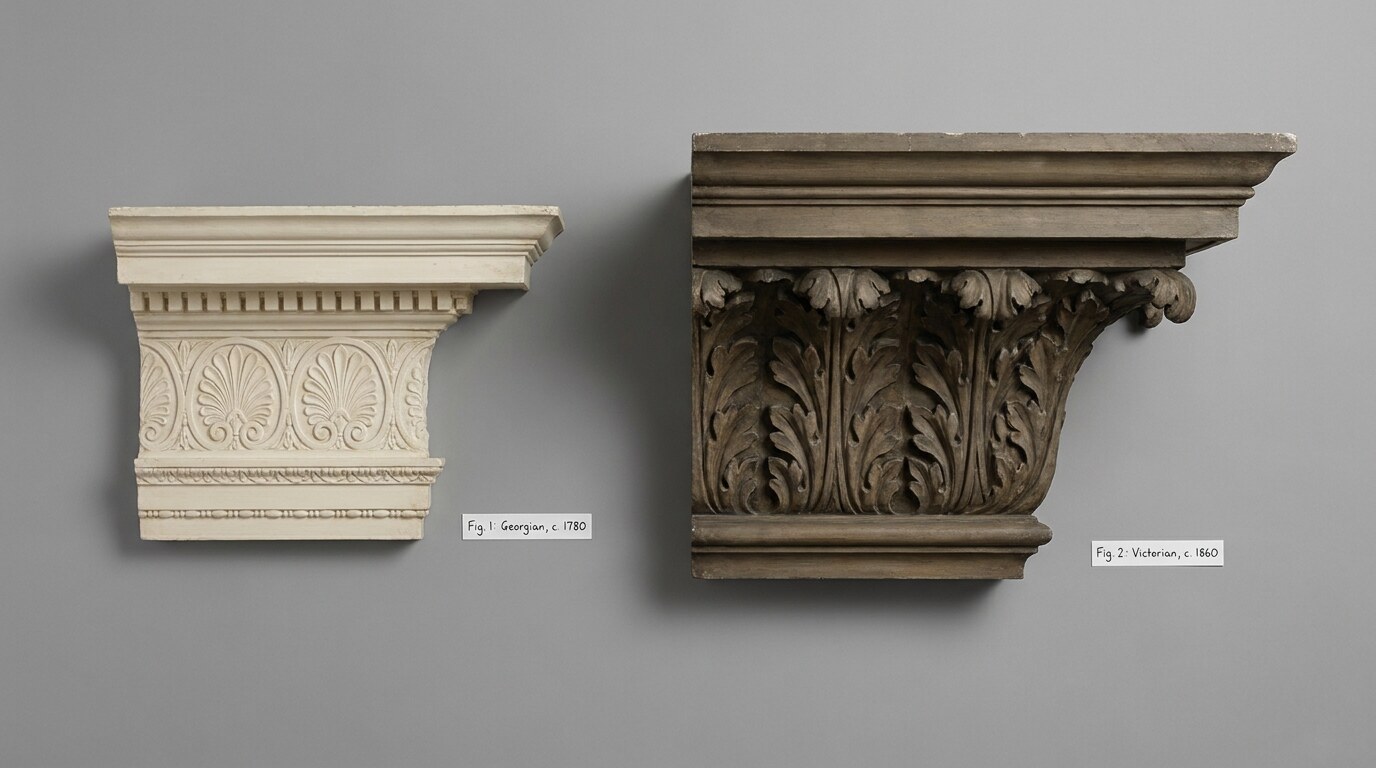
What a fibrous plaster ceiling rose actually is
A 19th- and 20th-century ceiling rose is rarely solid plaster. Fibrous plaster, patented by Léonard Desachy in Paris in 1856 and adopted in British production from approximately 1865, consists of plaster of Paris reinforced with a backing of hessian (jute cloth) or fibreglass, cast in negative gelatine moulds and finished in 4 to 8 mm thick shells. The technique allows a 1.5-metre-diameter ceiling rose to weigh 12 to 18 kg rather than the 90 to 130 kg of a solid plaster of equivalent dimensions.
Casting process
Three casting techniques produce period-correct plasterwork. Run-in-situ moulding pulls a profiled metal template through wet plaster on a ceiling or cornice, in two or three coats, building up the running ornament directly on the ceiling lathwork; this technique was standard for Georgian cornices and remains the only way to install a fully integrated cornice without visible seams. Fibrous-plaster casting uses gelatine or modern silicone moulds taken from existing ornament, with the cast applied to ceiling or cornice as a glue-lifted unit. Run-in-place gauging combines the two: the bedding course is run, and cast enrichments (paterae, dentils, eggs-and-darts) are applied over.

Three workshops with documented restorations
Locker & Riley, founded 1903 in Loughton, Essex, holds an archive of approximately 8,000 historic moulds and has executed restoration plasterwork for Spencer House (London), the Ritz Hotel London, and the St Pancras Renaissance Hotel. Hayles & Howe, founded 1989 in Bristol, specialises in Georgian and Regency restoration and has worked on the Mansion House (London) and Wentworth Woodhouse (Yorkshire). Stevensons of Norwich, founded 1922, supplied fibrous plasterwork for the 2018–2020 restoration of the Painted Hall at the Old Royal Naval College, Greenwich.

Survey and measured-drawing protocol for restoration
Restoration plasterwork on a listed building begins with a measured-drawing survey at 1:5 scale of cornices and 1:10 scale of ceiling field ornament, supplemented by photographic documentation in raking light and squeeze impressions taken from intact sections. The squeeze impression (a lifted negative made in modelling clay or silicone) is the original mould source for fibrous reproduction. Run-in-situ cornice work on a 30-metre-perimeter Georgian drawing room takes a four-person team between four and six weeks, plus two weeks of preparation and substrate repair.
UK listed-building consent considerations
Plasterwork interventions on UK listed buildings require Listed Building Consent (LBC) under the Planning (Listed Buildings and Conservation Areas) Act 1990. Grade I and Grade II* listings require consultation with Historic England; Grade II listings are determined by the local planning authority's Conservation Officer. Sample replacement (more than 5% of original ornament) typically requires written method statement, paint stratigraphy, and phased trial restoration before full execution. Removal of original 18th- or 19th-century plasterwork without consent is a criminal offence under section 9 of the 1990 Act, with maximum penalties of two years' imprisonment.
The forward research question for this journal is the surviving pre-1714 (Stuart and earlier) plasterwork in private British country houses, with public catalogues currently listing 14 confirmed examples but published architectural surveys suggesting 30 or more await re-attribution.
References and further reading
- Historic England (listed buildings).
- Locker & Riley, Essex.
- Hayles & Howe, Bristol.
- Stevensons of Norwich.
- Old Royal Naval College (Painted Hall).
- RIBA Library.