Trompe-l'œil Wall Painting: 2,000 Years of Architectural Illusion in Interiors
Trompe-l'œil ("trick of the eye") is the painted illusion of architectural or sculptural features on flat plaster, documented continuously from the late-Republican Roman villas at Boscoreale and Pompeii (c. 50 BCE) through Renaissance ceilings by Andrea Mantegna and Paolo Veronese, into 18th-century Parisian cabinets de singerie, and into present-day commissions executed by ateliers including Atelier Mériguet-Carrère (Paris), Iksel Decorative Arts (Istanbul), and the Charleston Gallery (Sussex), with bespoke schemes pricing typically £1,500 to £3,500 per square metre as of 2026.
Origin: Pompeii Second Style and the megalographia
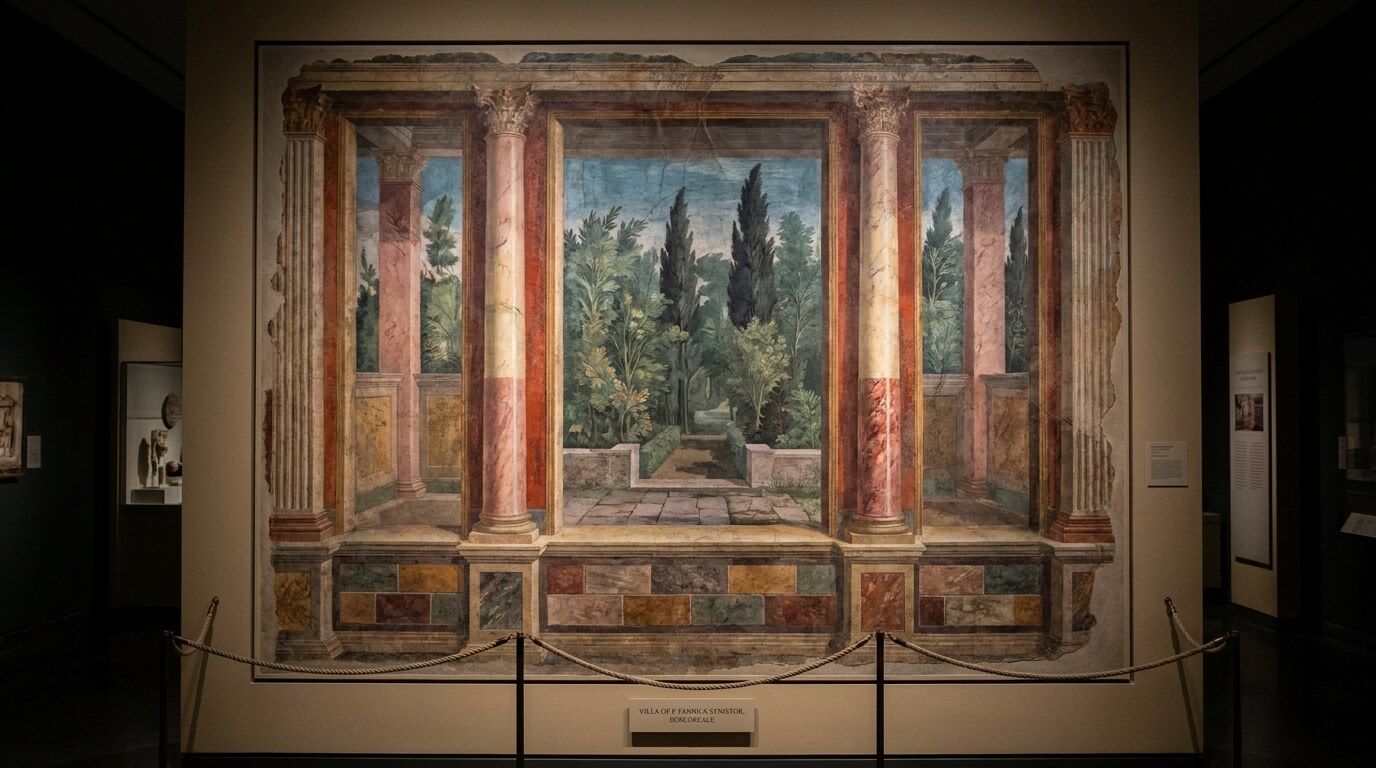
Trompe-l'œil's earliest documented application appears in Roman wall painting of the Second Style, a system of illusionistic architectural framing developed in Campania between approximately 80 BCE and 15 BCE. The cubiculum from the Villa of Publius Fannius Synistor at Boscoreale, removed during 1903 excavations and now installed in The Met Fifth Avenue Gallery 165, displays painted columns, illusionistic doorways, and receding garden vistas executed in fresco buon fresco between 50 and 40 BCE. The Pompeian Second Style established the visual conventions that survived two millennia: a low painted dado, a painted middle zone of architectural framing, and an upper zone of figurative or panoramic illusion.
Renaissance precedent: Mantegna 1465–1474, Veronese 1561
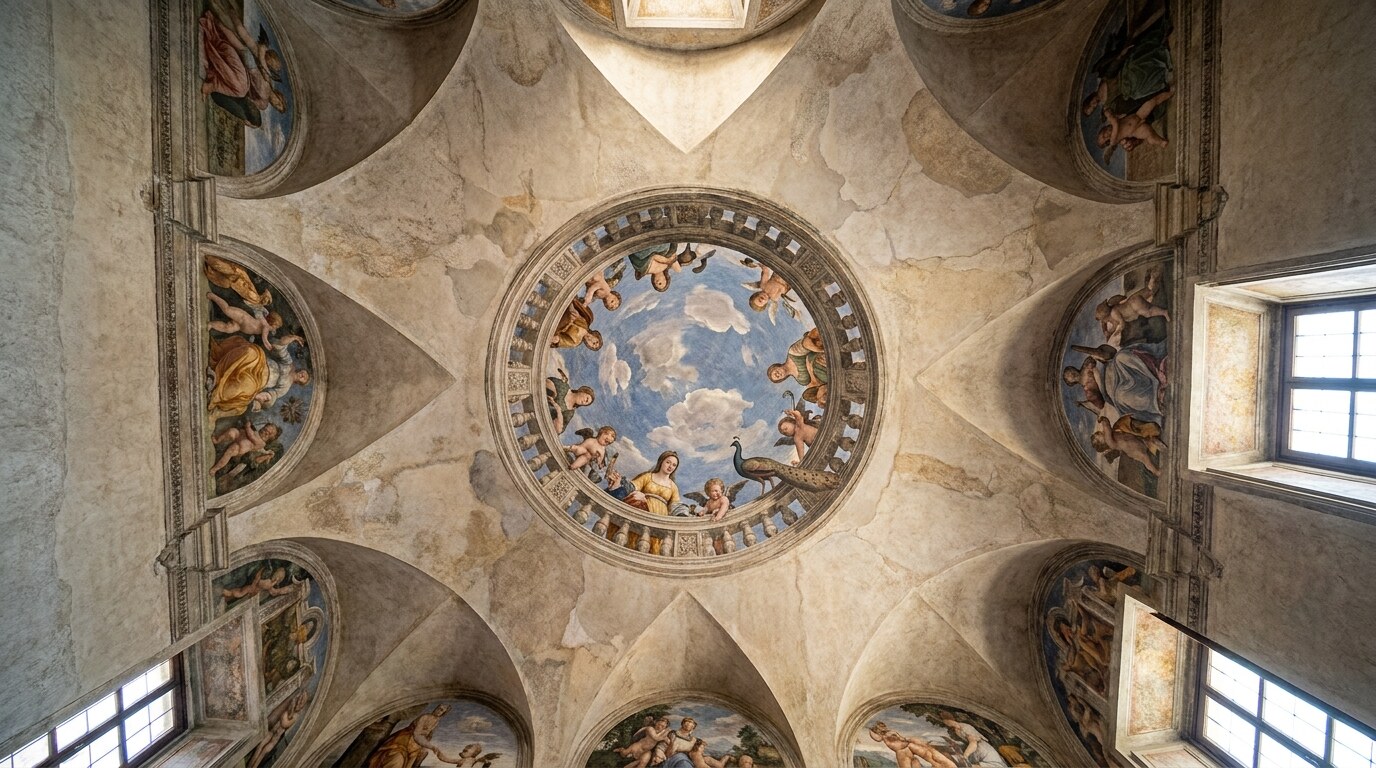
Two Renaissance commissions consolidated trompe-l'œil as an interior-decorative discipline. Andrea Mantegna painted the Camera degli Sposi in the Palazzo Ducale, Mantua, between 1465 and 1474, with a fictive oculus on the ceiling looking up at painted figures peering down at the viewer; the room measures approximately 8.05 m by 8.10 m and is the first surviving painted oculus in European interior painting. Paolo Veronese executed the frescoes at Villa Barbaro at Maser (Veneto) in 1560–1561, with painted balconies, painted figures peering through painted doorways, and painted landscapes opening through fictive windows.
18th-century cabinets de singerie
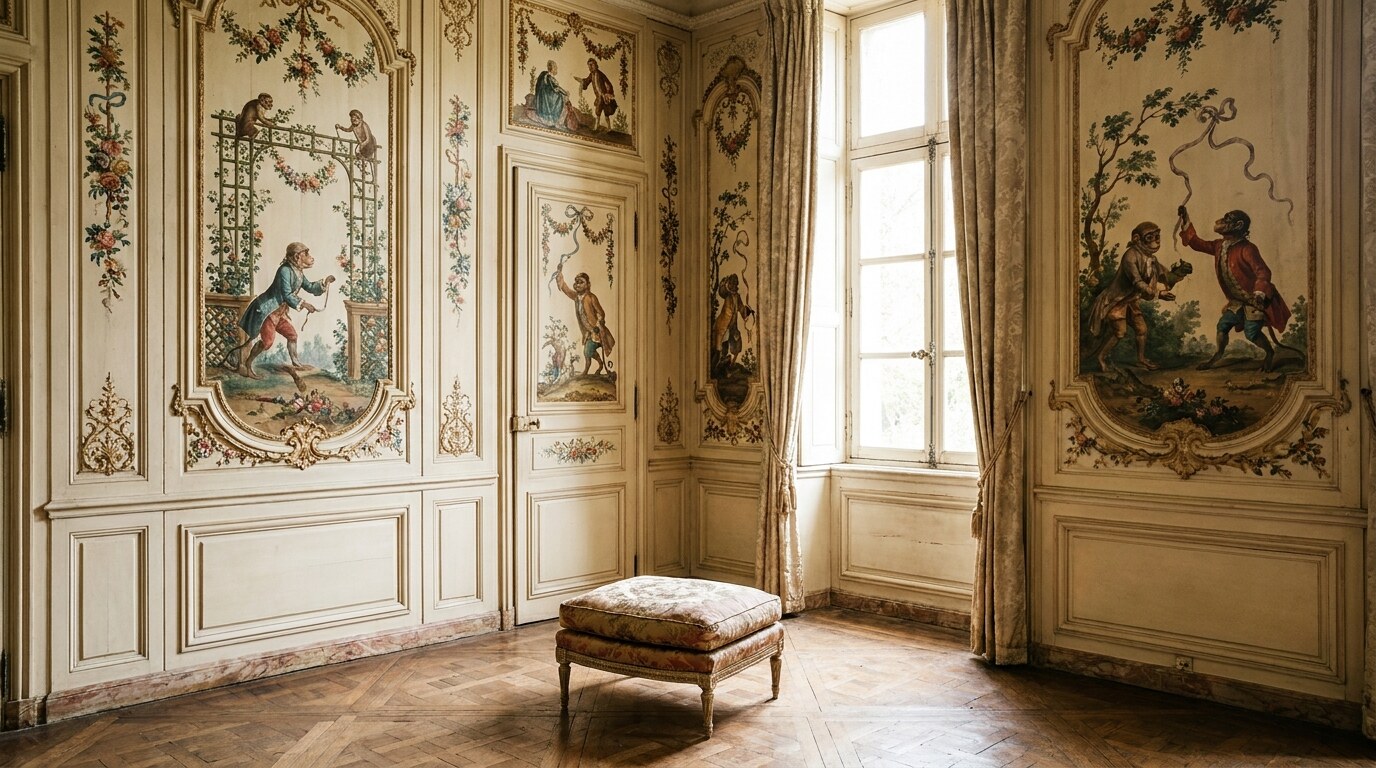
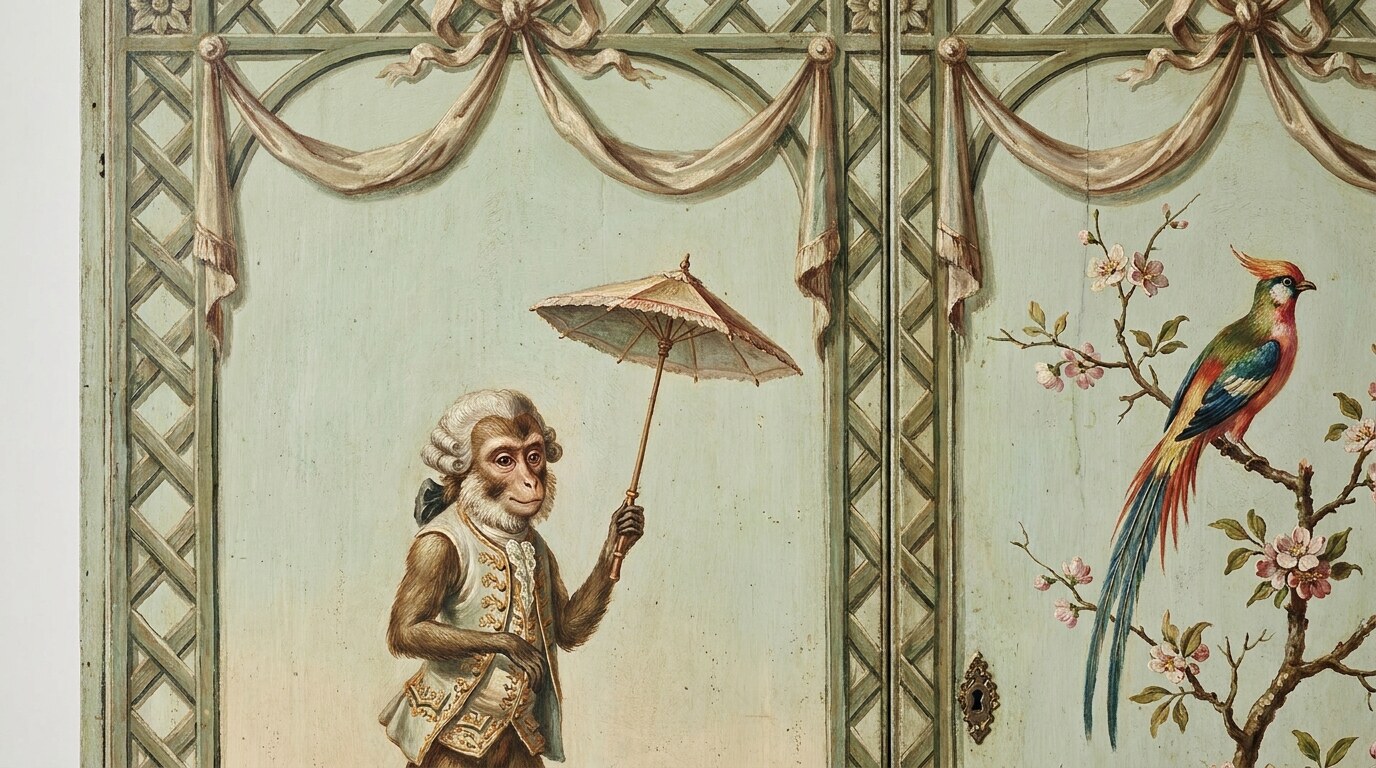
The 18th-century French cabinet de singerie ("monkey cabinet") applied trompe-l'œil to small intimate rooms, often boudoirs and dressing rooms. Christophe Huet (1700–1759) painted the singerie panels at the Hôtel de Rohan, Paris, between 1745 and 1752, depicting monkeys in human dress engaging in courtly pursuits within painted treillage and ribbon swags; the surviving panels are conserved by the Archives Nationales in their Hôtel de Rohan and Hôtel de Soubise buildings. The Château de Chantilly retains the second canonical surviving suite, the Grande Singerie in the Petit Château, painted by Huet between 1735 and 1740.
Live ateliers in 2026 with prices and lead times
Bespoke trompe-l'œil commissions in 2026 are produced by a small, identifiable set of ateliers in Paris, London, Istanbul, and New York.
| Atelier | Founded | Base | 2026 price (per m²) | Typical lead time |
|---|---|---|---|---|
| Atelier Mériguet-Carrère | 1960 | Paris | €1,800–€3,500 | 14–22 weeks |
| Iksel Decorative Arts (digital print on canvas) | 1989 | Istanbul | €600–€1,800 per panel | 4–6 weeks |
| Atelier de Ricou | 1968 | Paris | €1,500–€3,000 | 12–18 weeks |
| Charleston Gallery (Bloomsbury revival) | 1986 | Sussex | £1,200–£2,400 | 16–24 weeks |
| Tess Newall (London) | 2013 | London | £1,200–£2,800 | 8–14 weeks |
Specifying trompe-l'œil in a contemporary scheme
Three specification questions recur on contemporary trompe-l'œil commissions. The first concerns substrate: traditional fresco buon fresco requires a lime plaster ground applied wet and worked within the same day, while modern oil-on-canvas and acrylic-on-plaster panels (the dominant production method since 1970) tolerate factory production off-site and on-site installation later. The second concerns scale: figurative trompe-l'œil reads at a viewing distance of 2 to 4 metres; specified at smaller dimensions it loses illusion, at larger dimensions it requires academic figure drawing that few ateliers retain. The third concerns light: trompe-l'œil schemes are designed to a fixed light direction (most often a single tall window left of frame) and a fixed viewing height (eye-level for an adult standing). Specifying movable furniture or downlighters that change the apparent light source breaks the illusion the painter has built.
Three canonical interiors to visit
Three publicly accessible interiors allow specifiers to study trompe-l'œil at first hand across periods. The Boscoreale cubiculum at The Met (Gallery 165) presents Roman Second Style at scale. Villa Barbaro at Maser (Veneto) opens its Veronese frescoes Wednesday to Sunday during the European spring and autumn seasons. The Hôtel de Soubise and Hôtel de Rohan house Christophe Huet's singerie panels and host them on rotating public viewing schedules.
The forward research question for this journal is the documentation of trompe-l'œil schemes painted between 1880 and 1925 in American Beaux-Arts town houses and country residences, of which surviving examples in good condition number an estimated 40 to 60 nationally. Owners and curators with access to such schemes are invited to write to [email protected].
References and further reading
- The Met Fifth Avenue, Boscoreale cubiculum (Gallery 165).
- Villa Barbaro at Maser.
- Archives Nationales (Hôtel de Soubise/Hôtel de Rohan).
- Atelier Mériguet-Carrère.
- Iksel Decorative Arts.
- Château de Chantilly, Grande Singerie.