
Louis XIV vs Louis XV vs Louis XVI Furniture: How to Tell the Three Styles Apart
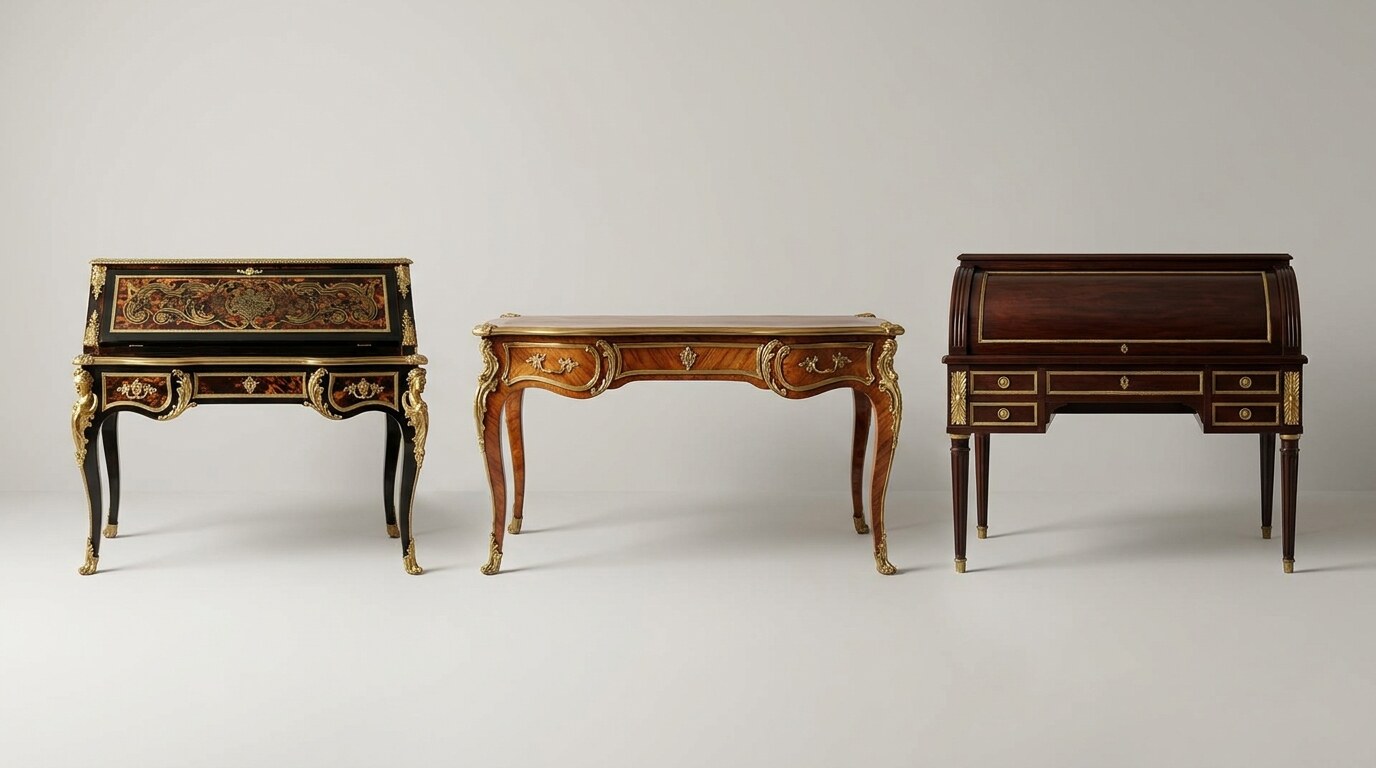
French Crown furniture made under Louis XIV (1643–1715), Louis XV (1715–1774), and Louis XVI (1774–1792) follows three distinct aesthetic programmes. The Louis XIV programme, executed under André-Charles Boulle (1642–1732), favoured heavy rectilinear forms in tortoiseshell and brass marquetry on ebony grounds. The Louis XV programme, led by Charles Cressent (1685–1768) and Bernard II van Risenburgh (c. 1696–1766), built asymmetric rocaille volumes in floral marquetry. The Louis XVI programme, dominated by Jean-Henri Riesener (1734–1806) and David Roentgen (1743–1807), returned to symmetrical antique vocabulary in mahogany and geometric marquetry.
Why three reigns produced three programmes
French furniture of the Ancien Régime was governed by the Crown's centralised production system. The Manufacture des Meubles de la Couronne, established at the Gobelins in 1667 under Charles Le Brun, set design standards across royal residences from Versailles to Marly to Fontainebleau. Each new reign brought a new Premier ébéniste du Roi: Boulle held the warrant under Louis XIV from 1672, Cressent produced for the Régence and early Louis XV from 1719, and Riesener received his warrant in 1774 and held it through 1784, after which David Roentgen and Guillaume Beneman shared the Crown's commissions until 1789. Each warrant-holder reset the formal vocabulary of court furniture across cabinet types, mounts, and surface treatments.
The Boulle workshop and Louis XIV (1670–1715)
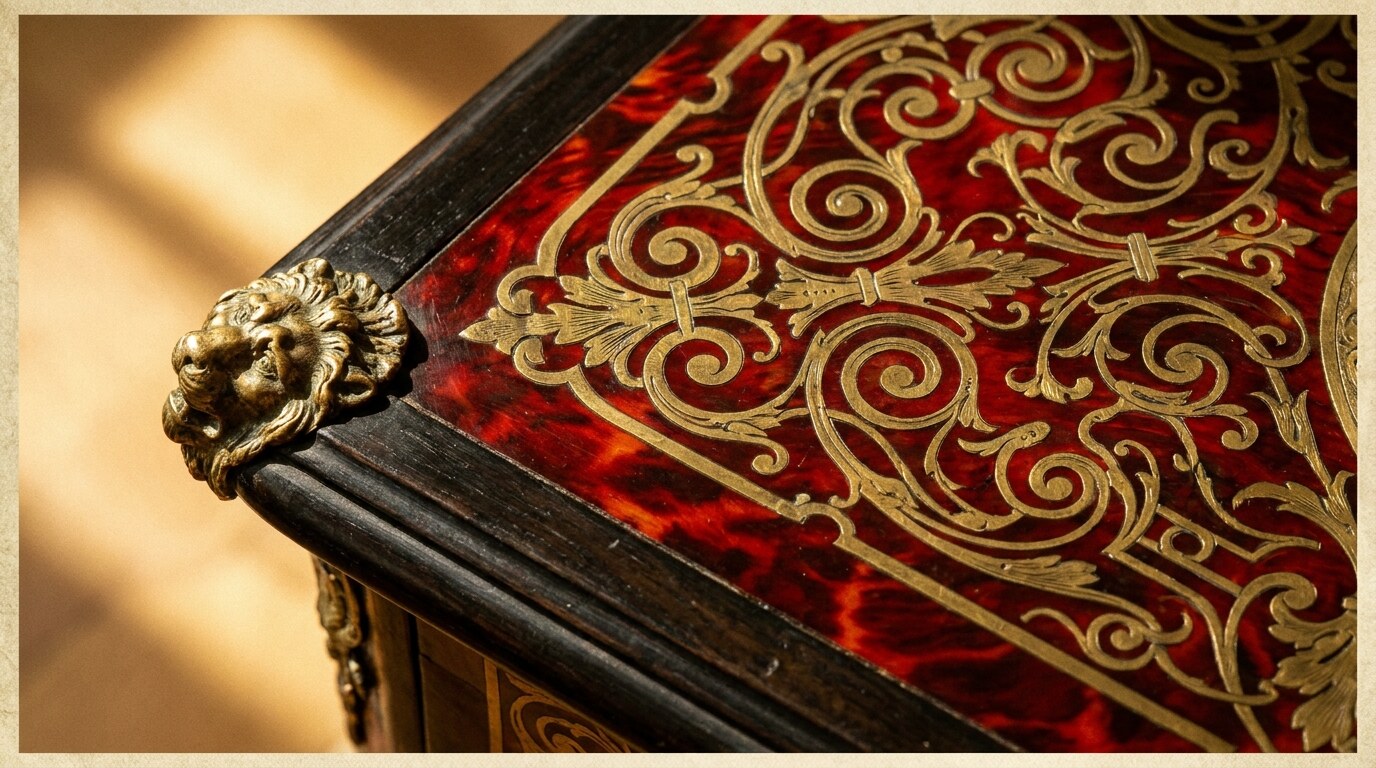
The Louis XIV programme is identifiable at sight by its severity. André-Charles Boulle developed a marquetry technique combining tortoiseshell (écaille) and engraved brass on ebony grounds, cut in pairs called première-partie (brass on tortoiseshell ground) and contre-partie (tortoiseshell on brass ground), allowing two cabinets to be produced from one set of cut materials. Boulle's documented workshop output between 1672 and 1732 is held in the Musée du Louvre, the Wallace Collection (which holds 26 documented Boulle pieces, the largest single Boulle group outside France), and the Mobilier National. Forms are heavy and architectural: the bureau Mazarin writing desk, the cabinet sur piétement, and the armoire à deux corps. Mounts are gilt-bronze ormolu with classical motifs (lion masks, acanthus volutes, female herms).
The Régence transition (1715 to c. 1730)
The Régence period under Philippe d'Orléans (1715–1723) and the early personal reign of Louis XV introduced asymmetry into a still-rectilinear silhouette. Charles Cressent established his workshop at rue Notre-Dame-des-Victoires, Paris, after 1719 and produced commodes with serpentine fronts, palm-frond ormolu mounts, and floral marquetry on tulipwood (bois de rose) grounds. The principal Régence form to identify is the commode à la Régence: three drawers, a serpentine front, cabriole legs that begin to curve, and floral end-grain marquetry.
Louis XV rocaille at its peak (1730 to 1755)
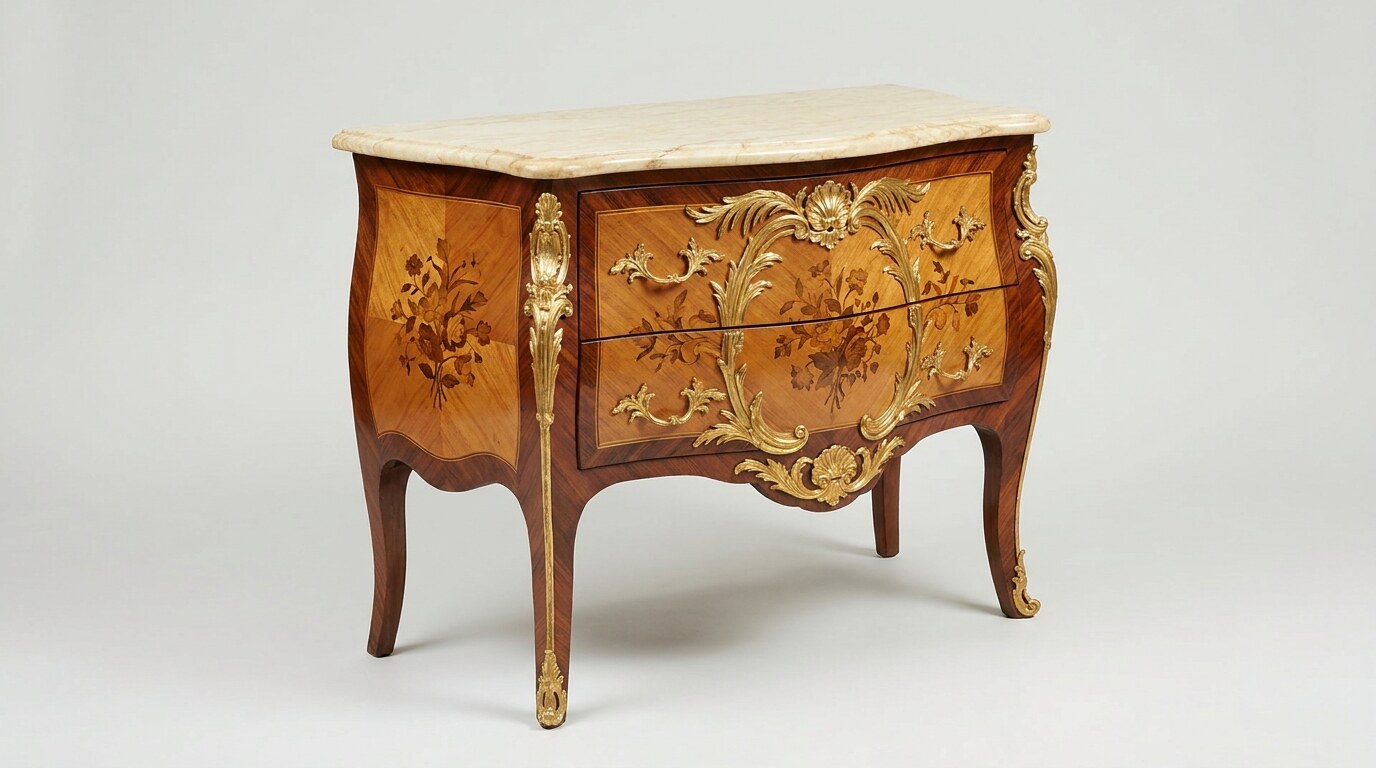
The Louis XV programme produced the highest level of carved-mount complexity in court furniture. Bernard II van Risenburgh (BVRB), working from rue Saint-Nicolas in the Faubourg Saint-Antoine after 1730, supplied tulipwood and kingwood marquetry case furniture mounted with chased and gilded ormolu in asymmetric rocaille forms; his stamped pieces are documented in the Wallace Collection (London), the Musée Carnavalet (Paris), and the Frick Collection (New York). Forms abandon all symmetry: cabinets become bombé (swelling outward at the front), legs sweep into deep curves, and tops are shaped in serpentine or kidney profiles. Marquetry shifts to floral bouquets in stained woods on light grounds.
Louis XVI antique revival (1774 to 1789)
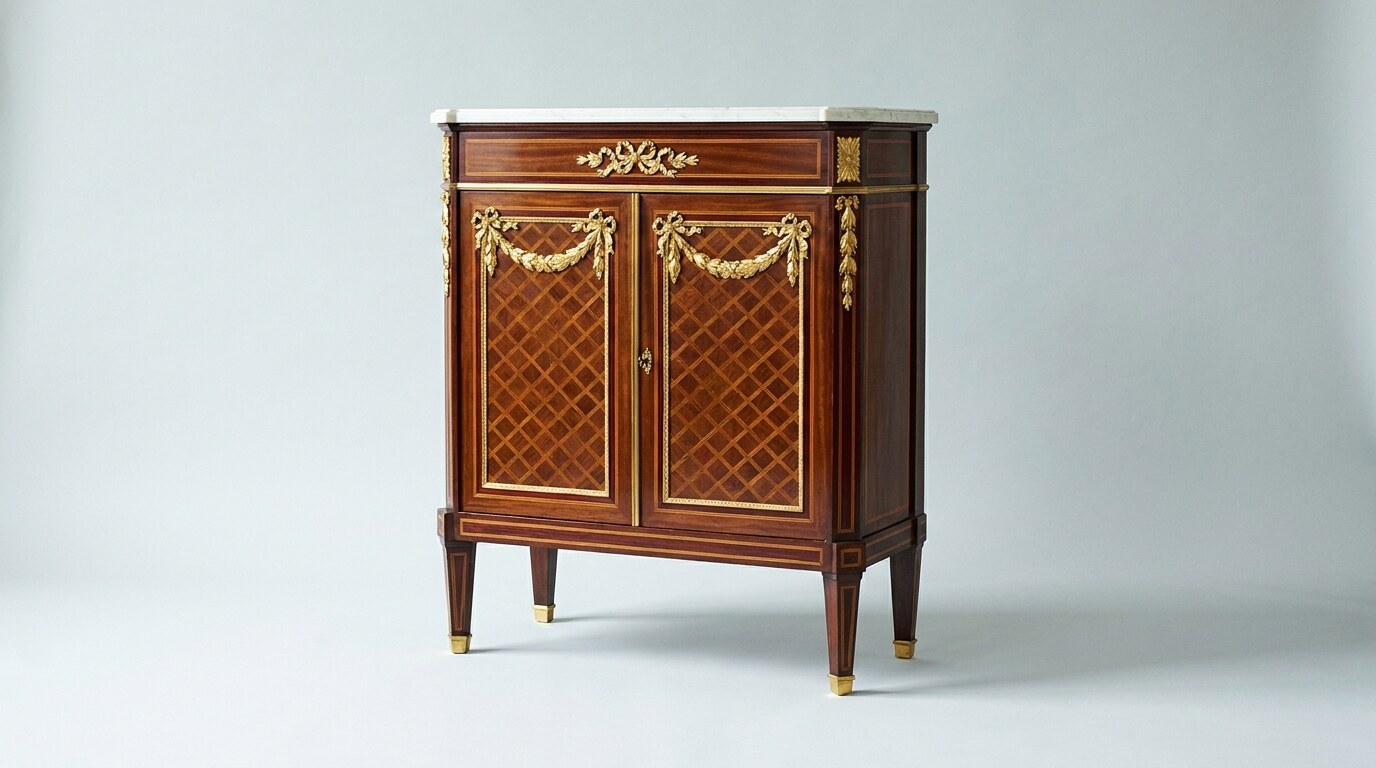
The Louis XVI programme reset court furniture toward symmetry, classical ornament, and lighter timbers. Jean-Henri Riesener delivered more than 700 documented pieces to the Crown between 1774 and 1789, with surviving inventories at the Mobilier National recording mahogany, ebony, and amaranth as principal timbers, set with neoclassical ormolu mounts in motifs of laurel garlands, ribbon bows, anthemia, and beading. Forms return to rectilinear plans with subtle taper: legs taper square or round and end in sabots (gilt-bronze foot caps); fronts are flat or slightly bowed. Marquetry, where used, is geometric (cube and trellis patterns) rather than floral.
A four-test field guide (legs, mounts, marquetry, surfaces)
A specifier examining a French Crown-period cabinet can apply four tests in sequence to identify the reign. Each test produces a binary indication that narrows the period.
| Test | Louis XIV | Louis XV | Louis XVI |
|---|---|---|---|
| Leg shape | Square baluster, often turned | Cabriole, deep curve, scrolled toe | Tapered straight (square or round) |
| Ormolu vocabulary | Lion masks, acanthus, herms | Asymmetric rocaille shells, palm fronds | Laurel garlands, ribbon, anthemia |
| Marquetry | Tortoiseshell + brass on ebony | Floral bouquets on tulipwood | Geometric cube/trellis on mahogany |
| Plan / silhouette | Rectilinear, heavy mass | Bombé, serpentine, asymmetric | Rectilinear, taper, restrained |
Where to see verified examples
Five public collections allow specifiers to study verified, stamped pieces across all three reigns. The Musée du Louvre Department of Decorative Arts displays approximately 80 stamped Crown-period pieces drawn from royal residences; the Wallace Collection in London holds the largest concentration of Louis XV ormolu-mounted furniture outside France; the Mobilier National in Paris stewards furniture still in active use at French Republic residences. The Getty Center in Los Angeles displays approximately 30 documented French royal pieces in its decorative-arts galleries (Building W2). The Met Fifth Avenue in New York presents a representative range of all three reigns in galleries 524 to 526.
Authenticating against later revivals
French royal furniture has been reproduced continuously since 1815, with peaks during the Second Empire (1852–1870) and again in the 1890s. Authentication therefore matters at any price point above the entry tier. Period furniture carries the maker's stamp (estampille) and the jurande mark of the guild inspector; Riesener's stamp reads "J.H. RIESENER" (capitals); BVRB's reads "B. V. R. B." inside an oval. Hand-cut dovetails in drawers, secondary woods of oak (rather than pine), animal-glue construction, and the absence of machine-cut tenons distinguish period from revival. The British Antique Dealers' Association and the Syndicat National des Experts in Paris publish member directories of certified authenticators.
The forward research question for the journal is the present location of the 327 pieces of Garde-Meuble Royal furniture sold in the 1793–1794 dispersals from the Tuileries and Versailles. The 1793 sale catalogues, transcribed and published by the Mobilier National in 2003, list inventory numbers; readers with provenance leads on these dispersed pieces are invited to write to [email protected].
References and further reading
- Musée du Louvre, Department of Decorative Arts.
- Wallace Collection (Boulle, BVRB, Riesener holdings).
- Mobilier National.
- Getty Center, Decorative Arts.
- The Met, French period rooms.
- Syndicat National des Experts (Paris).