
Rococo vs Baroque: Dates, Geographies, and Formal Distinctions
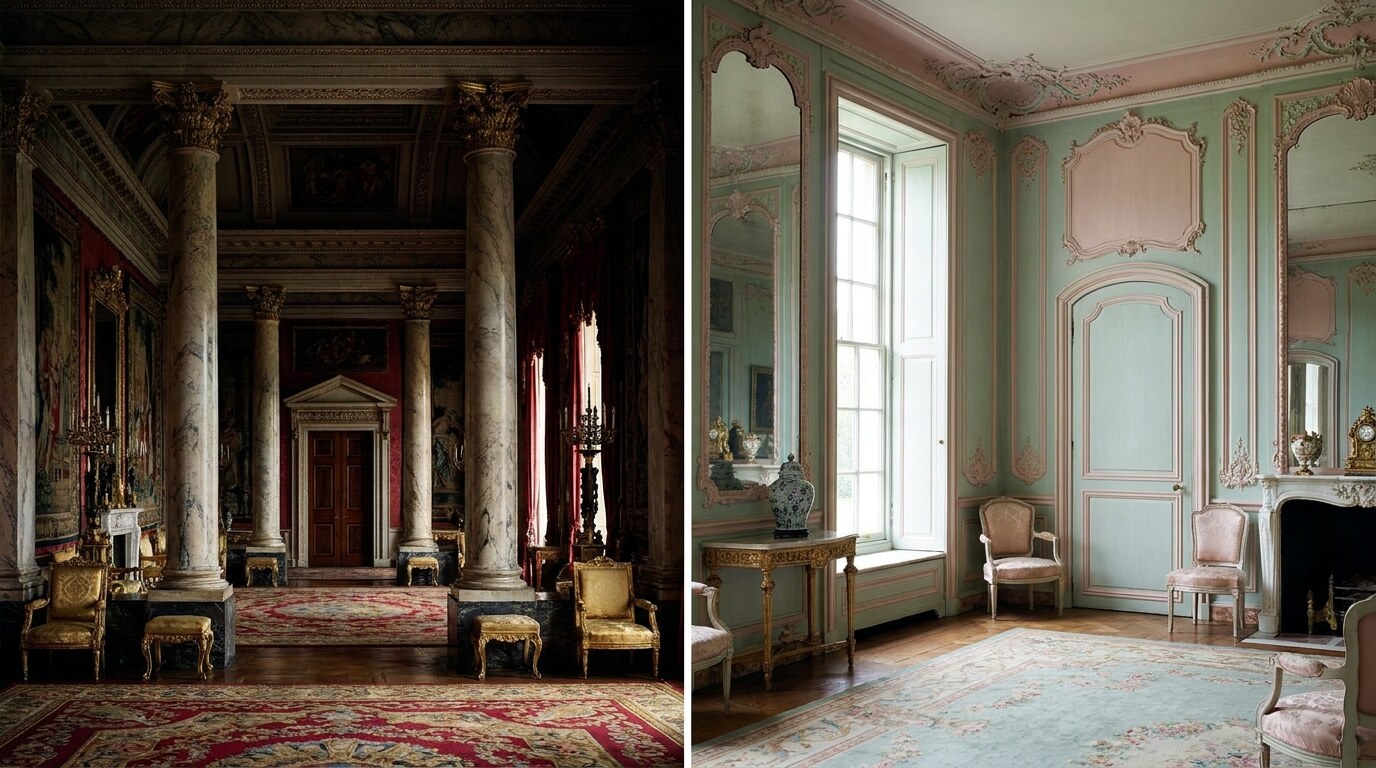
Baroque and Rococo are two successive 17th- and 18th-century European court styles distinguished by date (Baroque c. 1600–1730, Rococo c. 1715–1770), geography (Baroque centred on Roman papal commissions and Versailles, Rococo on Parisian hôtels particuliers and South-German pilgrimage churches), and form (Baroque favouring monumental symmetry, dynamic diagonals, and theatrical scale; Rococo favouring asymmetric rocaille, lighter pastel palettes, and intimate room volumes).
Date and geographic boundary
The transition from Baroque to Rococo can be dated narrowly. The accepted boundary year is 1715, the year of Louis XIV's death and the beginning of the Régence under the Duc d'Orléans, after which Crown patronage shifted from the formal state architecture of Versailles to private Parisian hôtels particuliers commissioned by the aristocracy and grand bourgeoisie. Baroque continued in Italy and Spain until approximately 1730, in Eastern Europe (Bohemia, Bavaria) until approximately 1750, and in Iberian colonial South America into the 1770s. Rococo emerged earliest in Paris (1715–1720), spread to Bavaria and the Habsburg territories by 1730, and reached its high point everywhere by 1750.
Five formal markers compared
| Marker | Baroque | Rococo |
|---|---|---|
| Massing | Heavy, symmetrical, axial | Light, asymmetric, off-axis |
| Palette | Saturated red, gold, deep green; chiaroscuro | Pastel pink, blue, green; even daylight |
| Ornament | Acanthus, broken pediments, putti | Rocaille shell, C-scrolls, asymmetric cartouches |
| Scale | Monumental (state halls 25–40 m long) | Intimate (salons 6–9 m square) |
| Programme | State, religious, dynastic | Private, courtly, conversational |
Canonical Baroque interiors
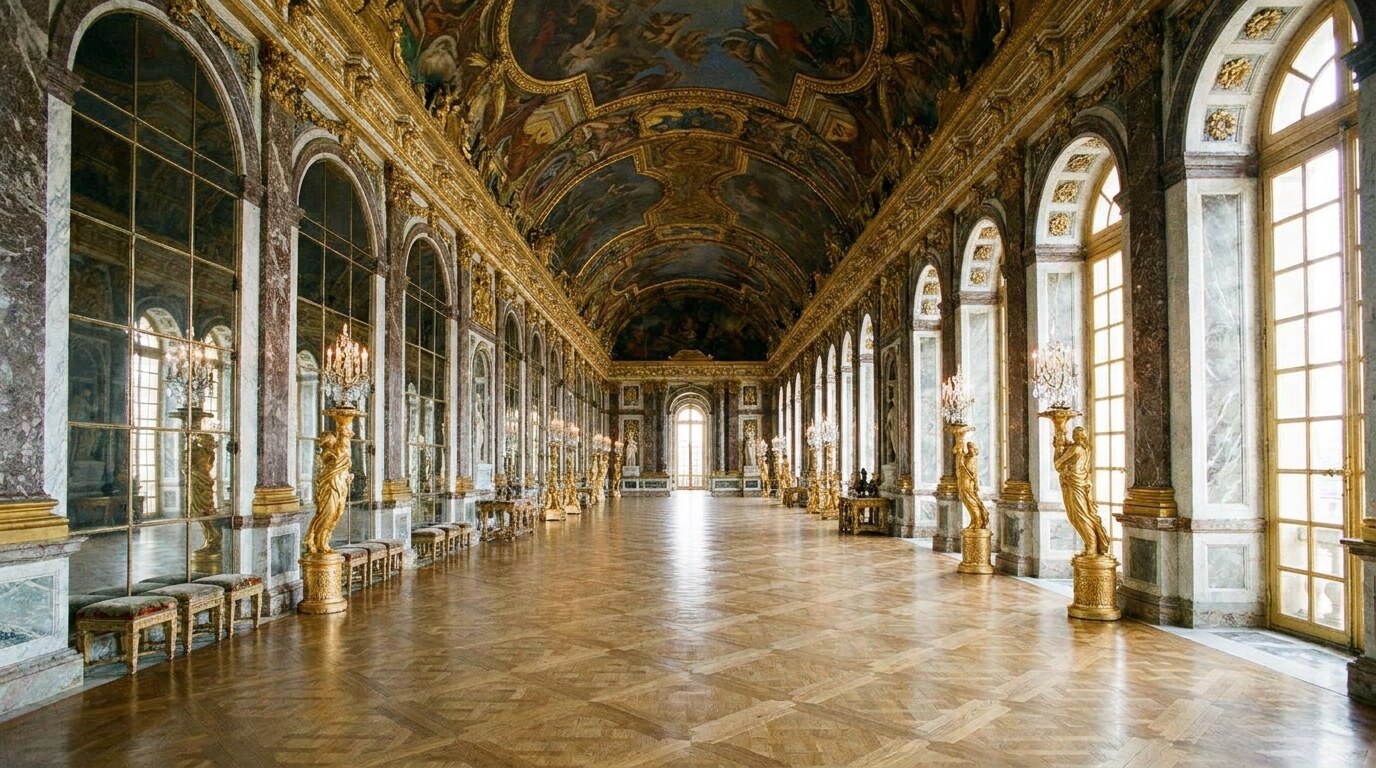
Three canonical Baroque interiors document the style at its highest realisation. The Galerie des Glaces at Versailles, designed by Jules Hardouin-Mansart and decorated by Charles Le Brun between 1678 and 1684, measures 73 metres long, 10.5 metres wide, and 12.3 metres high, with 357 mirrors arranged in 17 arched panels along its inner wall facing 17 windows; the Galerie is the canonical Baroque state interior in Europe. The Cornaro Chapel at Santa Maria della Vittoria, Rome, by Gian Lorenzo Bernini (1647–1652), houses the Ecstasy of Saint Teresa within a polychrome marble theatre. The Stadthuis (now Royal Palace) at Amsterdam, by Jacob van Campen (1648–1665), is the canonical northern-Baroque civic interior.
Canonical Rococo interiors
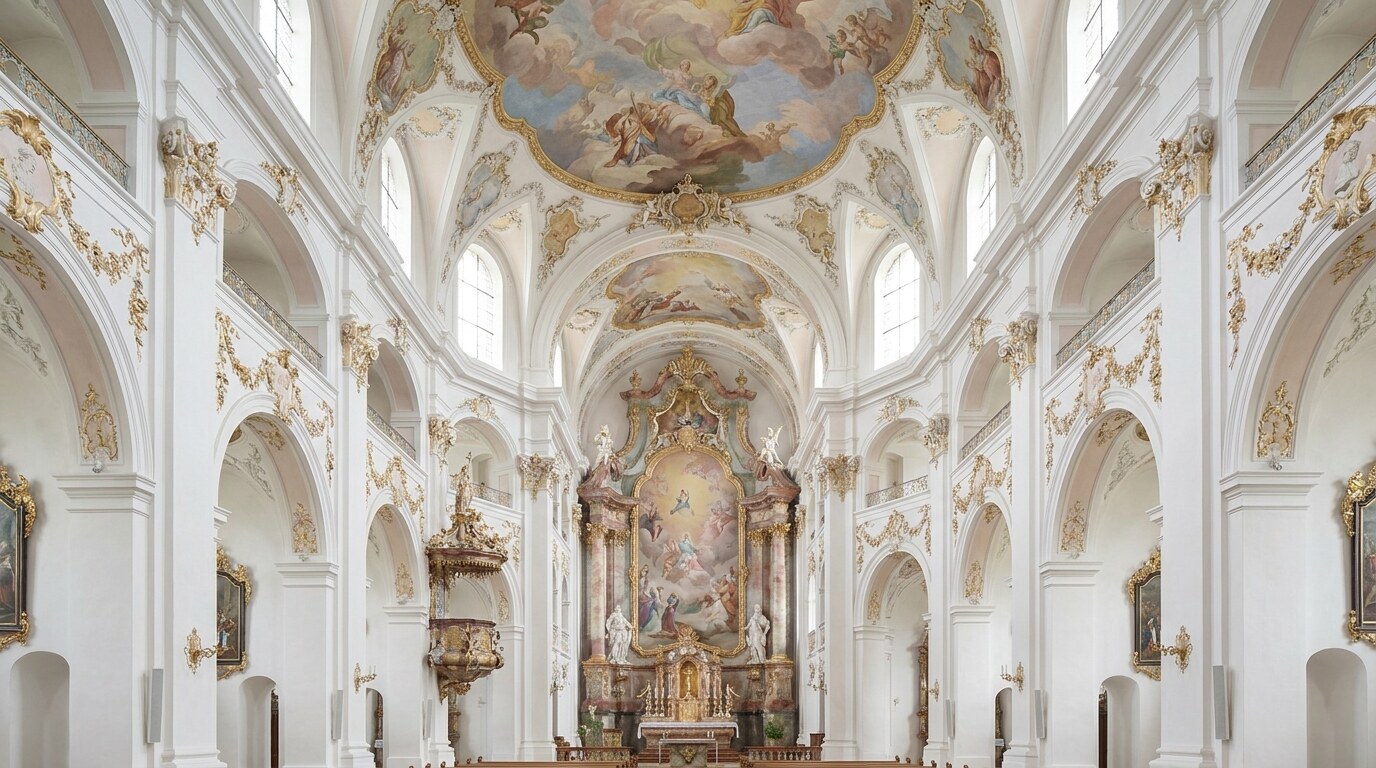
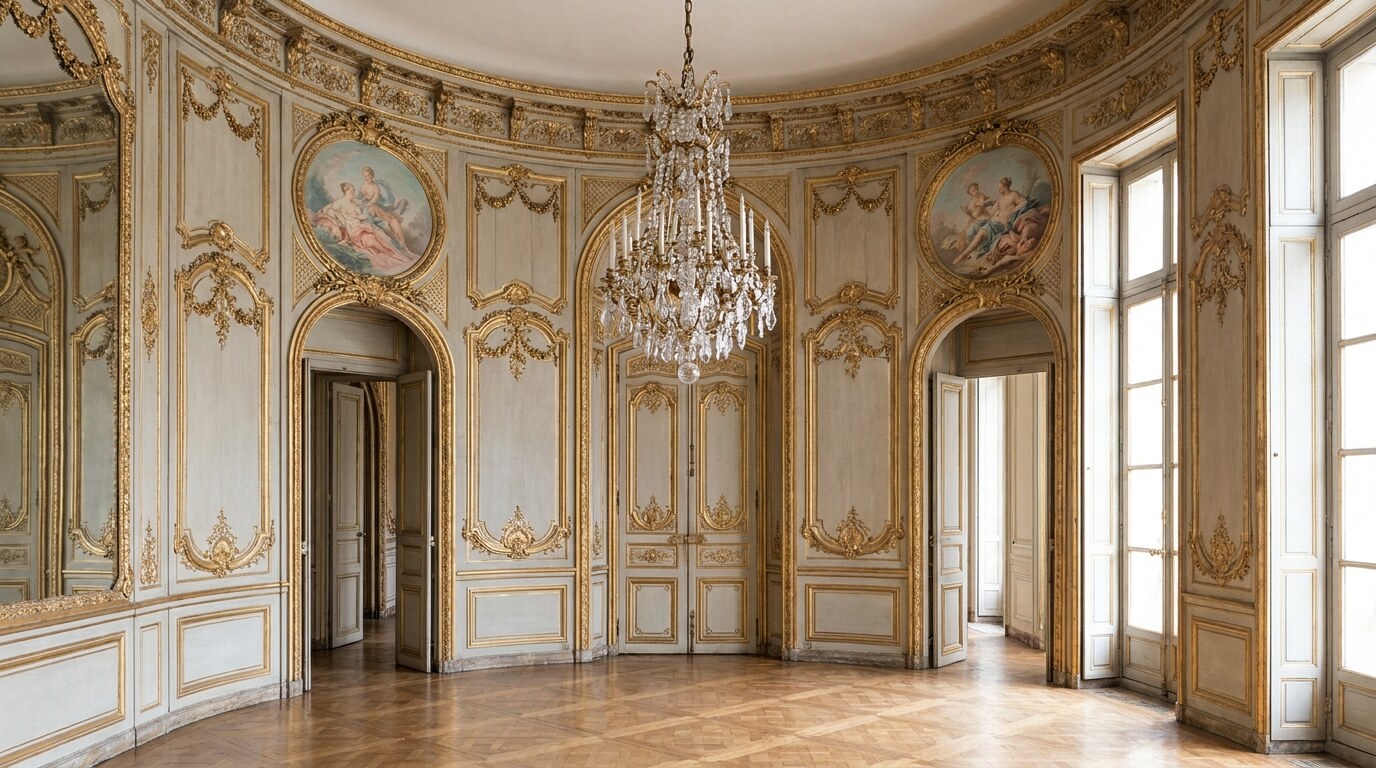
Three canonical Rococo interiors document the style's reach. The Hôtel de Soubise Salon de la Princesse, Paris, designed by Germain Boffrand 1735–1739 with painted reserves by François Boucher and Charles-Joseph Natoire, is generally accepted as the European Rococo's high point. The Wieskirche in Bavaria (1745–1754) by Dominikus Zimmermann is the most-visited Rococo pilgrimage church, receiving more than one million visitors annually. The Cuvilliés Theatre in Munich, by François de Cuvilliés the Elder (completed 1755), is the surviving canonical Rococo theatre interior in Europe.
Why the transition happened around 1715
The 1715 transition was driven by a sociological shift in Crown patronage rather than a stylistic exhaustion. With Louis XIV's 72-year reign ending in September 1715, the Crown's day-to-day life moved away from Versailles (under the regency of the five-year-old Louis XV) and back to Paris, where the aristocracy had been building their own private hôtels particuliers in the Faubourg Saint-Germain since approximately 1680. These intimate town houses required a smaller-scaled, more conversational decorative idiom; Rococo provided it.
A field test you can apply in a museum gallery
A specifier or visitor in a museum can apply a four-question test to distinguish a Baroque from a Rococo interior at sight. (1) Is the symmetry strict, axial, and bilateral, or are mouldings and reserves placed asymmetrically across the wall? (2) Is the palette saturated and dominated by red, gold, and dark green, or pastel and dominated by soft pink, eau-de-Nil, and butter yellow? (3) Are the principal ornaments acanthus and broken pediments, or asymmetric C-scrolls and rocaille shells? (4) Is the room volume monumental or intimate? Three or more "first-option" answers indicate Baroque; three or more "second-option" answers indicate Rococo.
The forward research question for this journal is the architectural taste of the Régence transition years (1715–1723) in regional French commissions outside Paris, where surviving evidence suggests a slower transition than the Parisian narrative implies and remains under-published.
References and further reading
- The Met, essay on Rococo (heilbrunn timeline).
- Victoria and Albert Museum, essay on Baroque.
- Centre des monuments nationaux (Hôtel de Soubise).
- Bavarian Palace Department.
- Wieskirche.