
Empire Style Furniture: Napoleon, Jacob-Desmalter, and Symbolic Iconography
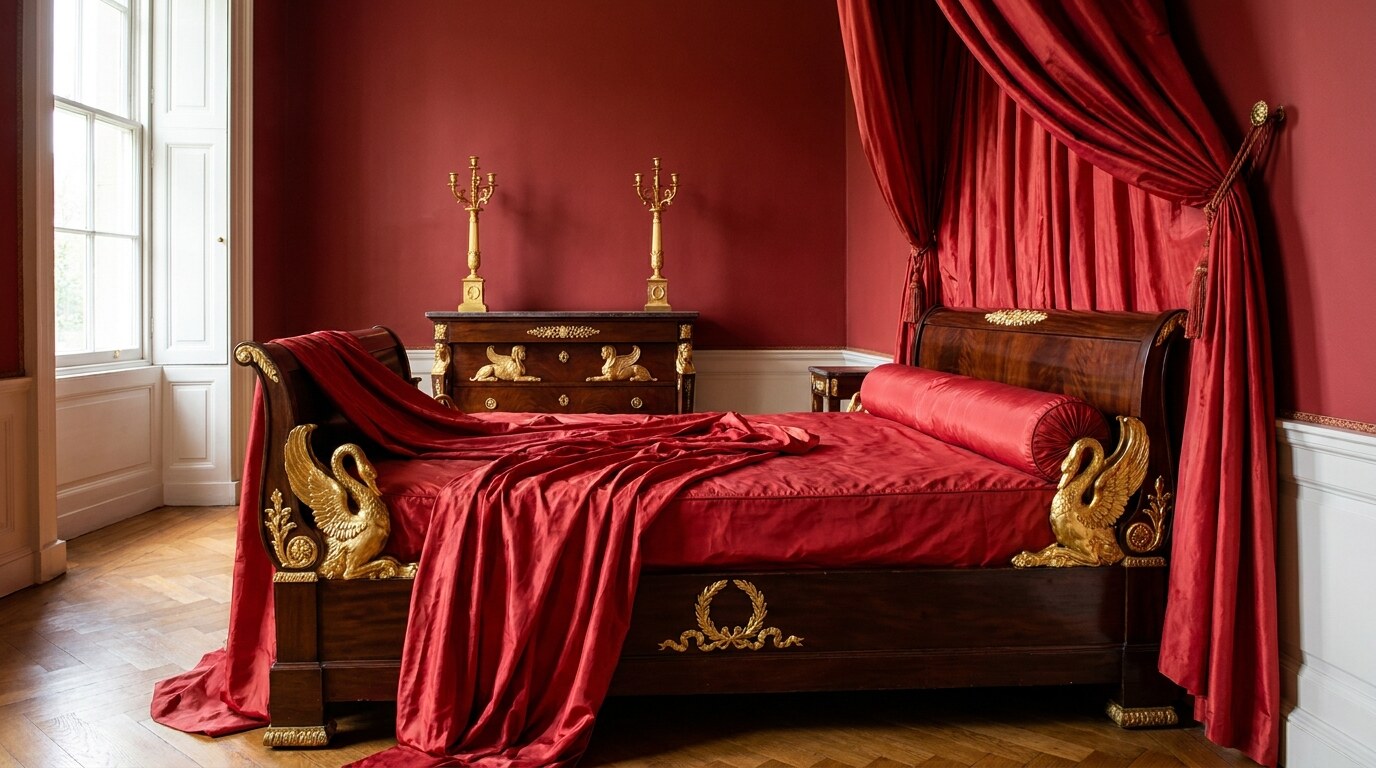
Empire style furniture is the official decorative idiom of the First French Empire (1804–1815), designed under the supervision of architects Charles Percier (1764–1838) and Pierre-François-Léonard Fontaine (1762–1853), executed primarily by the cabinet-maker François-Honoré-Georges Jacob-Desmalter (1770–1841), and codified in Percier and Fontaine's 1801 Recueil de décorations intérieures. The style is identifiable by mahogany veneers, ormolu mounts in motifs of laurel, palmettes, sphinxes, swans, and Egyptian deities, columnar supports, and an archaeological set of references to Imperial Rome and Napoleonic Egypt.
Percier and Fontaine as state designers
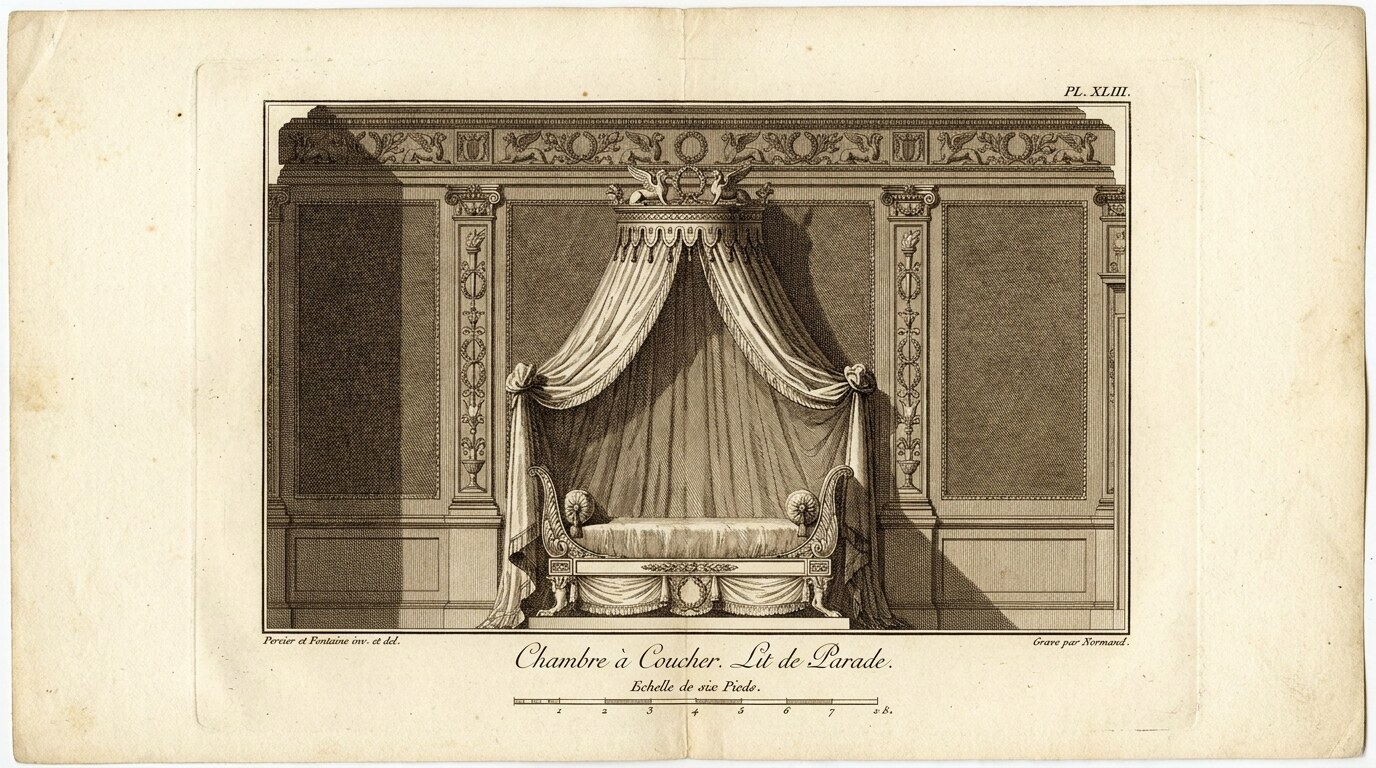
Charles Percier and Pierre-François-Léonard Fontaine were state architects to Napoleon Bonaparte from the Consulate (1799) through the First Empire and into the Restoration. Their Recueil de décorations intérieures, first published in Paris in 1801 with a second expanded edition in 1812, became the design canon for the Empire across Europe and was reproduced in pirated editions in London (1808), Berlin (1814), and Stuttgart (1816). The Recueil illustrates more than 80 furniture designs, room schemes, and ornament details, all referenced to specific Empire commissions at the Tuileries, Saint-Cloud, Fontainebleau, Compiègne, and Malmaison.
Jacob-Desmalter's workshop output
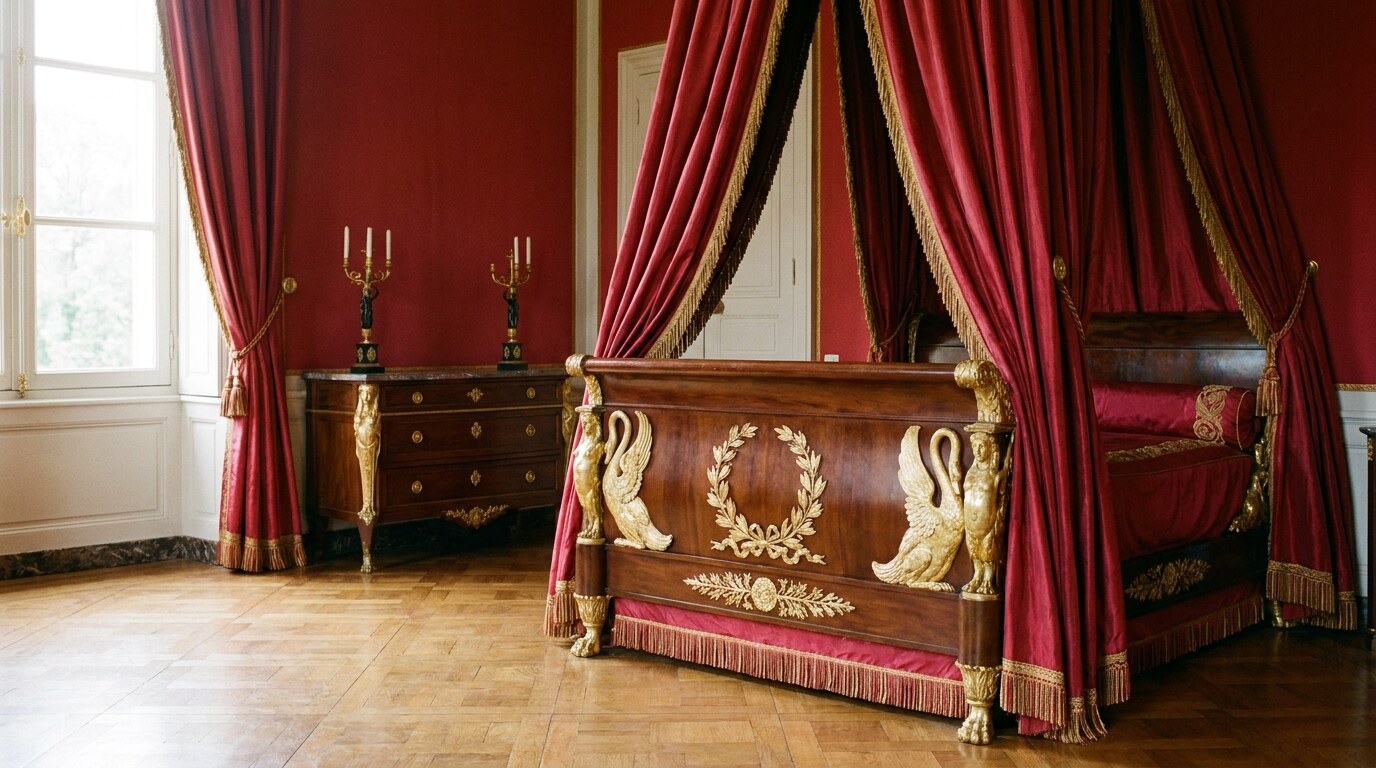
Jacob-Desmalter operated the largest furniture workshop in Paris during the Empire period. François-Honoré-Georges Jacob-Desmalter (1770–1841) inherited the workshop of his father Georges Jacob in 1796 and produced furniture for the Imperial Crown for the Tuileries, Saint-Cloud, Fontainebleau, Compiègne, Malmaison, and the King of Westphalia's residences between 1803 and 1814, with surviving documented inventories at the Mobilier National listing more than 1,400 individual commission entries. The workshop employed approximately 350 workers at its 1810 peak and supplied complete room ensembles (chairs, beds, commodes, console tables, candelabra) to single specifications for Imperial residences.
Iconographic vocabulary
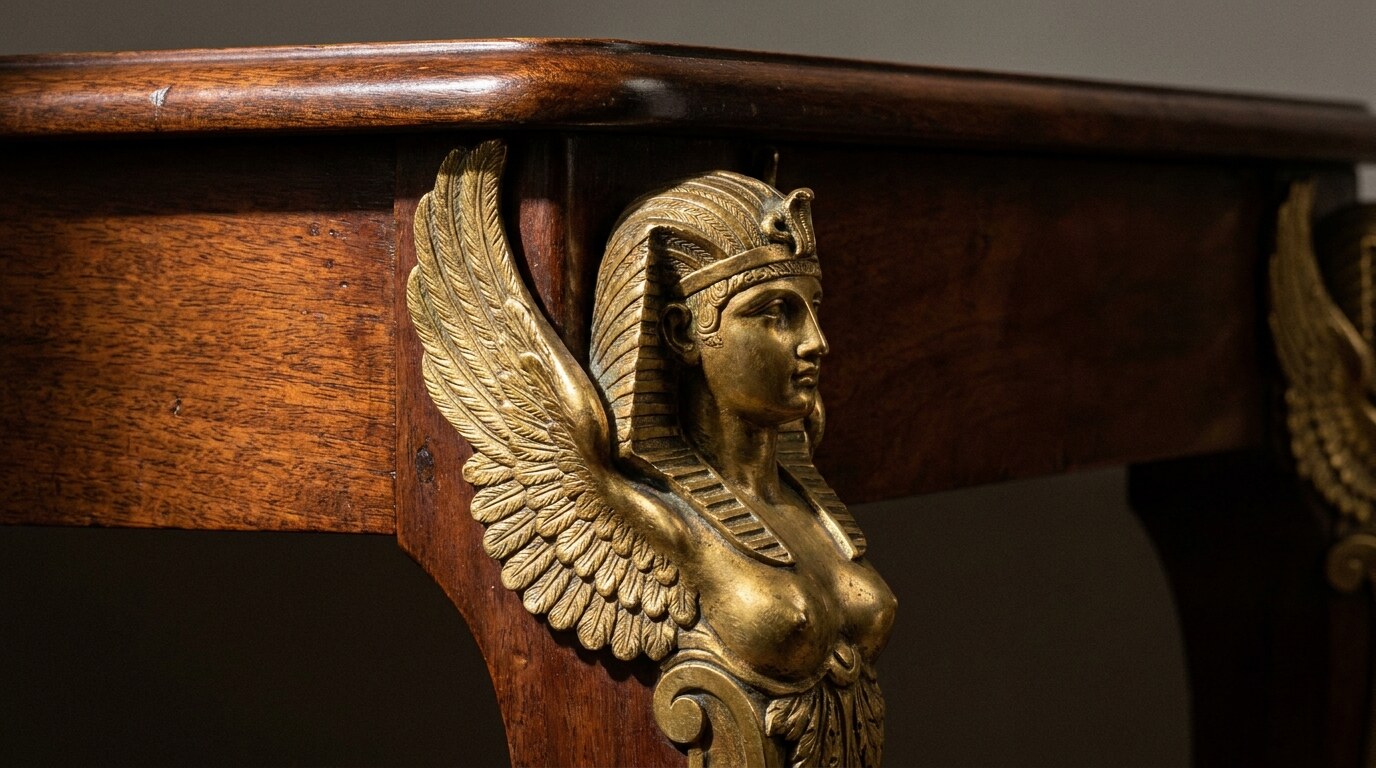
Empire ormolu mounts use a finite vocabulary of recurring symbols, each carrying a documented Imperial reference.
| Motif | Imperial reference | Application |
|---|---|---|
| Bee | Personal emblem of Napoleon (adopted 1804) | Wallpaper, embroidery, ormolu |
| Eagle | Imperial coat of arms; Roman legion standard | Bed pediments, wall mounts |
| Sphinx | Egyptian campaign 1798–1801 | Console legs, mantel mounts |
| Swan | Joséphine's personal emblem | Bed posts, chair arms |
| Victory (Nike) | Roman victory iconography | Console pediments, wall reliefs |
| Laurel garland | Roman triumphal symbolism | Furniture friezes, cornices |
Mahogany sourcing under the Continental Blockade
Empire mahogany sourcing tells a small but documented economic story. The Continental Blockade declared by Napoleon's Berlin Decree (21 November 1806) cut off direct trade with British-controlled tropical colonies including British Honduras (Belize), the principal source of Cuban mahogany. From 1806 to 1814 Empire-period mahogany passed via licensed neutral shipping or French-flag privateers, with prices rising approximately 280% across the period; documented inventories at Compiègne show selective use of native French walnut on lower-rank furniture (palace officials' apartments) while reserving mahogany for Imperial principal rooms.
Authentication of period vs Restoration vs 19th-century reproduction
Three production phases survive in the trade with overlapping visual vocabulary, requiring careful authentication. Period Empire (1804–1815) carries the maker's stamp (estampille), uses hand-cut dovetails, oxidised oak secondary woods, and water-gilded ormolu mounts cast from finely chased original masters; documented inventory numbers and royal storage marks add provenance. Restoration-period furniture (1815–1830) continues the visual vocabulary into the Bourbon Restoration with slightly less rigorous mount-chasing standards. 19th-century reproductions (Second Empire, 1852–1870, and 1880–1910) machine-cut dovetails, use sapele or African mahogany substitutes, and apply mercury-fire-gilded mounts of cruder finish.
Major collections
Five public collections allow specifiers to study verified Empire furniture at scale. The Château de Malmaison west of Paris preserves the most coherent surviving Empire interiors at room-set level, including the Music Room, Library, and Joséphine's Bedchamber. The Mobilier National in Paris stewards approximately 1,200 Empire-period pieces still in active use at French Republic residences. The Met (Wrightsman Galleries, 5th Avenue, New York) presents Imperial-period seat furniture by Georges Jacob and Jacob-Desmalter. The Bibliothèque nationale de France holds Percier and Fontaine's working drawings.
The forward research question for this journal is the surviving documentation of Jacob-Desmalter's wage and material books for the period 1810–1814, of which approximately 60% remain unpublished in the Mobilier National archive at Saint-Maur, with potential to refine current attribution practice.
References and further reading
- Château de Malmaison.
- Mobilier National.
- The Met, Wrightsman Galleries.
- Bibliothèque nationale de France (Percier & Fontaine drawings).