
Persian and Aubusson Rugs: Knot Counts, Authentication, Provenance
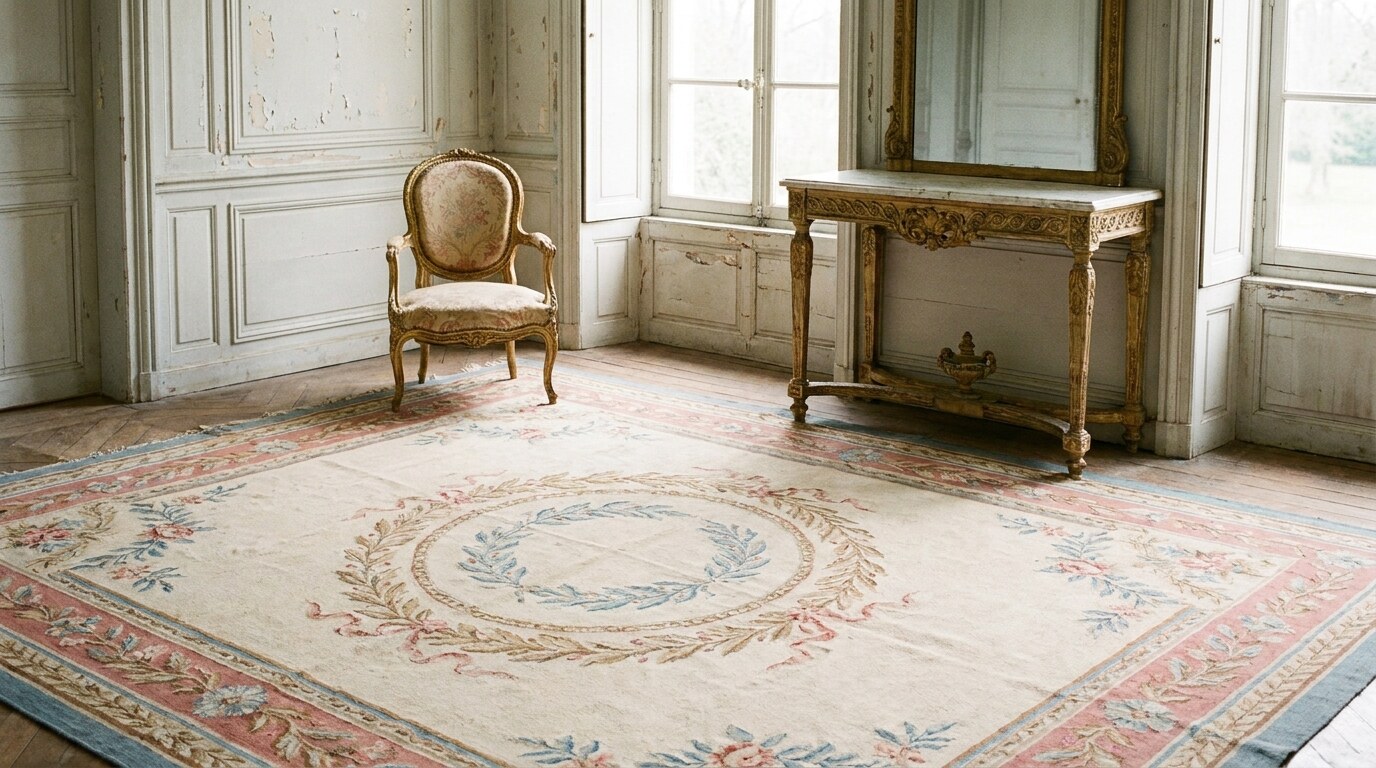
Persian and Aubusson rugs occupy two distinct positions in classical interior specification: hand-knotted Persian carpets from named city workshops (Tabriz, Kashan, Isfahan, Kerman, Heriz, Qum) graded by knots per square inch (typically 120 to 800 KPSI), and flat-woven French Aubusson rugs produced in the Creuse Valley since the 17th century at workshops including Manufacture Robert Four (founded 1890) and Atelier 3, with bespoke pieces selling at €1,200 to €4,800 per square metre as of 2026.
Three Persian-rug knots explained
Three knot types govern Persian rug construction. The Senneh (Persian) knot is asymmetric, wrapped around one warp thread fully and the next partially, allowing tighter detail and used in fine workshops in Tabriz, Isfahan, and Kashan. The Gördes (Turkish) knot is symmetric, wrapped around two warp threads equally, producing a denser pile and more durable wear, used in Heriz and many provincial Persian workshops. The Jufti knot is wrapped around four warp threads (rather than two), halving the labour but reducing density; Jufti-knotted rugs are sometimes mis-sold as fine pieces and command lower trade prices.
Six city signatures
| City | Typical knot density | Typical foundation | Visual signature |
|---|---|---|---|
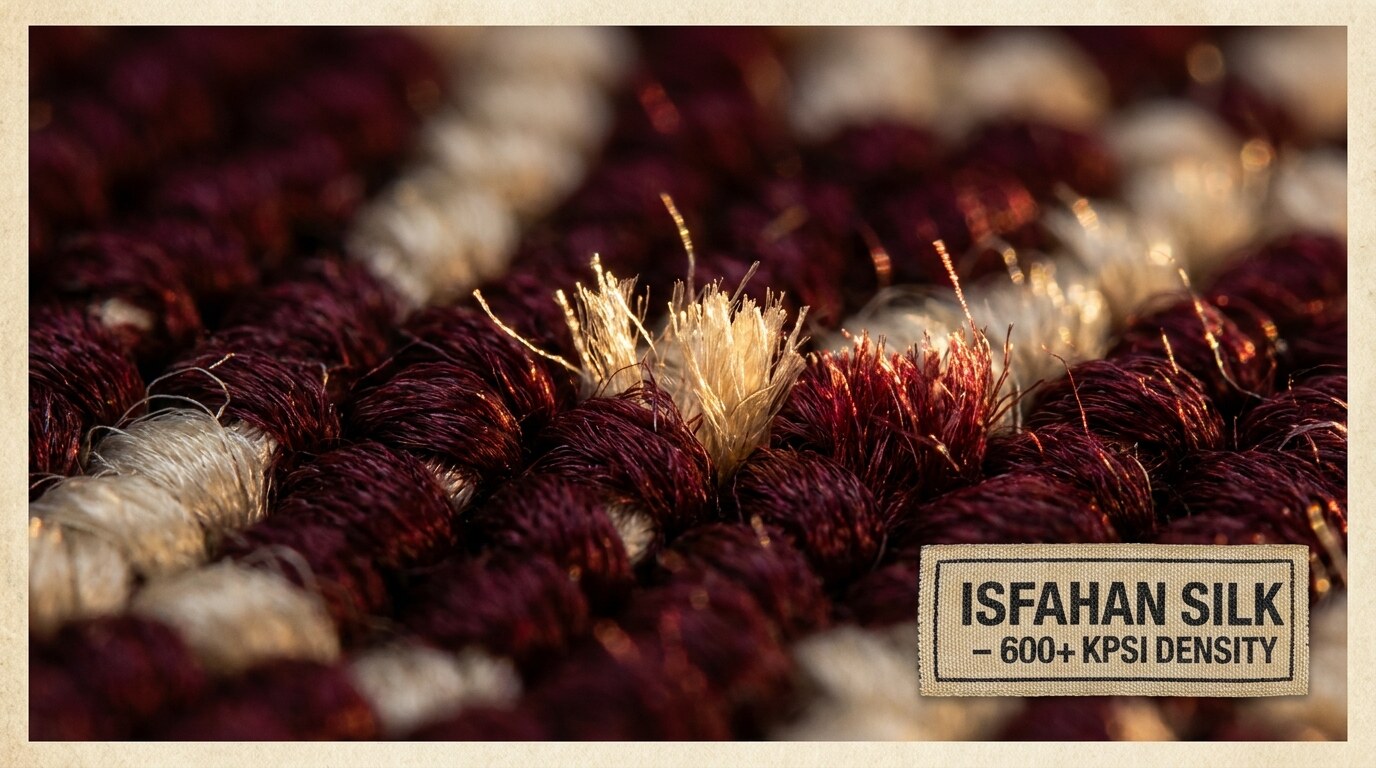
| Isfahan | 600–800 KPSI | Silk warp | Curvilinear floral medallion, navy and ivory |
| Kashan | 250–500 KPSI | Cotton warp | Persian medallion, deep red field |
| Tabriz | 120–600 KPSI | Cotton warp | Hunting scenes, garden pattern, central medallion |
| Kerman | 140–280 KPSI | Cotton warp | Pictorial garden, soft palette of pink and ivory |
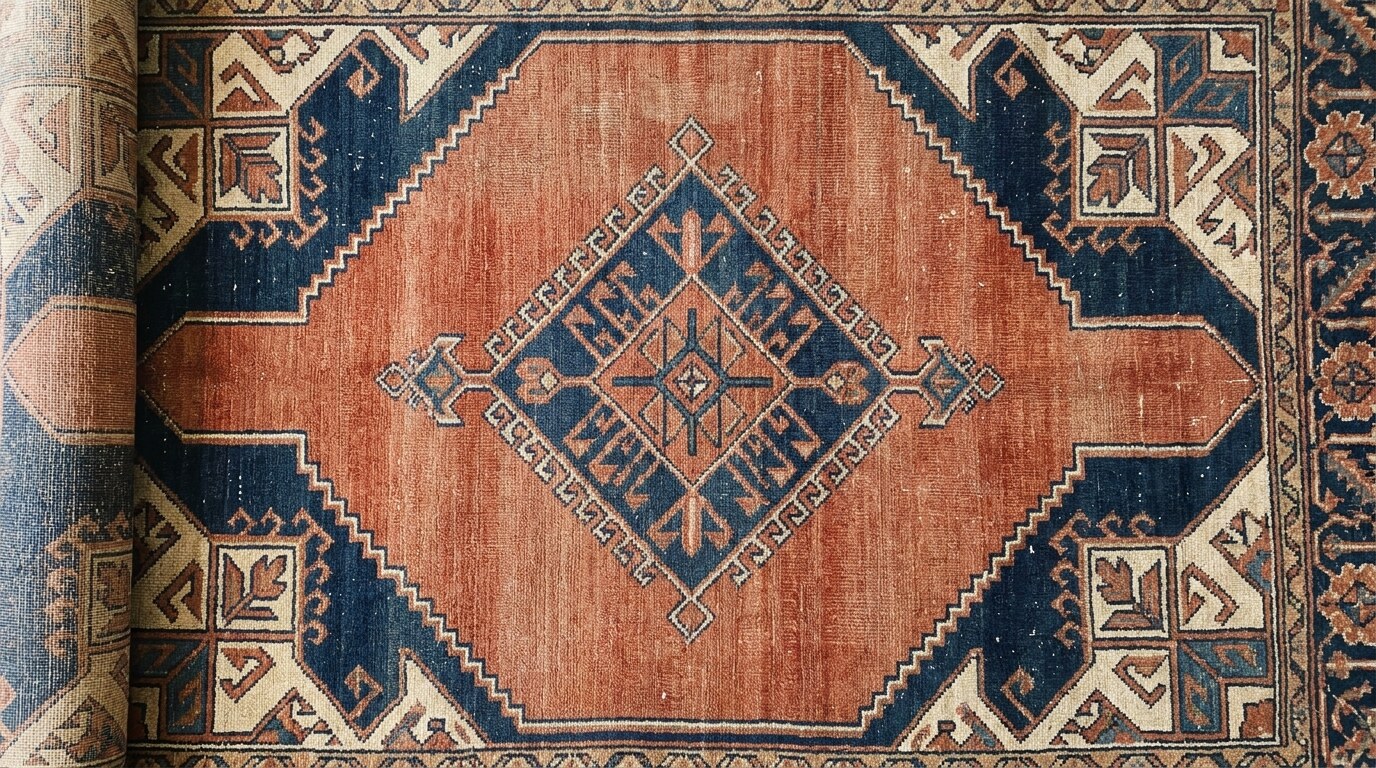
| Heriz | 80–140 KPSI | Cotton warp | Geometric medallion, durable wear, terracotta and navy |
| Qum | 500–700 KPSI | Silk warp + silk pile | Fine all-silk floral, smaller scatter sizes |
Isfahan rugs typically run 600 to 800 KPSI on silk-warp foundations; Heriz rugs typically run 80 to 140 KPSI on cotton-warp foundations and are marketed for floor durability rather than fineness. A specifier choosing rugs for a high-traffic room (entrance hall, dining room) should select Heriz, Tabriz, or Kerman; a rug for a private drawing room or study can use Isfahan or Kashan.
Authentication and provenance documentation
Three authentication tests apply to Persian rugs offered as antique. The first is the back: hand-knotted rugs show individual knot bumps on the back, with colour variations matching the front; machine-made or chemically-washed reproductions show flat or printed-looking backs. The second is fringe attachment: original fringes are a continuation of the warp threads themselves, not separately added; sewn-on fringes indicate either repair or reproduction. The third is dye authenticity: pre-1880 vegetable dyes (madder root for red, indigo for blue, weld for yellow) age unevenly and produce abrash (horizontal striations of slight colour shift); aniline synthetic dyes (introduced 1850s, dominant after 1880) produce flat uniform colour and fade faster.
Aubusson flat weave defined
Aubusson rugs are flat-woven, not knotted. Aubusson flat weave constructs the rug by interlacing weft threads through warp threads in a panel arrangement, with the pattern formed entirely by the weft colours; the technique produces a flat pile-less surface 4 to 6 mm thick, distinct from knotted Persian rugs that produce a 6 to 14 mm cut-pile surface. The technique originated in the Creuse Valley of central France in the late Middle Ages and was raised to royal manufactory status (manufacture royale) under Louis XIV in 1665.
The Creuse Valley workshops
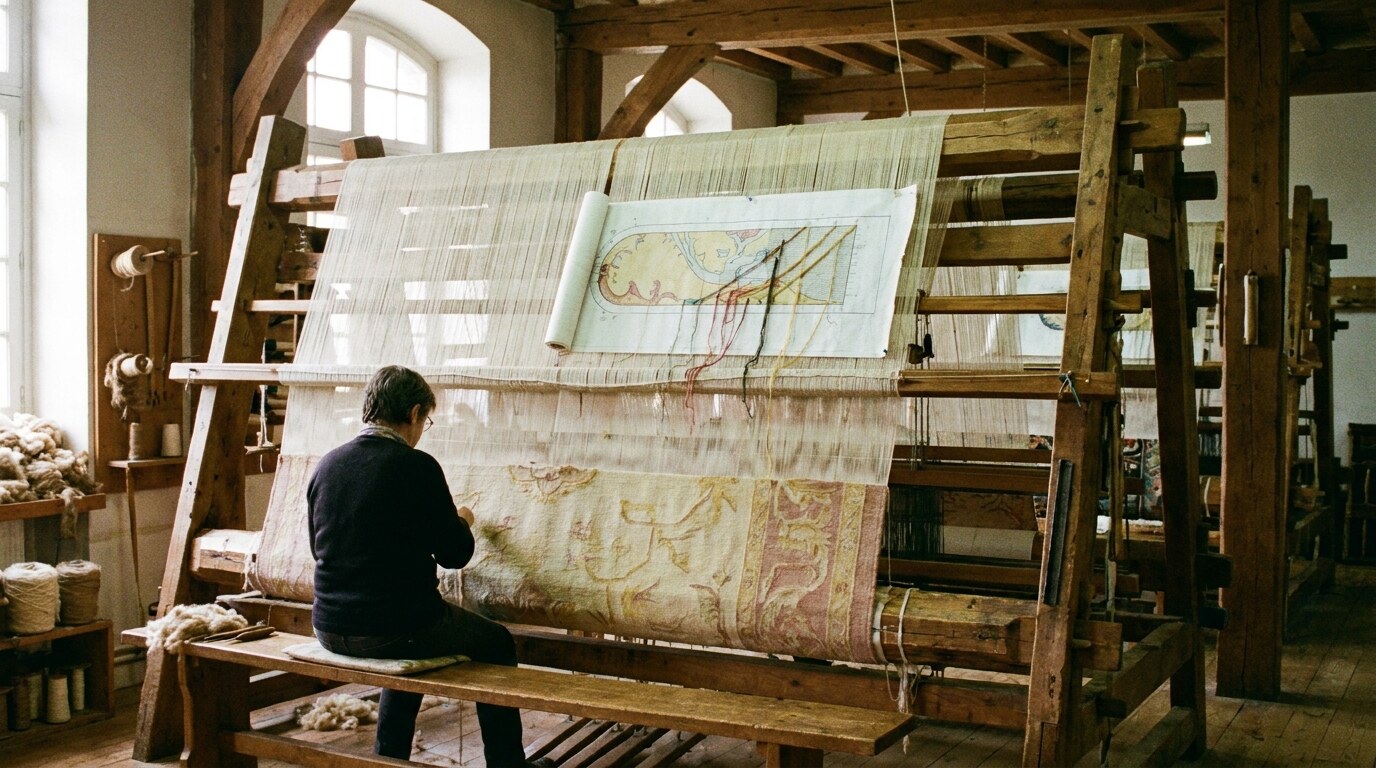
Three workshops dominate Aubusson production today. Manufacture Robert Four (founded 1890) holds an archive of more than 4,500 cartoon designs and produces both wall-hung weavings and floor rugs at the company's Aubusson workshop; bespoke rug commissions run €1,500 to €4,800 per square metre. Atelier 3 (founded 1969) and the Cité internationale de la tapisserie (founded 2010) cover the remainder of regular production and host the public study collection.
Buying tactics in 2026
Two market channels supply most antique Persian and Aubusson rugs to the trade. The auction route (Christie's, Sotheby's, Bonhams in London and New York; Tajan and Artcurial in Paris) is faster and price-transparent, with annual sales of approximately 280 antique Persian lots at Christie's London and 140 antique Aubusson lots at Tajan Paris. Persian rugs of demonstrable late-19th-century provenance with original colours and minimal repair traded at Christie's London 2024–2025 at median £180 to £480 per square foot, with exceptional Isfahan and Tabriz lots clearing at £900 to £1,800 per square foot. The dealer route (Moshe Tabibnia in Milan, John Eskenazi in London, FJ Hakimian in New York) carries higher mark-ups but provides condition guarantees, restoration history, and provenance documentation.
The forward research question for this journal is the documented provenance of the 16 Aubusson rugs commissioned by the French Crown 1770–1789, of which six are catalogued in public collections in France and the United States and 10 are believed to remain in private hands or were dispersed during 1793–1794 sales.
References and further reading
- Manufacture Robert Four, Aubusson.
- Cité internationale de la tapisserie, Aubusson.
- Christie's, Persian rug catalogues.
- Victoria and Albert Museum, textile collection.
- The Met, Islamic Art Department (Persian collection).