
English Country House Style: Decoded by Sister Parish, Nancy Lancaster, John Fowler
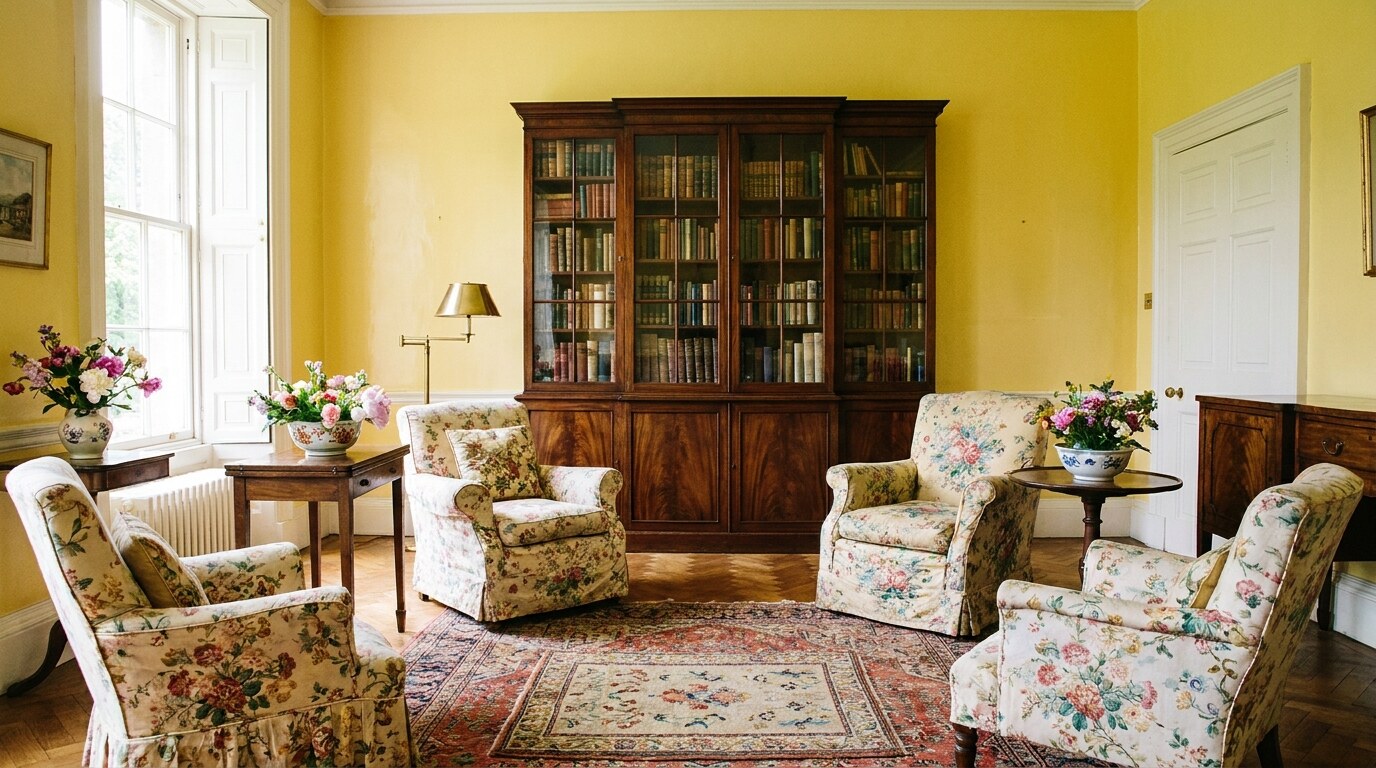
English country house style is the editorial label applied to the layered, faded, antique-rich interior idiom codified between 1930 and 1985 by Nancy Lancaster (1897–1994) at Colefax & Fowler, John Fowler (1906–1977) in his work for the National Trust, and the American decorator Sister Parish (1910–1994) at Parish-Hadley. The style relies on chintz, glazed paint, mismatched antique seating, brown furniture, oriental carpets, and inherited objects, presented as if accumulated over generations rather than commissioned at one date.
Defining the style as a 1930 to 1985 invention
The phrase "English country house style" is younger than the houses it describes. Nancy Lancaster, an American by birth, took over Colefax & Fowler in 1944 and operated from 22 Avery Row, Mayfair, London W1, where her own apartment above the showroom set the visual canon: butter-yellow glazed walls, layered Persian carpets, mismatched chintz, brown furniture, and cut garden flowers in lustreware bowls. John Fowler had joined Lady Sibyl Colefax's firm in 1938 and brought a meticulous restoration discipline to the partnership; together Lancaster and Fowler invented the editorial style that 1950s and 1960s English country owners then adopted as if it had always existed.
Nancy Lancaster and the Yellow Drawing Room at 22 Avery Row
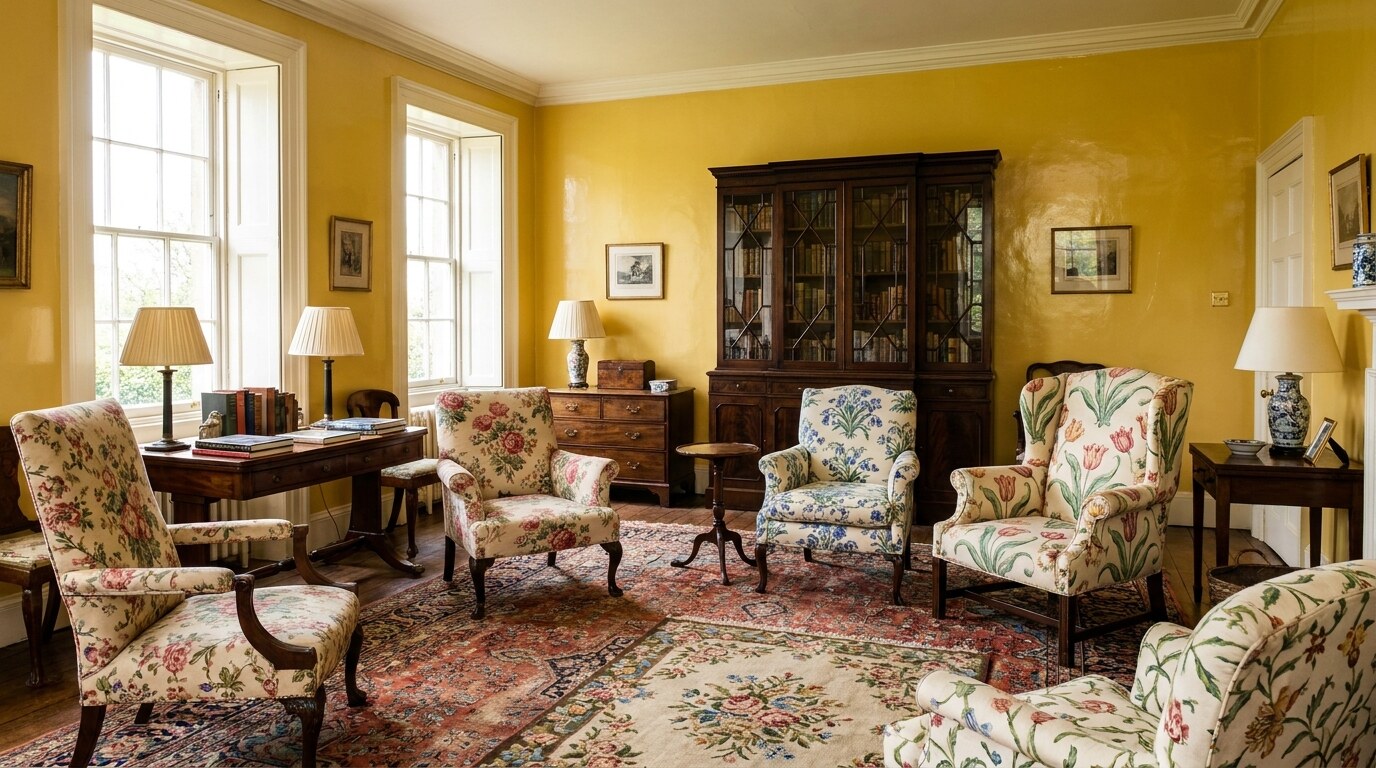
Nancy Lancaster's Yellow Drawing Room at 22 Avery Row, completed 1957 with John Fowler, became the most-photographed English interior of the post-war period. The room measures approximately 9 metres by 6 metres with a 4.2-metre ceiling height, glazed in 14 layers of butter-yellow distemper over a white ground to produce the lacquered surface visible in House & Garden photographs from 1959 onward. Furnishings included a Mortlake-woven wall hanging, a George III mahogany breakfront bookcase, two pairs of George II giltwood mirrors, and four chintz-upholstered armchairs in different patterns, set on a Tabriz Persian carpet covered with a smaller needlepoint rug.
John Fowler's National Trust work, 1956 to 1977
John Fowler's contribution to the canon ran through his unpaid advisory role to the National Trust. Between 1956 and his death in 1977, Fowler advised the National Trust on the redecoration of more than 70 historic British interiors, including Sudbury Hall (Derbyshire), Clandon Park (Surrey), and Petworth House (Sussex), establishing the Trust's house-museum aesthetic that subsequent curators have largely preserved. Fowler's working method, documented in the National Trust's archives at Heelis (Swindon), combined paint stratigraphy (he commissioned analyses from chemists including Catherine Hassall), close study of surviving textiles, and what he called "the humble elegance" of pieced-together household accumulation.
Sister Parish in America: Beekman Place, Kennedy White House, Greenfield Hill
Dorothy May Kinnicutt Parish (1910–1994), professionally known as Sister Parish, transferred the English country aesthetic to American clients beginning in the late 1930s and consolidated her practice at Parish-Hadley Associates from 1962 with Albert Hadley. Sister Parish redecorated the Kennedy family quarters at the White House in 1961 at Jacqueline Kennedy's invitation, and her residential commissions for the Astor, Whitney, Mellon, Paley, and Engelhard families across 1950 to 1990 are documented in the Parish-Hadley Associates archive at the New-York Historical Society. Parish's signature additions to the English idiom included painted floors, hooked rugs, and four-poster beds in old-toile cottons, applied to American houses from coastal Maine to coastal Florida.
The eight visual signatures
Eight visual signatures distinguish English country house style from adjacent traditional idioms (American Federal, French country, neoclassical revival).
- Glazed wall paint in butter yellow, gris Trianon, soft pink, or eau-de-Nil, applied in 8 to 14 layers over white ground.
- Chintz upholstery in mixed patterns, with no two chairs in the same fabric within one room.
- Layered carpets: a worn Persian or Turkey rug at room scale with a smaller needlepoint or Aubusson piece set over it.
- Brown furniture in mahogany, walnut, and rosewood, mixed across periods (Georgian, Regency, William IV) within one scheme.
- Comfortable, mismatched seating sized for adult bodies (deep cushions, generous arms) rather than parade-room scale.
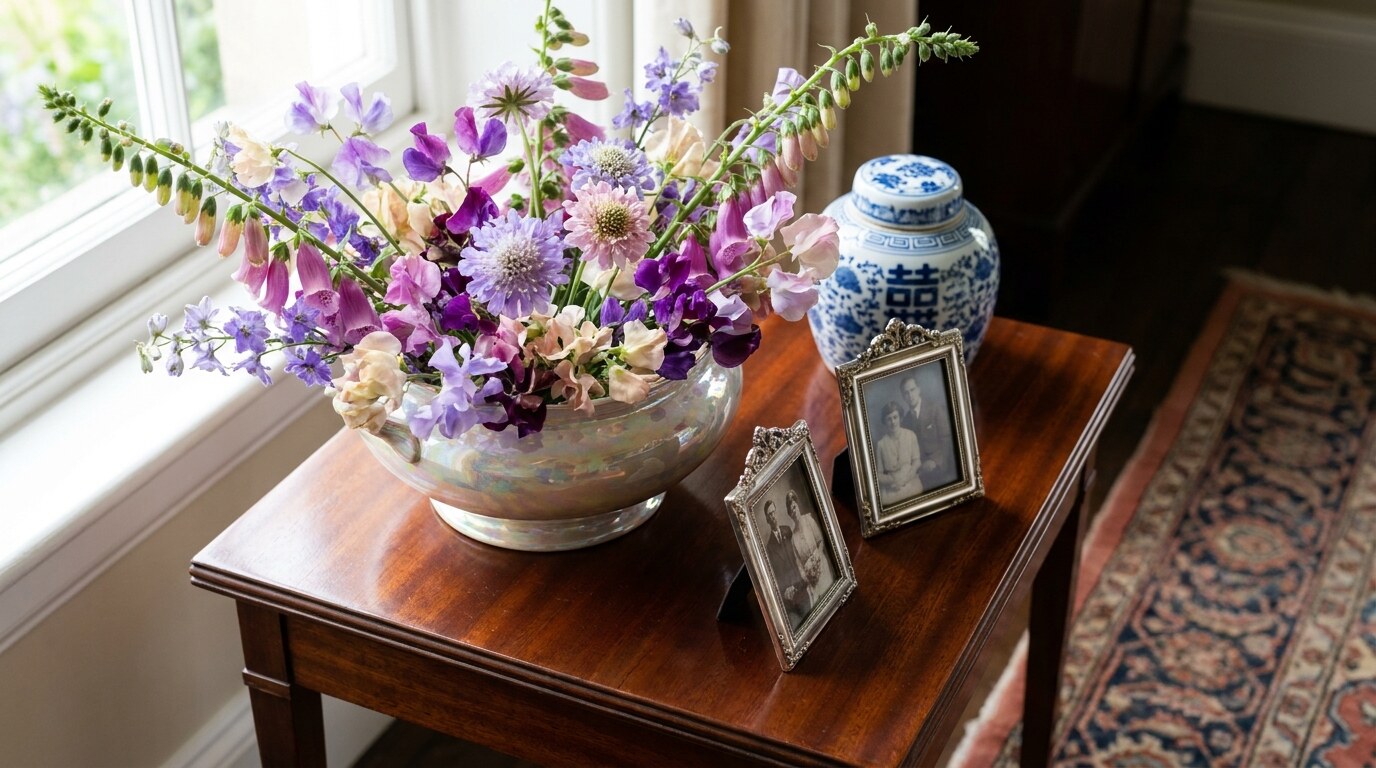
- Inherited objects on display: family photographs in silver frames, lustreware bowls, blue-and-white porcelain, lampshades made from old maps.
- Cut garden flowers in season, never floristry; the bowls are part of the decoration.
- Curtain treatment with hand-stitched buckram pinch pleats, contrast leading edge in silk gimp, and full pelmet boards.
The 2020s revival via Pentreath, Grenney, Konig, Bulmer
A working revival of English country house style is documented across British and American interiors press 2020 to 2026, led by a small set of named decorators. Ben Pentreath (Bloomsbury, founded 2008), Veere Grenney (London, founded 1996), Rita Konig (London, founded 2006), and Edward Bulmer (Hereford, founded 2007) publish English country house schemes regularly in The World of Interiors, House & Garden UK, and Architectural Digest. Their interpretation differs from the Lancaster-Fowler original in three ways: lighter accumulation (fewer objects per surface), more contemporary art mixed with antiques, and a willingness to use modern bespoke joinery alongside period furniture.
Three houses to study from the canon
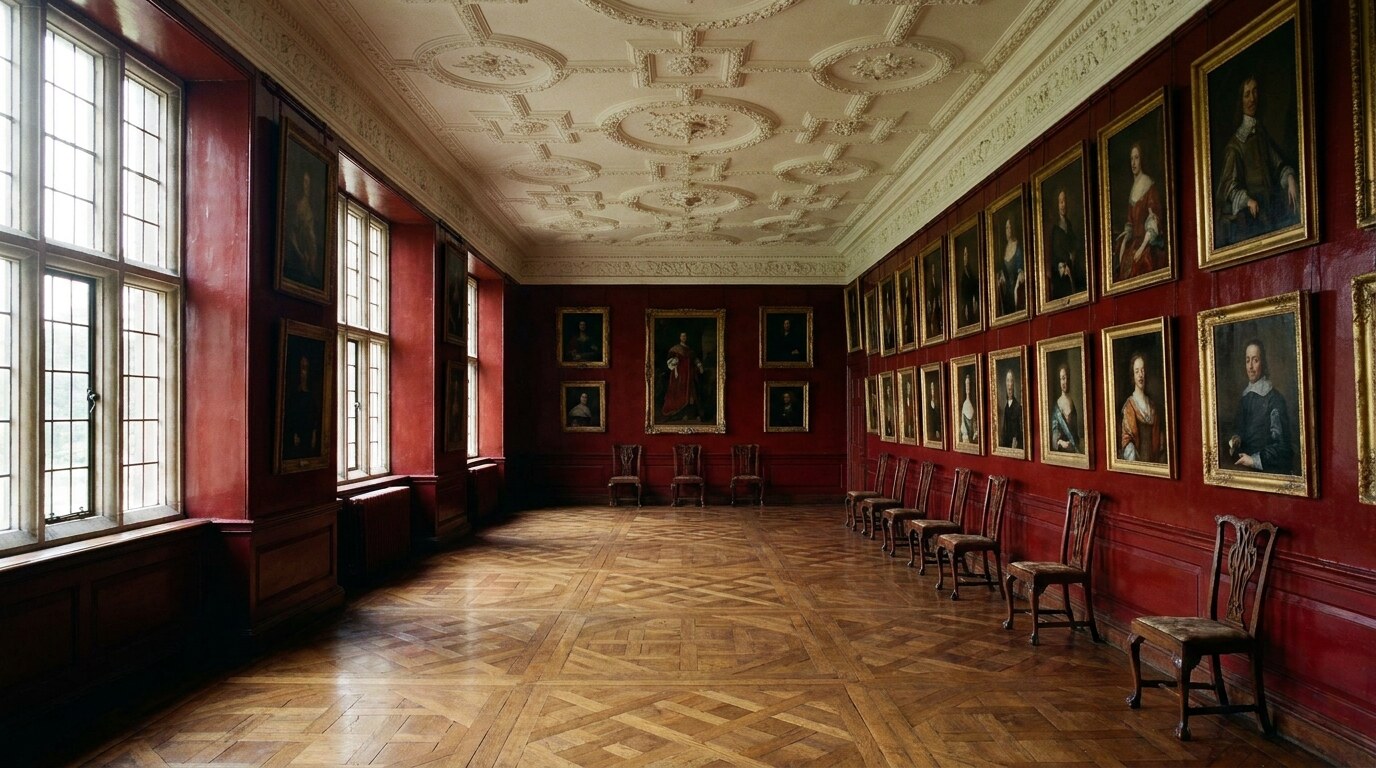
Three houses currently open to the public allow visitors to study the style at primary-source level. Sudbury Hall (National Trust, Derbyshire) retains John Fowler's 1969 redecoration of the saloon and long gallery substantially intact. Haseley Court (private, Oxfordshire) was Nancy Lancaster's own country house from 1955 to 1980 and survives with significant Lancaster-Fowler interventions; the topiary chess set in the garden is a designed extension of the interior idiom. Wilton House (private, Wiltshire) shows Fowler's 1960s advisory work on the Double Cube Room in dialogue with seventeenth-century Inigo Jones architecture.
The forward research question for this journal is the location of the 1968–1972 unpublished colour notes by John Fowler held in private hands rather than the National Trust archive; published bibliographies indicate at least 34 site notebooks remain undocumented. Readers holding such material are invited to write to [email protected].
References and further reading
- National Trust, Sudbury Hall.
- Colefax & Fowler.
- New-York Historical Society, Parish-Hadley archive.
- The World of Interiors.
- Architectural Digest.
- House & Garden UK.