
Murano Glass Chandeliers: Production, Identification, Historical Periods
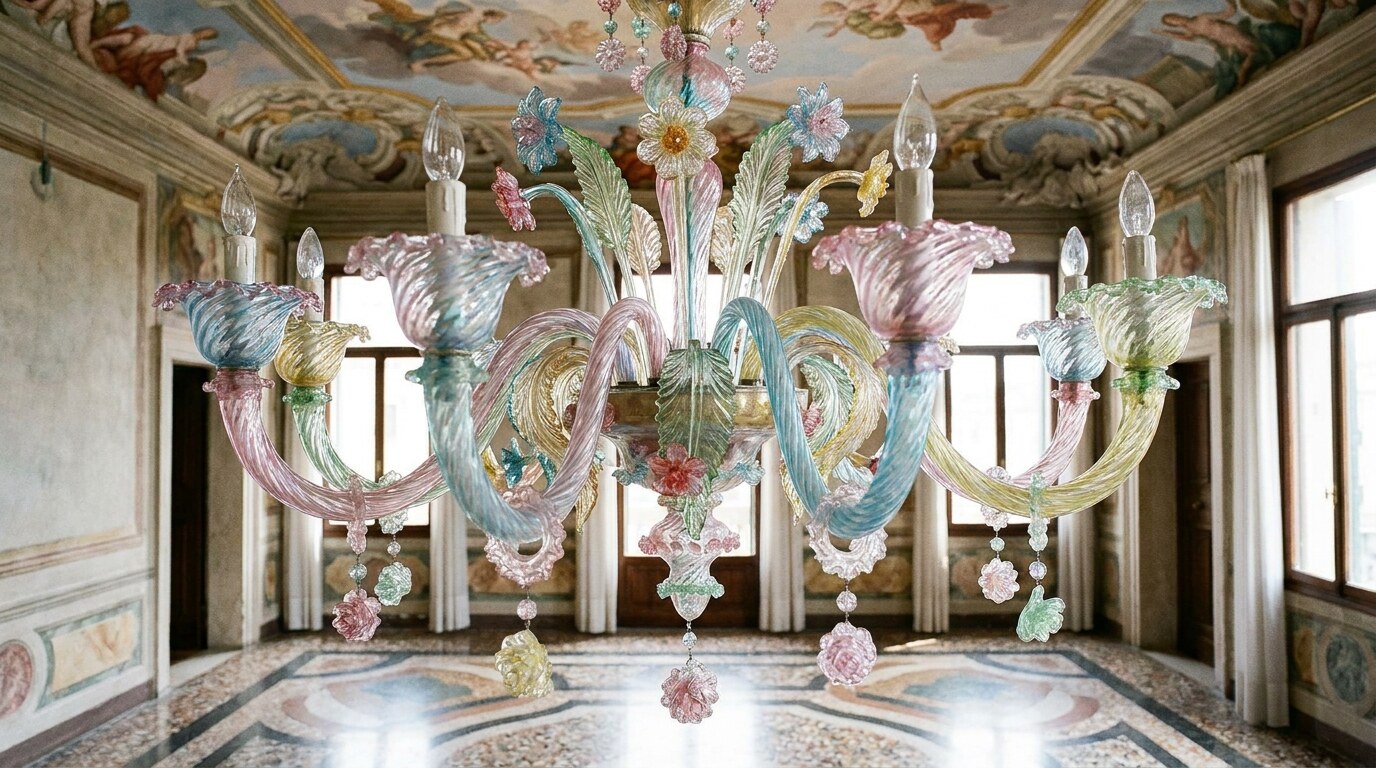
Murano chandeliers are blown-glass lighting fixtures produced on the island of Murano (Venice lagoon) from approximately 1700 to the present. Seven historical periods are identifiable by glass colour, arm shape, and fixture form: early Baroque (1700–1730), classic ciocche (1730–1790), Empire (1800–1830), Historicist revival (1860–1900), Liberty (1900–1925), Modernist (1925–1965), and contemporary (1965–present). Active producers in 2026 include Salviati (founded 1859), Venini (1921), Barovier & Toso (formal company 1936, family lineage 1295), and Seguso Vetri d'Arte (1933).
Seven periods to identify
| Period | Dates | Visual signatures |
|---|---|---|
| Early Baroque | 1700–1730 | Heavy clear glass, simple S-curve arms, no flowers |
| Classic ciocca | 1730–1790 | Pastel arms, hand-blown flowers and leaves, "flowering branch" |
| Empire | 1800–1830 | Clear glass + ormolu mounts, classical motifs (sphinx, swan) |
| Historicist revival | 1860–1900 | Rococo/Renaissance pastiche, intense colours |
| Liberty | 1900–1925 | Iridescent finishes (Salviati's iridato), Art Nouveau curves |
| Modernist | 1925–1965 | Geometric forms, single colours (Venini, Vistosi, Mazzega) |
| Contemporary | 1965–present | Sculptural; mixes hand and machine techniques |
The classic ciocca chandelier
The ciocca ("flowering branch") is the canonical Murano chandelier form, developed in the second quarter of the 18th century and continuously produced for nearly 300 years. The ciocca form was codified by Giuseppe Briati (1686–1772) between 1730 and 1740 in his Murano workshop, with the canonical 12-arm version on a central blown-glass column, decorated with hand-blown leaves, hand-pulled flowers, and dripping rosette pendants in pastel colours; the form has remained the dominant Murano silhouette ever since. A typical ciocca has 8 to 24 arms, weighs 15 to 90 kg, and uses 200 to 800 individually blown decorative elements.
How to read maker marks and signed pieces
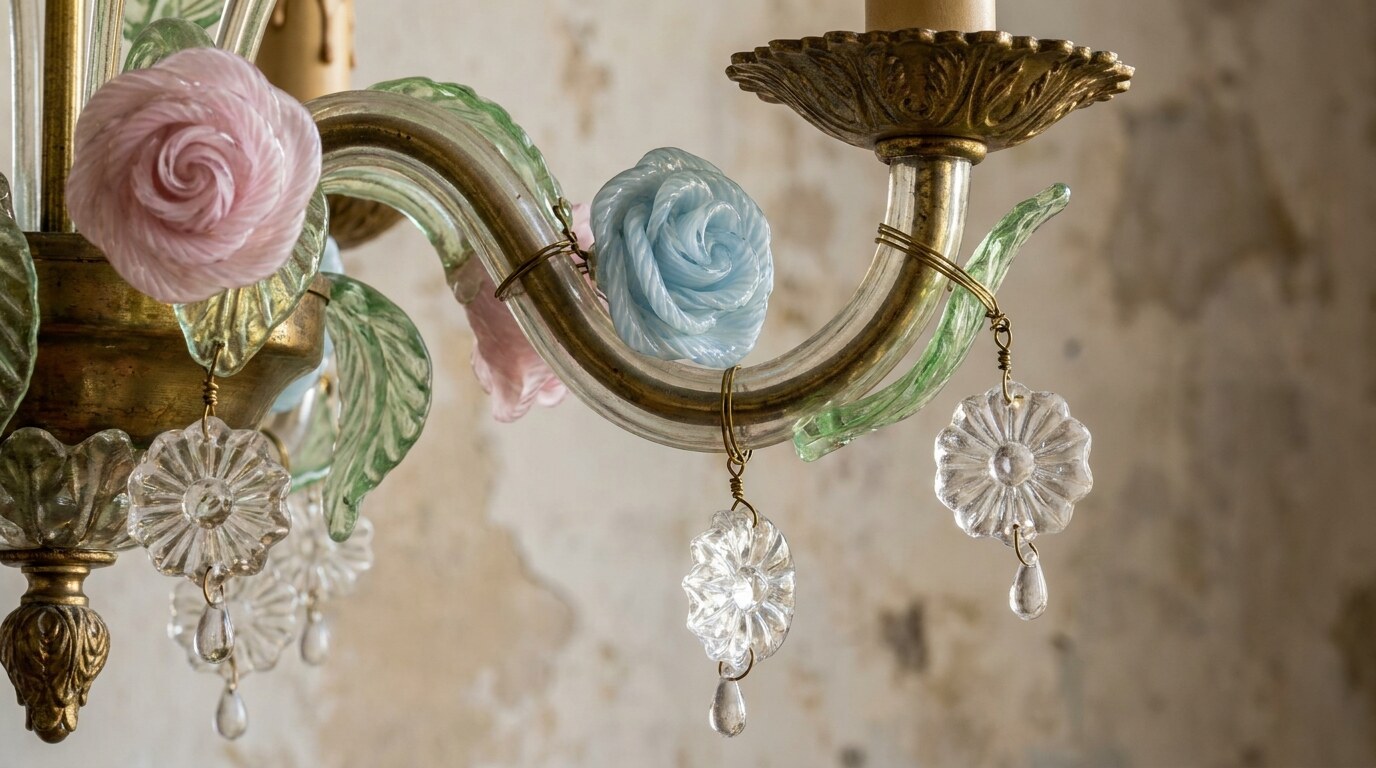
Murano makers' marks fall into two categories. Engraved or acid-etched marks on glass appear on Venini (typically a three-line acid mark "VENINI · MURANO · MADE IN ITALY"), Barovier & Toso (signed in script), and Salviati (signature varies by period). Foil paper labels (rectangular adhesive labels stuck to a non-visible surface) are common on Liberty- and Modernist-period pieces; many have been lost during cleaning, complicating attribution. Unsigned pieces require attribution from form, colour, and provenance documentation: a sale-room catalogue, dealer invoice, or installation photograph from a documented residence raises confidence and price.
Restoration thresholds for antique fixtures
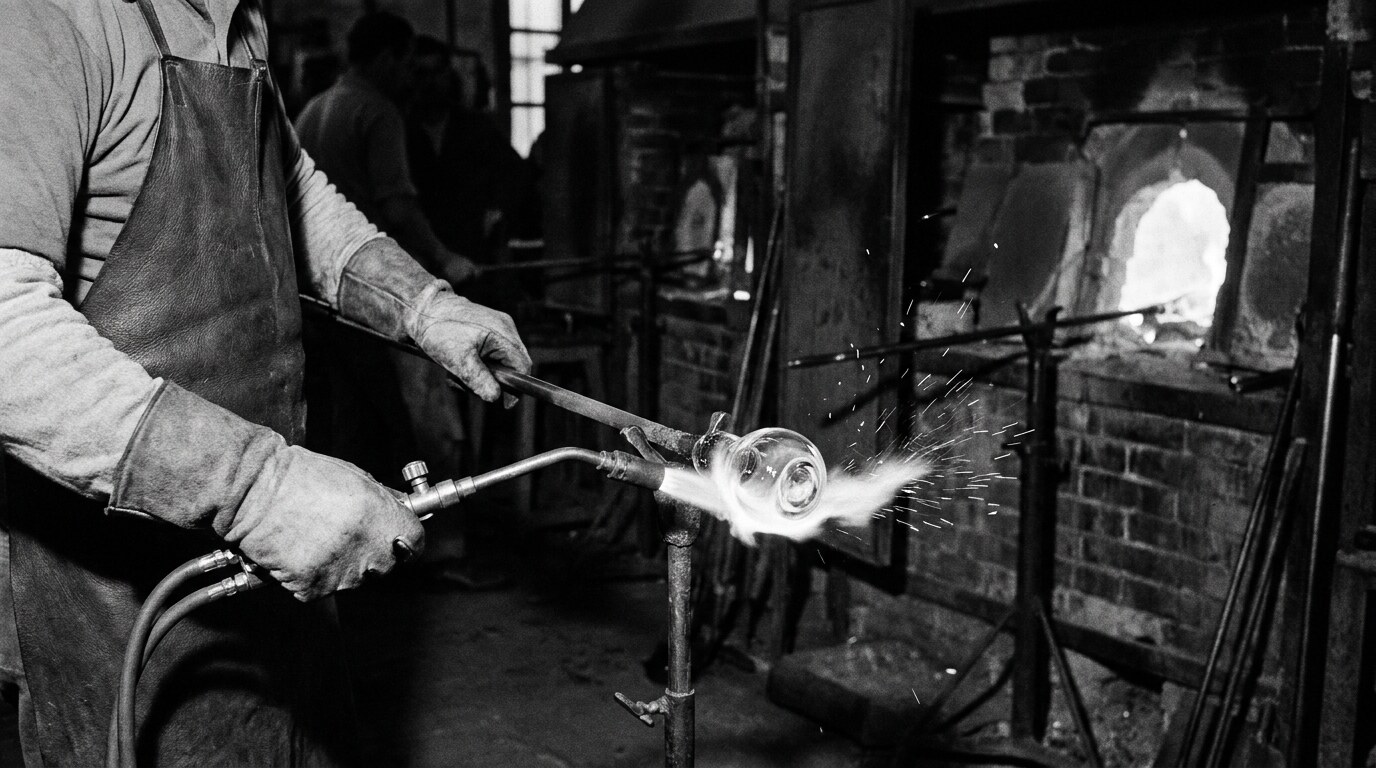
Three condition thresholds determine restoration economics. Below 5% replaced elements, an antique ciocca retains full collector value with minor sympathetic repair. Between 5% and 20% replacements, value drops 20 to 40% but the piece remains marketable as restored period. Above 20%, value drops 60 to 80% and pieces enter the decorative trade rather than the collector market. Replacement glass elements are sourced from the original maker (where the maker is still in production), from specialist Murano restoration glassblowers (Vetreria Restauri Murano, founded 1968), or from period-correct stock held by London restoration firms (Wilkinson plc).
Wiring, weight, and rigging considerations
Three engineering questions apply to installing antique Murano chandeliers in modern residences. Weight loading: a 24-arm ciocca may weigh 60 to 95 kg with chain; modern UK and US ceiling specifications require structural anchorage to a joist or to a load-rated steel hanger plate, never to drywall plug-and-screw assemblies. Wiring: original 18th- and 19th-century Murano chandeliers were oil- or candle-lit; converted pieces require modern flexible cable threaded through hollow blown-glass arms, typically by a specialist who does not stress original glass. Bulb wattage: Murano arms were not engineered to dissipate the heat of incandescent bulbs above approximately 25 W; LED retrofits below 4 W per arm are now standard for restored pieces.
Buying in 2026
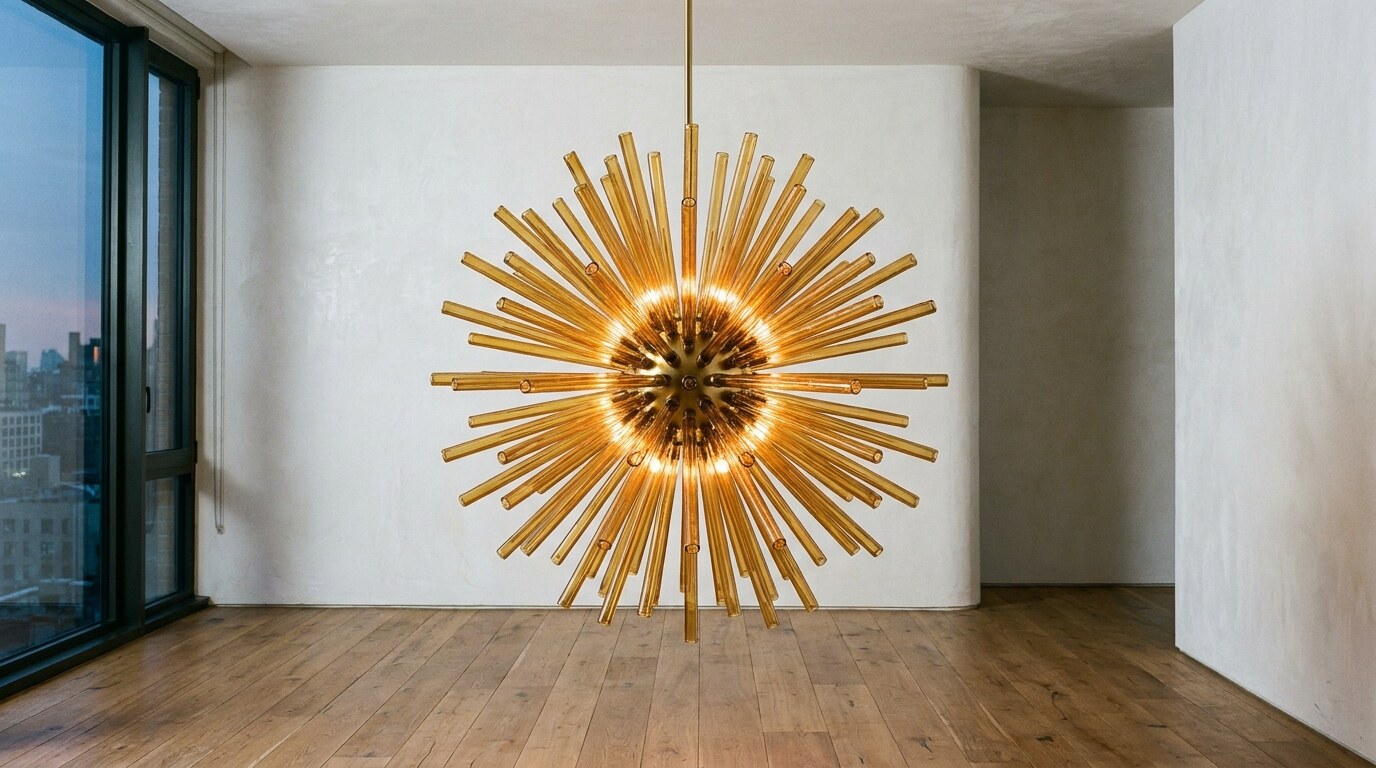
Antique unrestored Murano chandeliers from 1880 to 1920 sold at Sotheby's Milan and Wannenes 2024 to 2025 at median €4,800 to €18,000 per piece, with exceptional Liberty-period pieces signed Salviati clearing at €30,000 to €70,000. Direct purchase from Murano makers (Salviati, Venini, Barovier & Toso) supplies new commissions at €18,000 to €120,000 for full ciocche at typical 12 to 24 arm count. Vintage pieces from the modernist period (1925–1965) by Carlo Scarpa for Venini, by Angelo Mangiarotti for Vistosi, and by Tobia Scarpa for Venini have moved into the design-collector market and trade through 20th-century design specialists (Wright, Phillips Design Auctions).
The forward research question for this journal is the documented installation history of ciocche chandeliers in Venetian palazzi during the 1730–1790 period, of which surviving 18th-century inventories at the Archivio di Stato di Venezia list approximately 220 named installations but only 40 of them have been firmly identified with surviving fixtures.
References and further reading
- Museo del Vetro, Murano.
- Salviati, Murano.
- Venini, Murano.
- Barovier & Toso, Murano.
- Wannenes, Genoa.