
Marble for Classical Interiors: Carrara, Calacatta, Statuario, Negro Marquina Compared
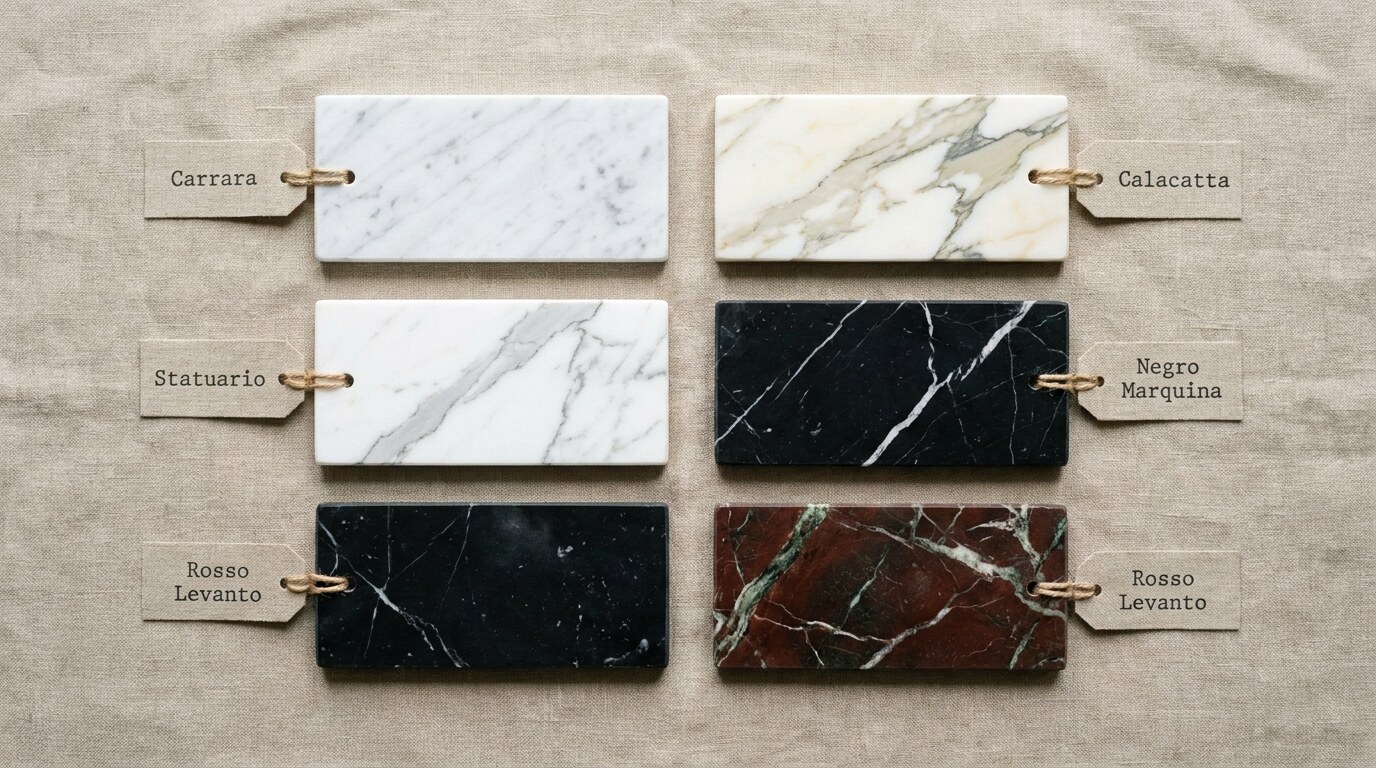
Four marbles dominate classical interior specification in 2026: Carrara (Tuscany, soft grey-white, €120 to €220 per square metre slab), Calacatta (Tuscan Apuan Alps, bold gold and grey veining, €600 to €1,800), Statuario (Tuscan Apuan, white with sharp grey veining, €700 to €2,400), and Negro Marquina (Markina-Xemein, Basque Country, deep black with white calcite veining, €180 to €420). Each is suited to specific applications based on hardness, porosity, vein behaviour, and finishing tolerance.
Geology and quarry geography
The four named marbles originate from two geological provinces. Carrara, Calacatta, and Statuario all come from the Apuan Alps in north-west Tuscany, an area of approximately 35 km by 18 km centred on the towns of Carrara, Massa, and Pietrasanta, where active marble extraction has been documented continuously since the Roman period (33 BCE under Augustus). Negro Marquina is quarried at Markina-Xemein in Bizkaia (Vizcaya), Basque Country, Spain, with the principal active concession held by Mármoles Visemar.
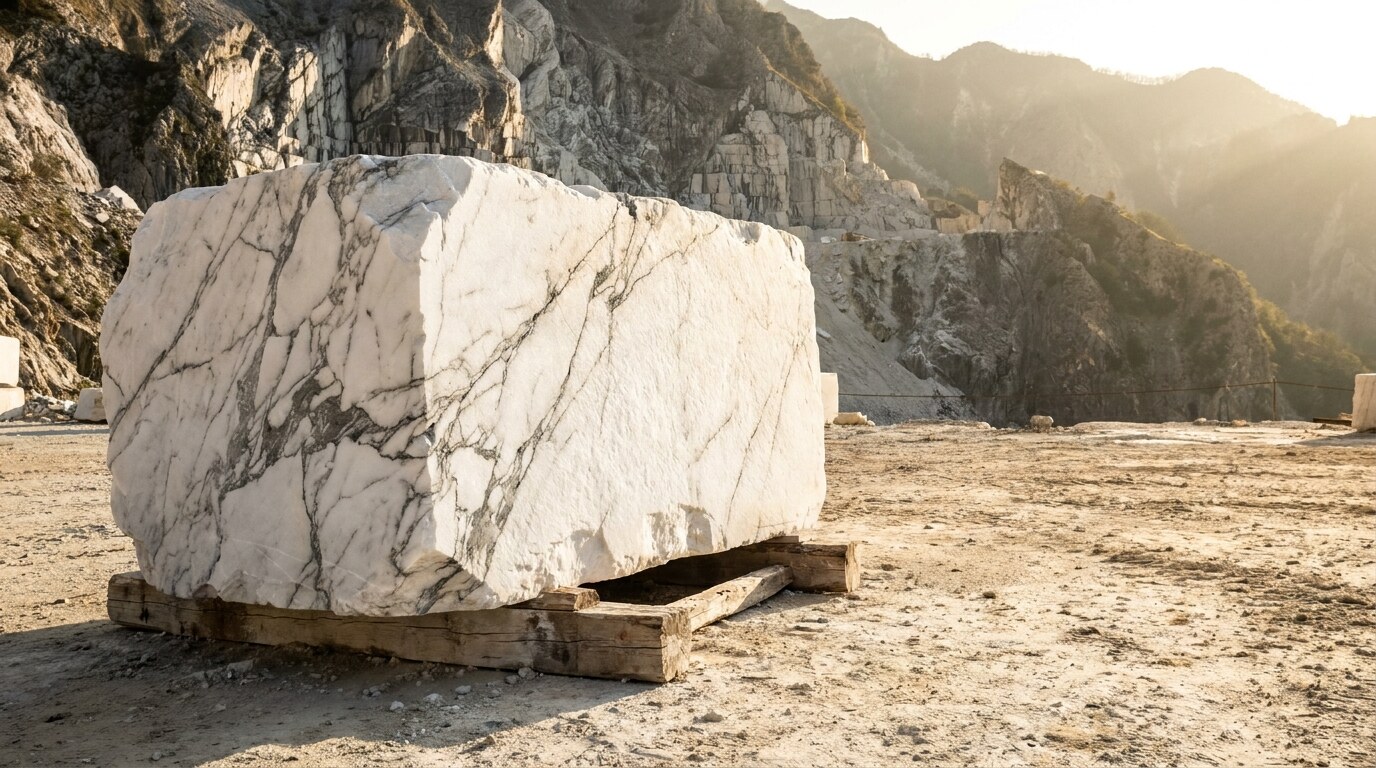
The three white Apuan marbles differ in geological micro-stratigraphy. Carrara comes from the most numerous quarries in the Apuan basin, with annual production exceeding 1.5 million tonnes; Calacatta is restricted to a small number of quarries (Calacatta Borghini, Calacatta Vagli, and Calacatta Oro are three named varieties from distinct quarries with distinct vein behaviours); Statuario is the rarest of the three, quarried in only two zones of the Apuan basin with annual production below 8,000 cubic metres.
Application matrix
| Marble | Chimneypiece | Floor | Vanity / splashback | Statuary block |
|---|---|---|---|---|
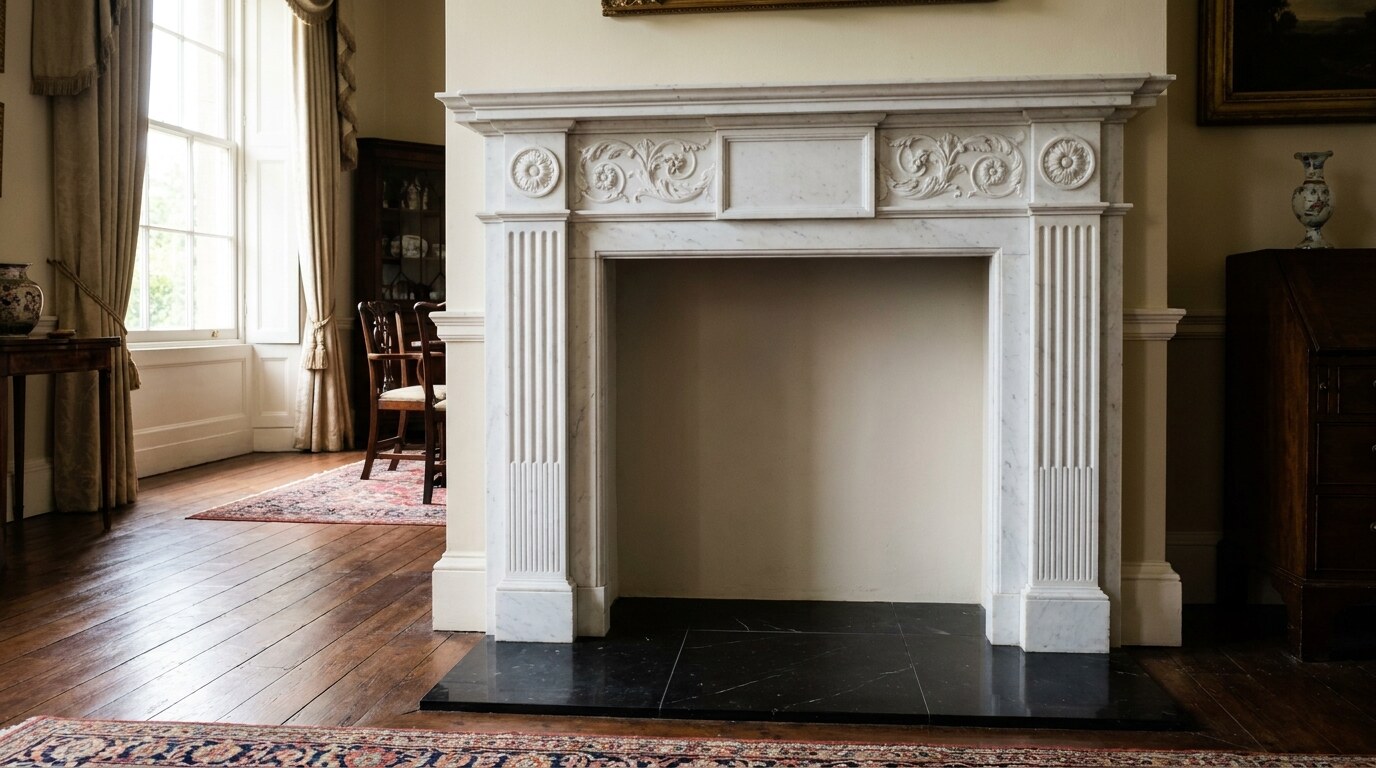
| Carrara | Standard | Recommended | Standard (with sealant) | Acceptable |
| Calacatta | Recommended (statement) | Acceptable in private rooms | Recommended | Avoid (high vein contrast) |
| Statuario | Recommended (statement) | Avoid (porous, high cost) | Recommended in dressing rooms | Recommended (Michelangelo specification) |
| Negro Marquina | Acceptable (monumental) | Recommended (durable) | Recommended | Avoid (does not carve cleanly) |
Finish and porosity
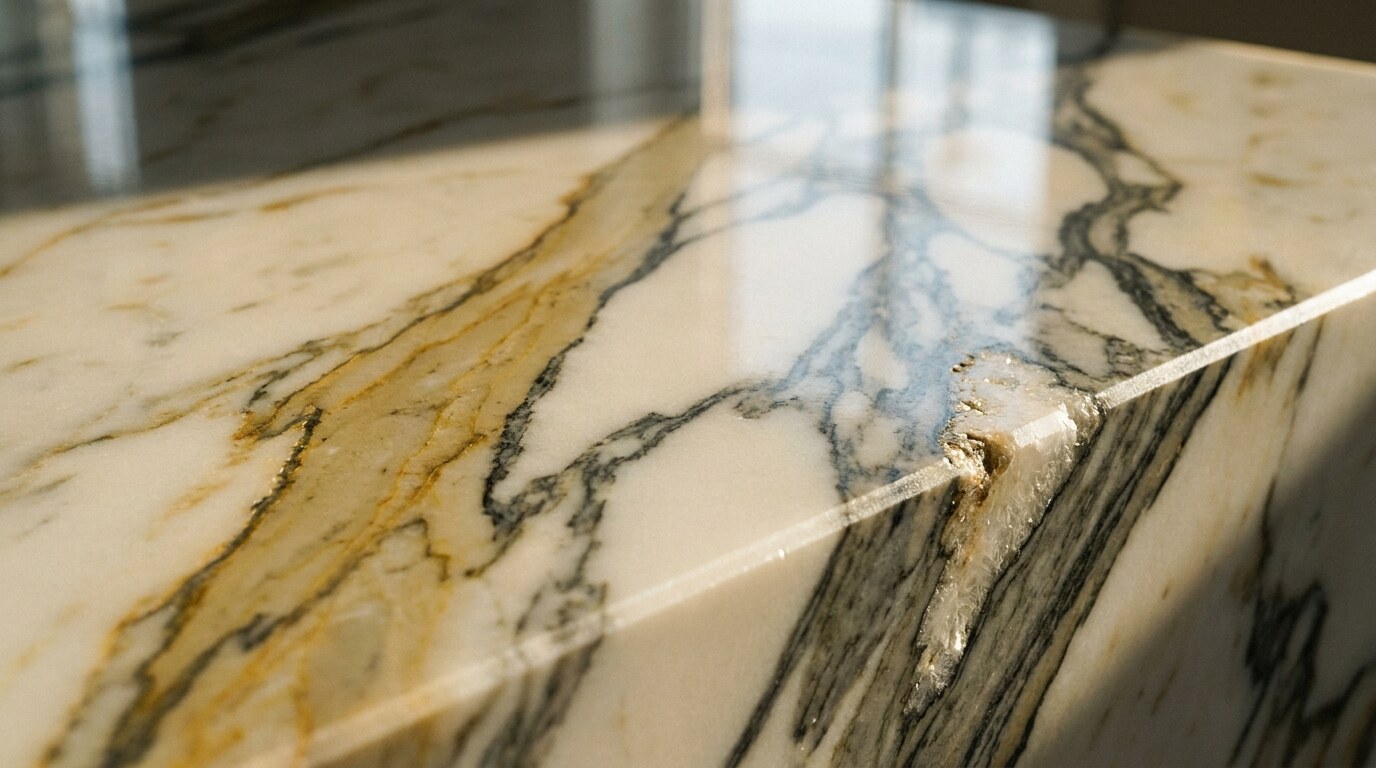
Five finish types are commonly specified: polished (mirror reflection, sealed surface), honed (matte even surface, more forgiving of stains), brushed (textured matte with revealed mineral grain), sandblasted (rough textured, exterior or wet-room flooring), and tumbled (rounded edges, antique appearance). Polished Carrara has a measured porosity of approximately 0.3% by volume; honed Carrara approximately 0.8% by volume; raw unfinished Carrara approximately 1.4%, which means honed and unfinished surfaces require sealing on installation and re-sealing every 18 to 30 months in domestic use. Negro Marquina's calcite veining is harder than its surrounding matrix, so polishing produces a slightly raised vein profile that gives the surface its characteristic visual relief.
Sealants and maintenance
Modern marble sealants fall into three classes. Solvent-based silicone-impregnating sealers (Tenax Hydrex, Akemi Stone Impregnator) penetrate the stone and resist water-borne and oil-borne staining for 18 to 36 months between recoats. Water-based fluoropolymer sealers (Stain-Proof Plus, MB-4) provide similar protection at lower VOC emissions and shorter dry times. Topical surface sealers (acrylic-based) are not recommended on classical interior marble because they yellow within 5 to 8 years and require chemical stripping for re-finishing. Etching from acidic spills (red wine, citrus, vinegar) cannot be prevented by any sealant, only minimised; etched polished surfaces require re-honing followed by re-polishing.
Sourcing in 2026
Bulk slab sourcing is concentrated in a small number of named processors. Antolini Luigi (founded 1958, headquartered Sega di Cavaion, Verona) holds the largest single global inventory of selected blocks, with stock catalogued slab-by-slab and viewable at the company's 30,000 m² showroom; Pisani Stones (founded 1947, Carrara) and Marmi Bruno Zanet (founded 1962, Verona) are the two principal Italian alternatives by inventory volume. For Spanish black marble, Cosentino (Cantoria, Almería, founded 1979) supplies through its Sensa stone collection. Specifying a project at slab-level (book-matching specific veins across a chimneypiece breast and pier face) requires inspection at the processor's yard before final cutting; major projects send a representative for slab tagging in person.
Three reference projects to study
Three accessible reference projects show the four marbles applied at high specification standard. The Met Fifth Avenue Petrie European Sculpture Court uses Carrara extensively in its 1990s renovation. The Borghese Gallery in Rome (Galleria Borghese, Villa Borghese) presents Statuario in 17th-century Bernini and Canova sculpture installed in original Carrara and Calacatta floors and frames. The Solomon R. Guggenheim Museum, while modernist, demonstrates Negro Marquina applied as floor in its restored Wright-original ramp baseboard. Each project's stone specification is documented in the institution's published technical record.
The forward research question for this journal is the unbroken provenance chain of Statuario quarried for the Vatican between 1450 and 1565 (a period including the Sistine Chapel and the late Michelangelo commissions), of which the contracting records of the Apuan quarry concessions remain incompletely transcribed.
References and further reading
- Antolini Luigi (slab catalogue and quarry pages).
- Cosentino (Spanish stone, including Negro Marquina).
- Marmomac, Verona (annual stone trade fair).
- The Met, Petrie European Sculpture Court.
- Galleria Borghese, Rome.
- ICOMOS (heritage stone conservation).