
Library Design: Built-Ins, Ladder Rails, Lighting, Acoustics
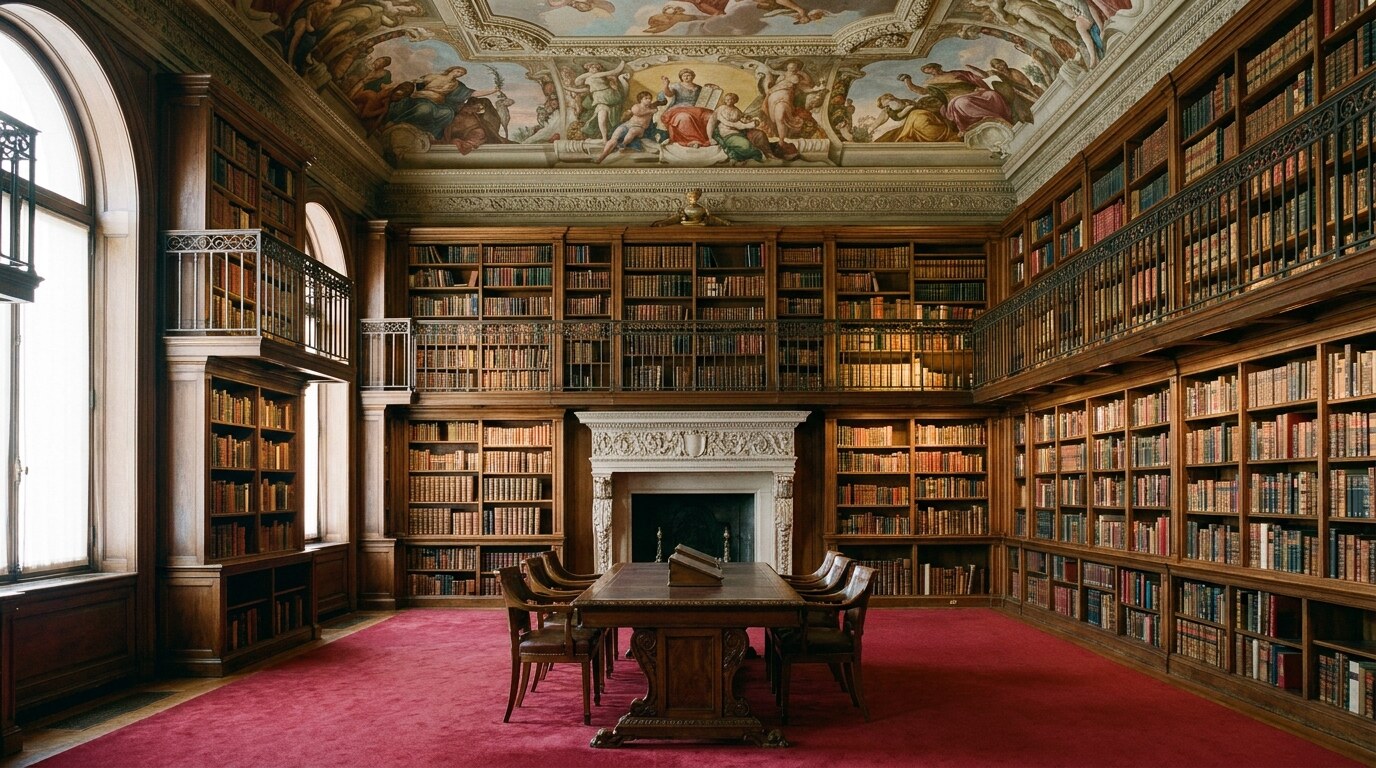
A classical library is a room type defined by four functional layers: full-height fitted bookcases with a continuous cornice; a moveable or fixed ladder rail at the top edge; dedicated reading lighting (typically a combination of central pendant, picture lights, and reading lamps at 250 lux task level); and acoustic dampening through carpet, curtains, and book mass. British and American canonical examples include the Robert Adam library at Kenwood House (1767–1769), Sir John Soane's library at Lincoln's Inn Fields (1808–1812), and the J.P. Morgan Library by Charles McKim (1902–1906).
Four functional layers in detail
The four layers operate independently and must be designed together. (1) Full-height fitted bookcases unify three walls or four walls of a room into a single composition with a continuous cornice; partial-height bookcases (waist-high cabinetry, freestanding bookcase) read as furniture rather than architecture. (2) A ladder rail (top-mounted brass T-rail or horizontal pole) supports a moveable rolling ladder for accessing the highest shelves. (3) Dedicated reading lighting provides task-level illumination at the reader's seated position; ambient room lighting alone is insufficient for sustained reading. (4) Acoustic dampening is essential because rooms lined with hard reflective bookcases otherwise reverberate excessively.
Bookcase joinery
Three bookcase joinery decisions determine the visible character of a library. Standard fitted-bookcase shelf depth for octavo and quarto books is 250 mm clear; folio shelves require 350 mm; a typical specification mixes both depths within one bookcase, with the lower folio shelves extending the bookcase carcass forward and the upper octavo shelves recessed within the run. Adjustable shelves on patented bronze pin clips (the McKim, Mead & White specification at the Morgan Library) allow flexibility; fixed shelves at standard heights produce a more architectural composition. Glazed door fronts protect the books from dust and limit handling but reduce easy access; library tradition divides between glazed (formal, museum-quality) and open (working library) approaches.
Ladder rail systems
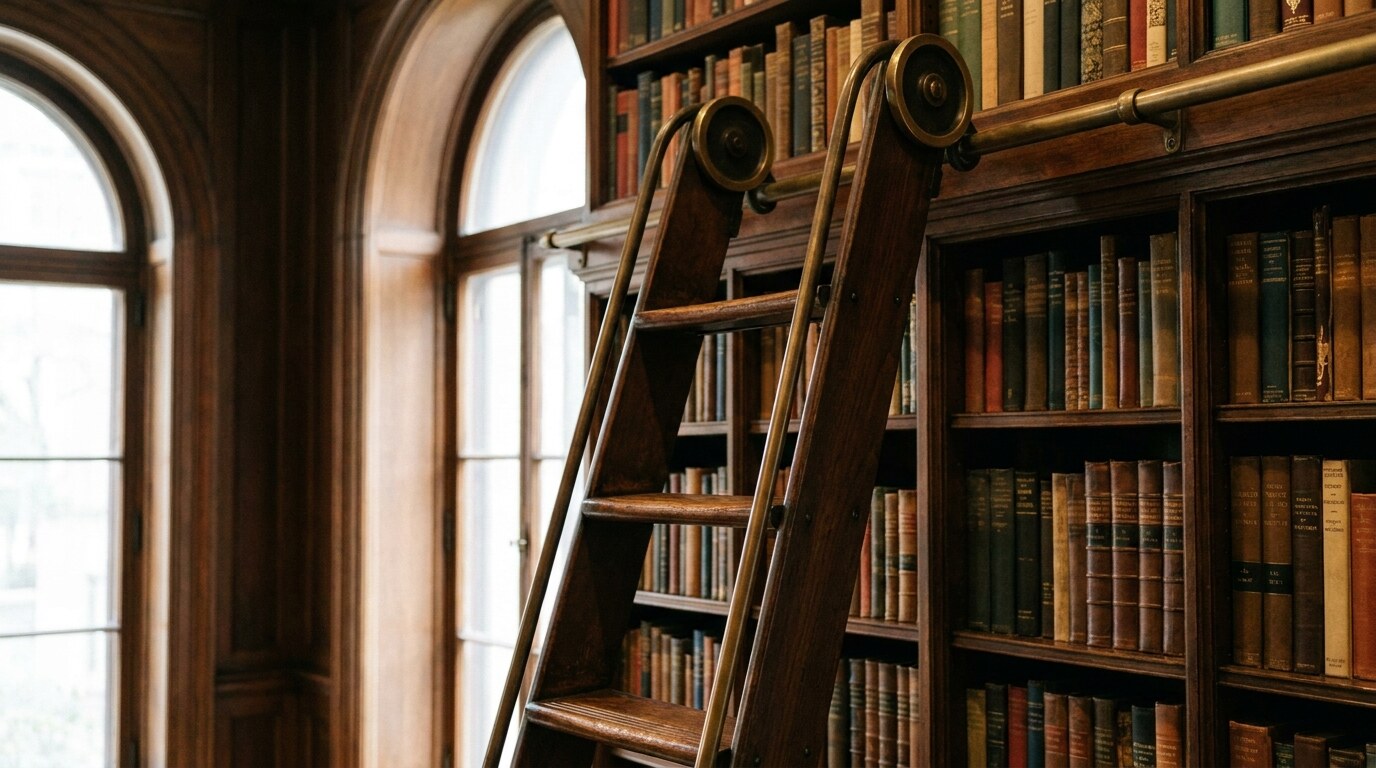
Putnam Rolling Ladder Company, founded 1905 at 32 Howard Street, New York, supplied rolling-library ladders for the J.P. Morgan Library installation by McKim, Mead & White in 1906 and continues in production from the same Manhattan workshop. Two systems exist: top-rail rolling ladders (brass or steel T-rail mounted at the top of the bookcase, ladder rolls horizontally and tilts down for use), and floor-rail systems (lower runners only, requires base shelf clearance). Whitechapel Ltd (London) and Olavi Hänninen (Helsinki) supply European-market alternatives at higher craft level; Whitechapel's "Edwardian Library Ladder" is a documented British staple at trade specifications.
Lighting at 250 lux task level
Three light layers serve the reading library. A central pendant (chandelier or single fixture) provides ambient illumination at approximately 100 lux floor level; this layer alone is insufficient for sustained reading. Picture lights or short-arm wall lights illuminate the bookcase fronts at 60 to 90 lux, allowing book-spine reading at distance and providing ornamental punctuation. Reading lamps (table or floor) provide task-level 250 lux at the seated reader's book; this is the layer that allows actual reading. Modern LED specifications match these targets at low energy (3,000 K colour temperature, CRI 90+ recommended).
Acoustics in book-lined rooms
Typical reverberation time in a book-lined room of 30 to 80 m³ floor volume runs 0.6 to 0.9 seconds at 500 Hz, which is acceptable for conversation and quiet reading; without books or with empty bookcases the same room reverberates 1.4 to 1.8 seconds, producing the harsh echo characteristic of empty study rooms. Books absorb sound at all frequencies; a fully shelved bookcase functions equivalently to acoustic dampening panels. Carpet (Persian or Aubusson at 8 to 14 mm pile) further dampens the floor reflection. Curtain treatment (especially heavy interlined curtains over single sash windows) absorbs additional reflective energy.
Three case studies with measured drawings
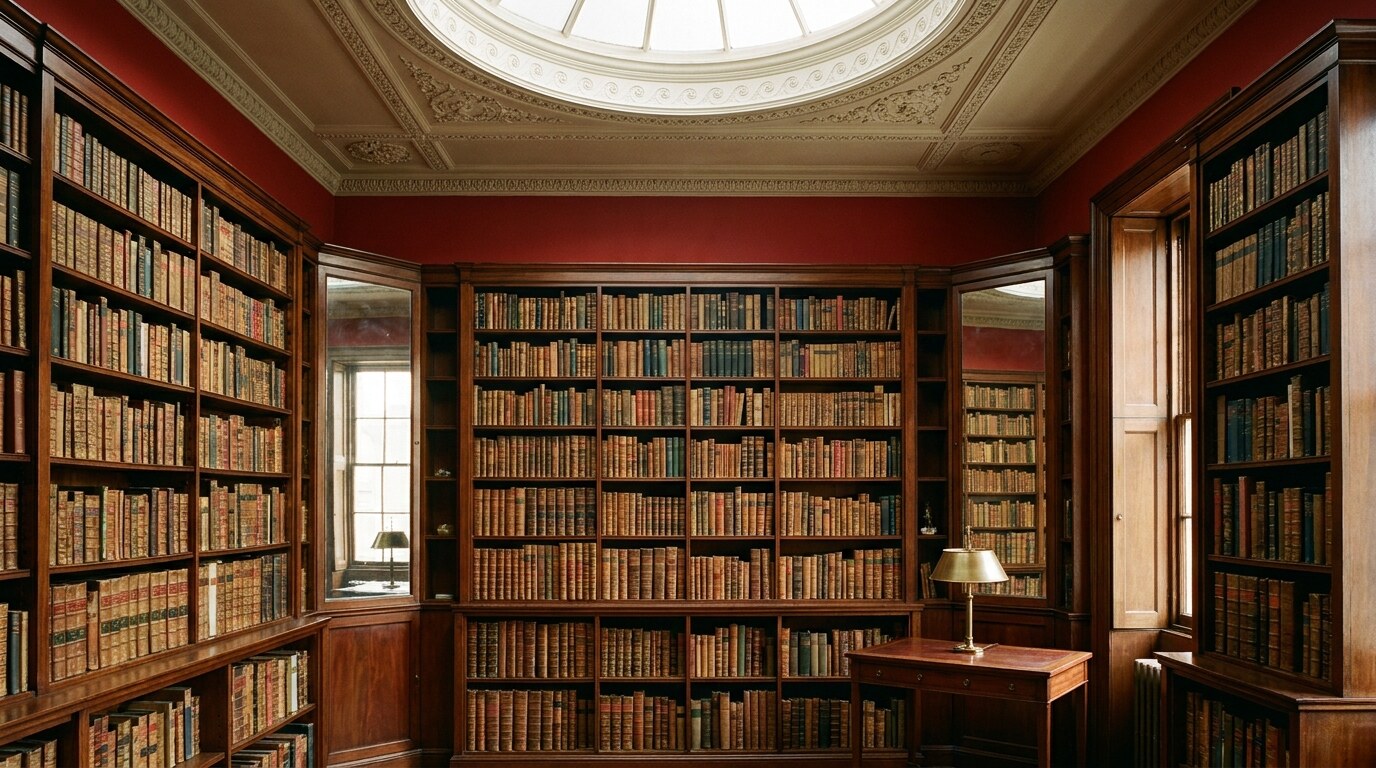
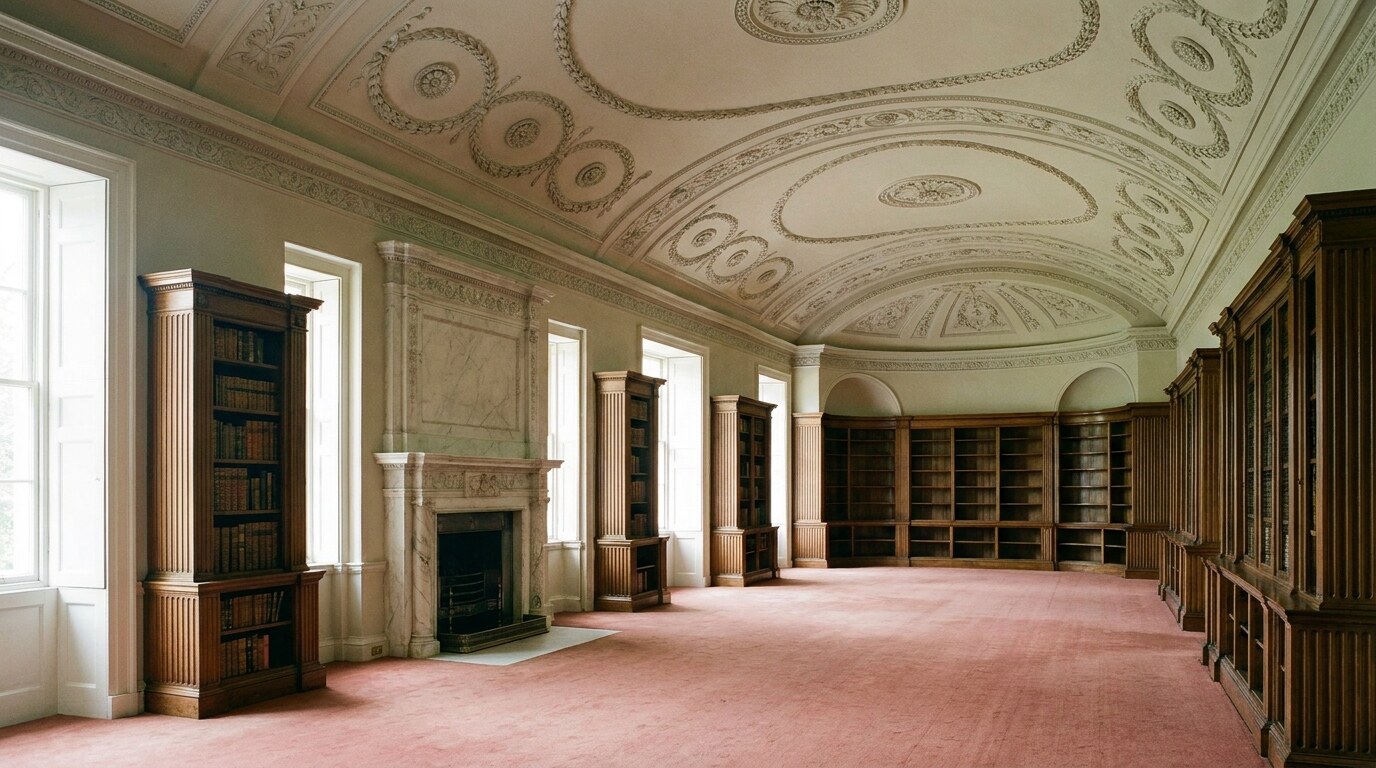
Three accessible classical libraries allow first-hand study. The Adam Library at Kenwood House (1767–1769) measures 60 ft by 22 ft with apsidal book-recesses at either end, and remains the canonical British neoclassical library; English Heritage holds measured drawings in its Swindon archive. The Library at Sir John Soane's Museum (1808–1812) is a smaller-scale (8 m × 6 m) more idiosyncratic interpretation with mirror reveals and skylit overhead. The Morgan Library & Museum East Room, completed 1906 to McKim, Mead & White's design, retains its original triple-tier bookcase system in walnut and bronze with adjustable shelves on patented bronze pin clips, and is publicly accessible Tuesday to Sunday.
The forward research question for this journal is the surviving 17th-century private library interiors in British and Italian houses, of which approximately 12 are partially documented but a comprehensive survey across the period 1600–1700 remains incomplete.