
Curtain Construction for Classical Rooms: Pleating, Trims, Headings, Lining
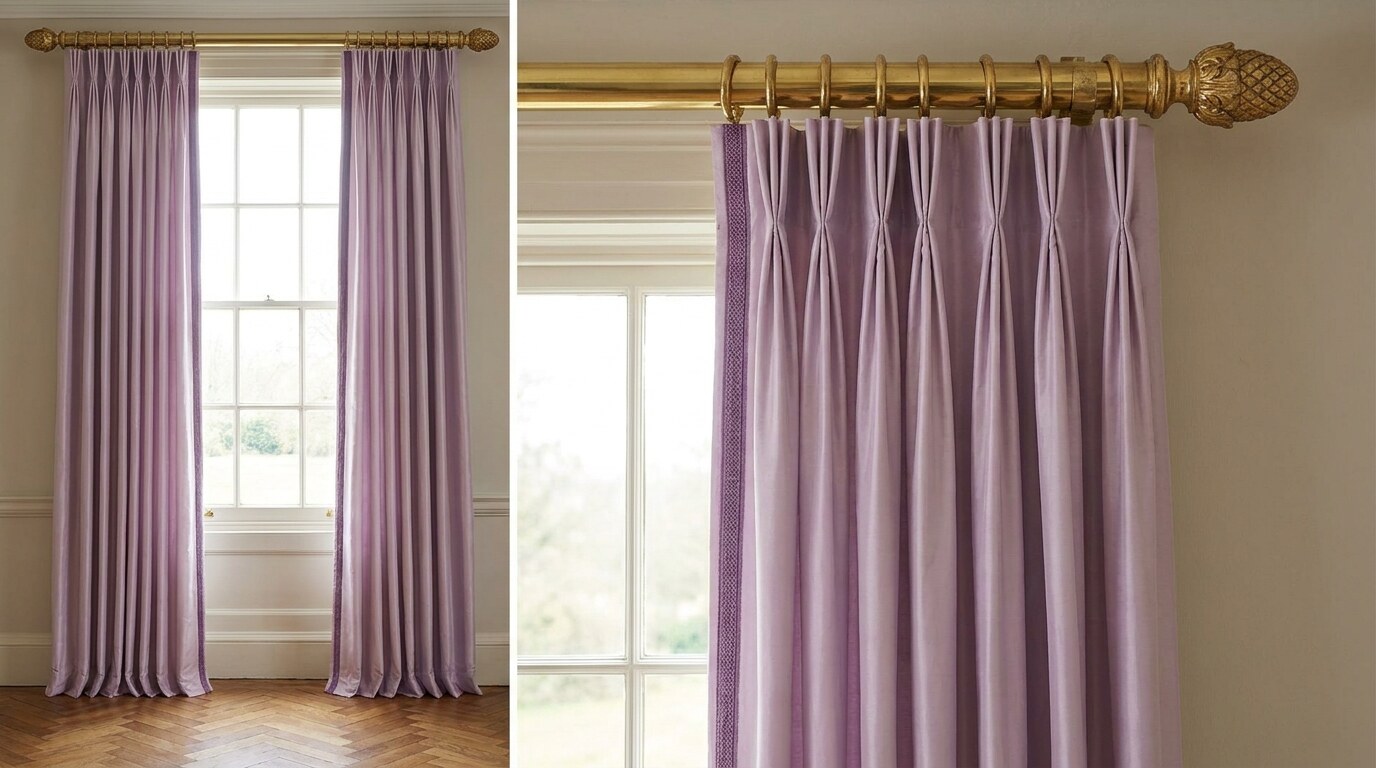
Classical-room curtain construction follows a tightly defined trade specification: a face fabric (silk taffeta, silk damask, or wool merino), an interlining of cotton bump (220–340 g/m²), a cotton sateen lining, hand-pinch French pleat or goblet pleat headings on a hand-stitched buckram, a passementerie trim or contrast leading edge, and pole or pelmet hardware sized to the architrave. London workrooms make full pairs at £2,500 to £6,000 per pair excluding fabric and hardware as of 2026.
The five layers of a classical curtain
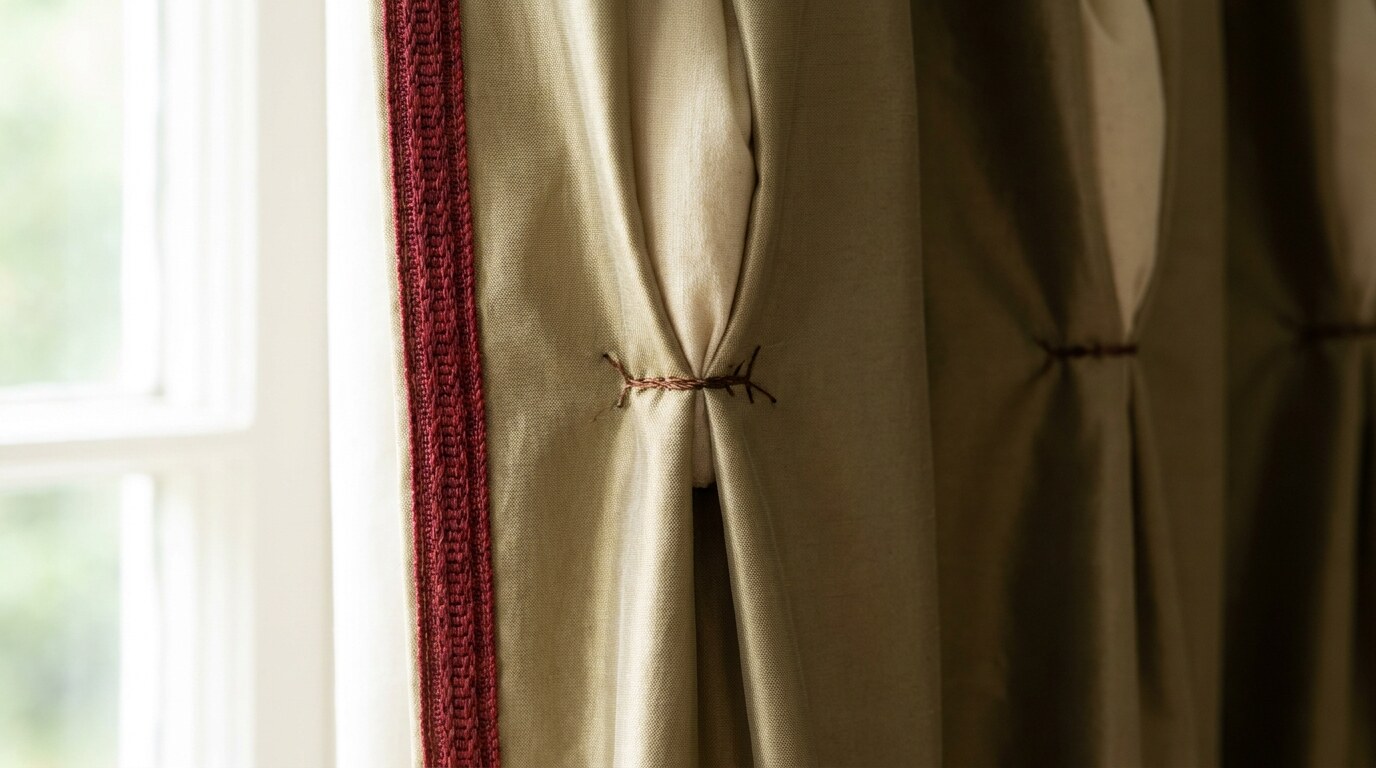
A correctly constructed classical curtain has five distinct layers, each with a specified function. The face fabric provides the visible surface and pattern; weights typically range 90 to 280 g/m² depending on fibre. Cotton bump interlining is specified at 220 g/m² for silks and 340 g/m² for heavier wools, hand-stitched along all four edges to the lining before the face fabric is attached, and provides the body that allows pleats to hold their shape and curtains to drape in soft column folds rather than collapsing into thin folds. Cotton sateen lining (typically 180 g/m², 100% cotton) faces the room and protects the face fabric; it is hand-stitched to the bump along three edges with a free hem-fall. Silk-thread hand-stitching joins the layers with a slip-stitch every 6 to 10 cm; machine top-stitching is the visible signature of a budget make-up.
Pleat heading types defined
| Heading | Construction | Best for |
|---|---|---|
| French pleat (triple) | Three pleats hand-stitched at the heading; spans 8 to 14 cm | Standard drawing rooms, libraries |
| Goblet pleat | Single tubular pleat stuffed with bump; spans 6 to 8 cm | Formal drawing rooms, dining rooms |
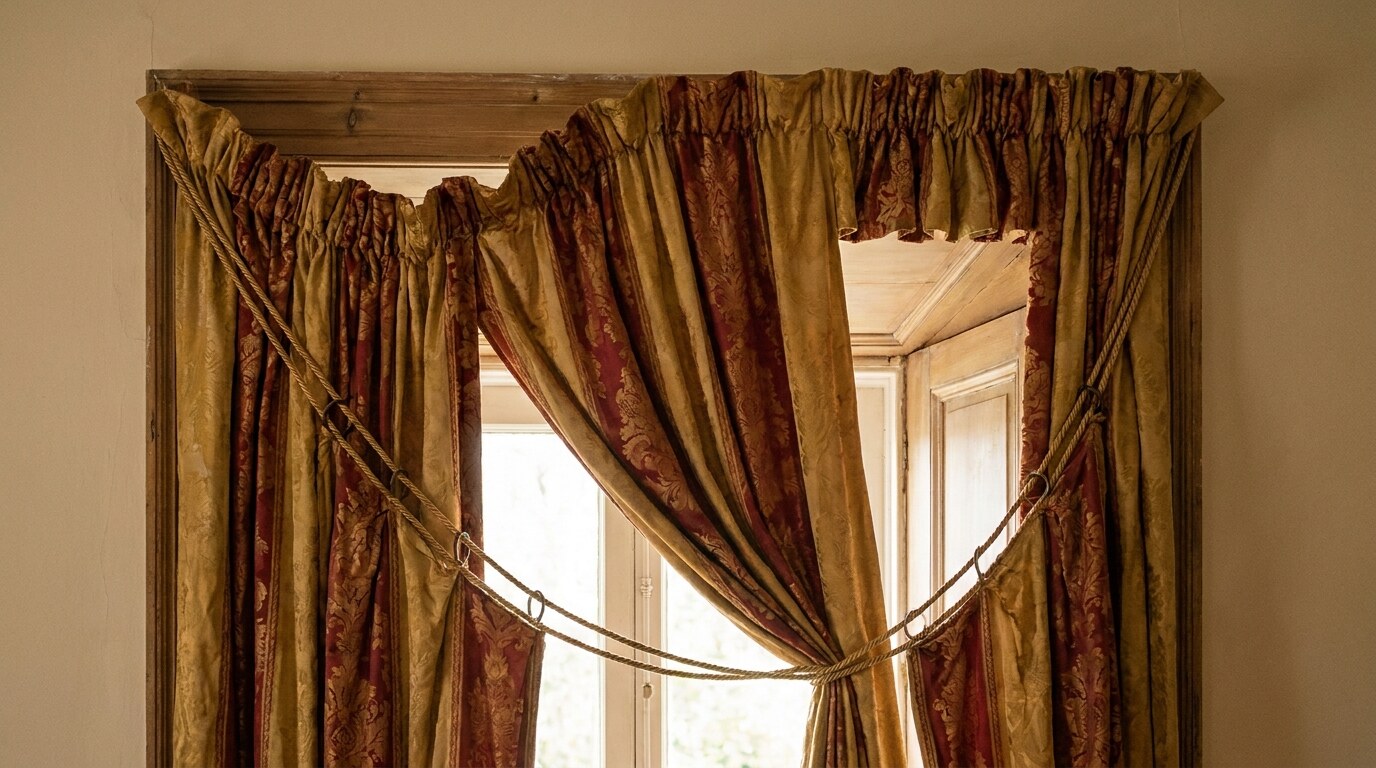
| Italian-strung | Cords run diagonally through heading rings to draw curtains in arc | State drawing rooms with pelmets |
| Smocked | Cross-stitched diamond heading 60 to 90 mm tall | Bedrooms, intimate sitting rooms |
| Box pleat | Flat pleats of 8 to 10 cm; tailored military silhouette | Studies, masculine schemes |
Pelmet and lambrequin specification
A pelmet (cornice) is a fabric-covered or timber-and-fabric-covered horizontal cornice mounted above the curtain pole, typically 15 to 25 cm tall, used to conceal the pole hardware and to add architectural weight to the window. Lambrequins are full pelmet boards with shaped lower edges (scalloped, scrolled, or stepped) extending 60 to 110 cm tall and often returning down the window architrave. Both forms require a timber substrate (12 mm birch plywood is the modern specification, replacing the historic wadding-on-buckram method that loses shape over 25 to 40 years), upholstered in matching or contrasting fabric over interlining, finished with hand-applied trim along all visible edges.
Trim selection
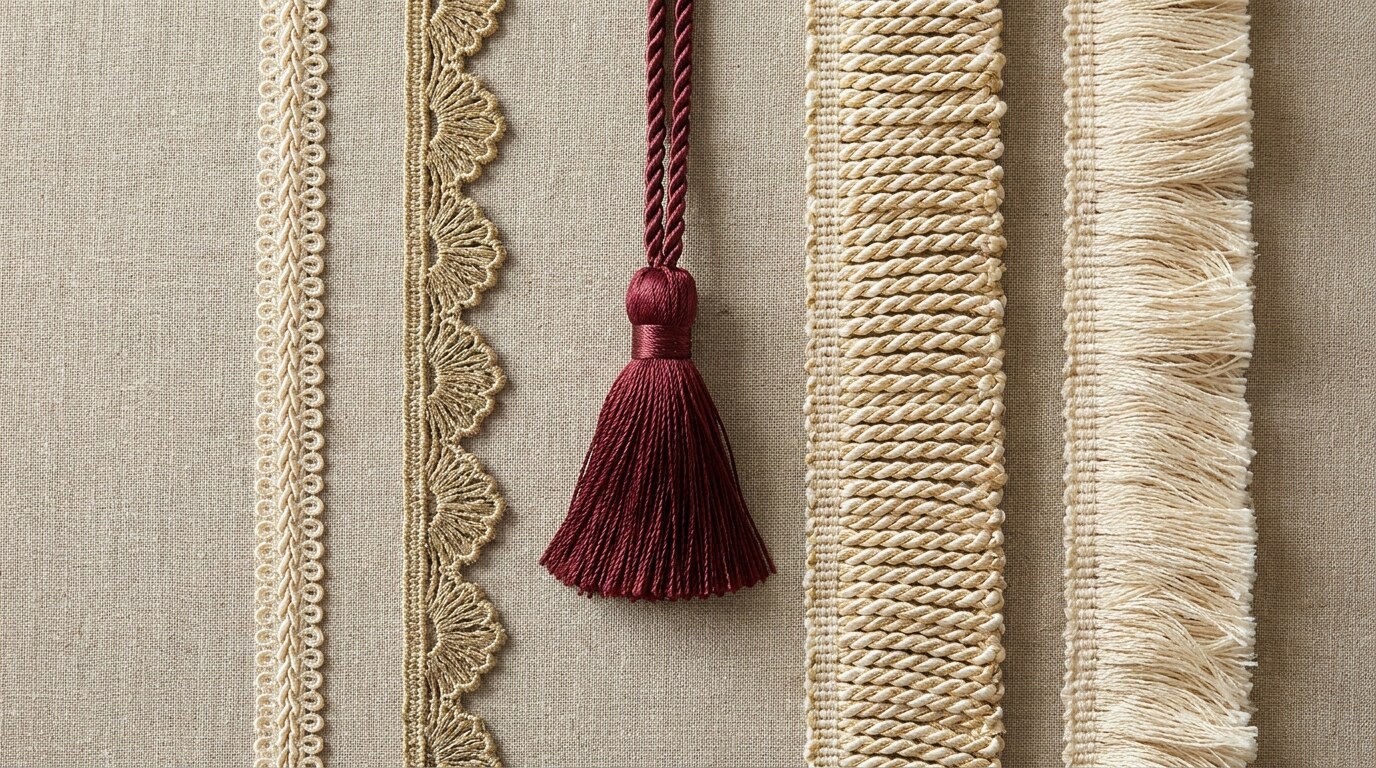
Five trim types recur on classical curtains: silk gimp (a flat narrow braid 6 to 14 mm wide, used as edge piping), fan-edge (a fan-shaped edging trim of dyed silk thread), key tassel (decorative tied tassel at corners or tieback), bullion fringe (twisted-cord fringe 60 to 120 mm long for valances and pelmet bottoms), and brush fringe (cut-pile fringe at 25 to 50 mm length). Heritage suppliers include Declercq Passementiers (Paris, founded 1852), Houlès (Paris, founded 1928), and Wendy & Bruno (London) for restoration-grade work.
Pole vs track hardware
Classical schemes use either a visible decorative pole (typically 25 to 50 mm diameter polished brass, antique brass, or carved giltwood) or a concealed track behind a pelmet. Visible poles work in rooms where the pole forms part of the decorative composition; concealed track is correct where a pelmet or lambrequin covers the heading. Hardware suppliers in 2026 include Charles Edwards, Collier Webb, and Vaughan Designs in London for fully bespoke metalwork.
Working drawings and trade rates (London 2026)
A hand-stitched goblet-pleat heading on a 270 cm drop, 300 cm width pair takes a senior workroom approximately 32 hours to make. London workrooms quote full-make rates of £2,500 to £6,000 per pair excluding fabric, pole, and trim, as of 2026. Including fabric (silk damask at €600 per metre, approximately 12 metres for the pair) and trim (£25 per metre × 6 metres) and hardware (£800 to £1,800 for a 3-metre giltwood pole with finials), a finished pair installs at £6,500 to £13,000 typical scope.
Three commercial mistakes new specifiers make
Three recurring specification mistakes cost projects time and money. The first is omitting interlining to reduce price: the curtains lose shape within 12 to 18 months, fold lines become permanent, and the project requires re-make at higher cost than original full specification. The second is specifying poles at too small a diameter for the drop: a 270 cm drop visually requires a pole of 38 to 50 mm diameter to balance the silhouette; 25 mm poles look thin and floating. The third is specifying contrast leading edge in a fabric of a different weight than the face: weight mismatch produces uneven hang along the leading edge and shows as a wave at the floor break.
The forward research question for this journal is the surviving photographic documentation of pre-1939 silk-curtain installations in British country houses, of which approximately 800 photographs are catalogued in the Country Life archive but specific curtain-construction details remain incompletely transcribed.
References and further reading
- Declercq Passementiers, Paris.
- Houlès, Paris.
- Charles Edwards, London.
- V&A Museum, textile and trim collections.
- House & Garden, technical features.