
Toile de Jouy: Origin, Imagery, and 21st-Century Reissues
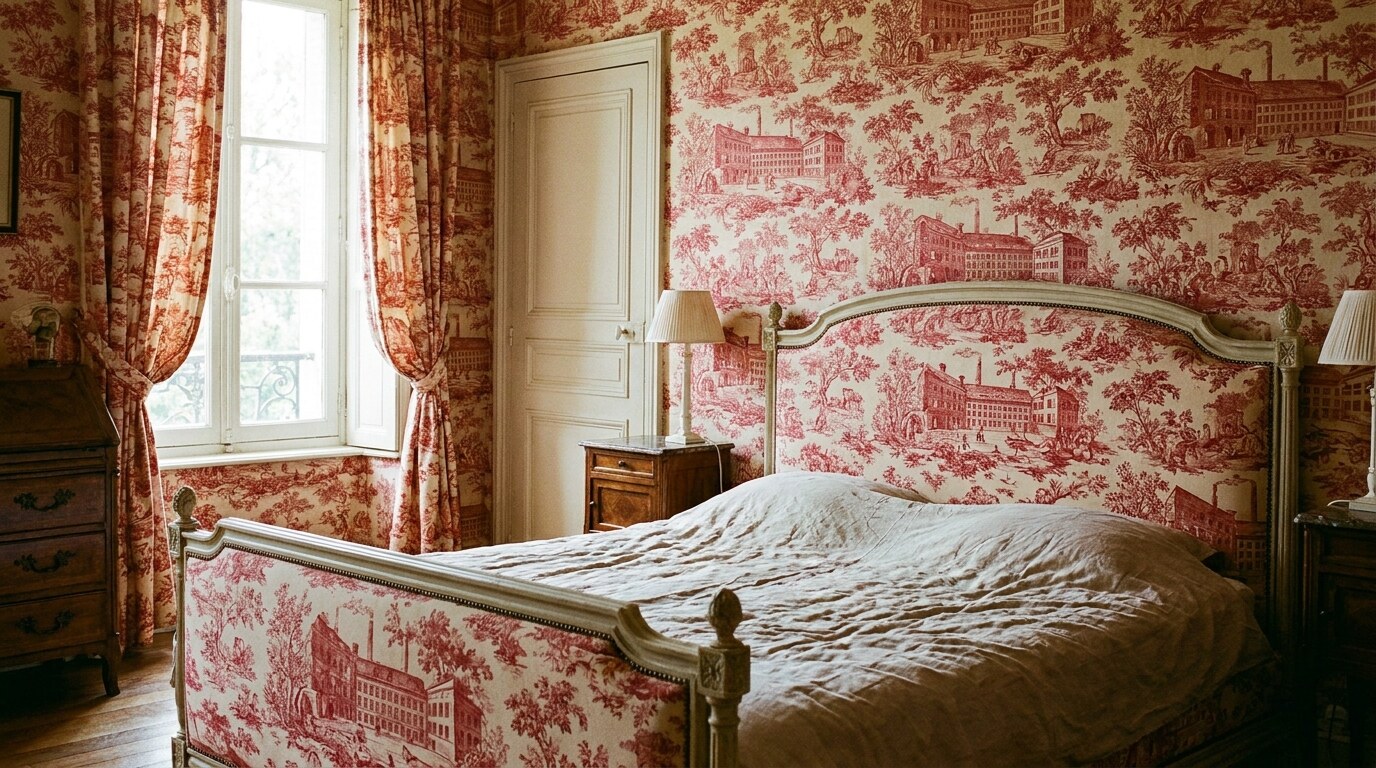
Toile de Jouy is the copperplate-printed cotton produced at the Oberkampf manufactory in Jouy-en-Josas, France, between 1760 and 1843. The fabric is characterised by single-colour pictorial scenes (typically red, blue, or sepia) on a cream or natural cotton ground, with surviving plates and a research collection at the Musée de la Toile de Jouy. Active producers in 2026 reissuing original Oberkampf designs include Pierre Frey (Paris, founded 1935) and Thibaut (New Jersey, founded 1886).
Christophe-Philippe Oberkampf and the Jouy-en-Josas factory 1760 to 1843
Christophe-Philippe Oberkampf (1738–1815) founded the Jouy-en-Josas manufactory in 1760 with capital from Étienne Demaraise; the factory was raised to royal manufactory status (manufacture royale) in 1783 and at its 1810 peak employed approximately 1,300 workers. Production continued under Oberkampf's son Émile-Justin Oberkampf and grandson after Christophe-Philippe's death in 1815, but the factory closed in 1843 after a long decline against competitive English production.
The copperplate vs roller-print distinction
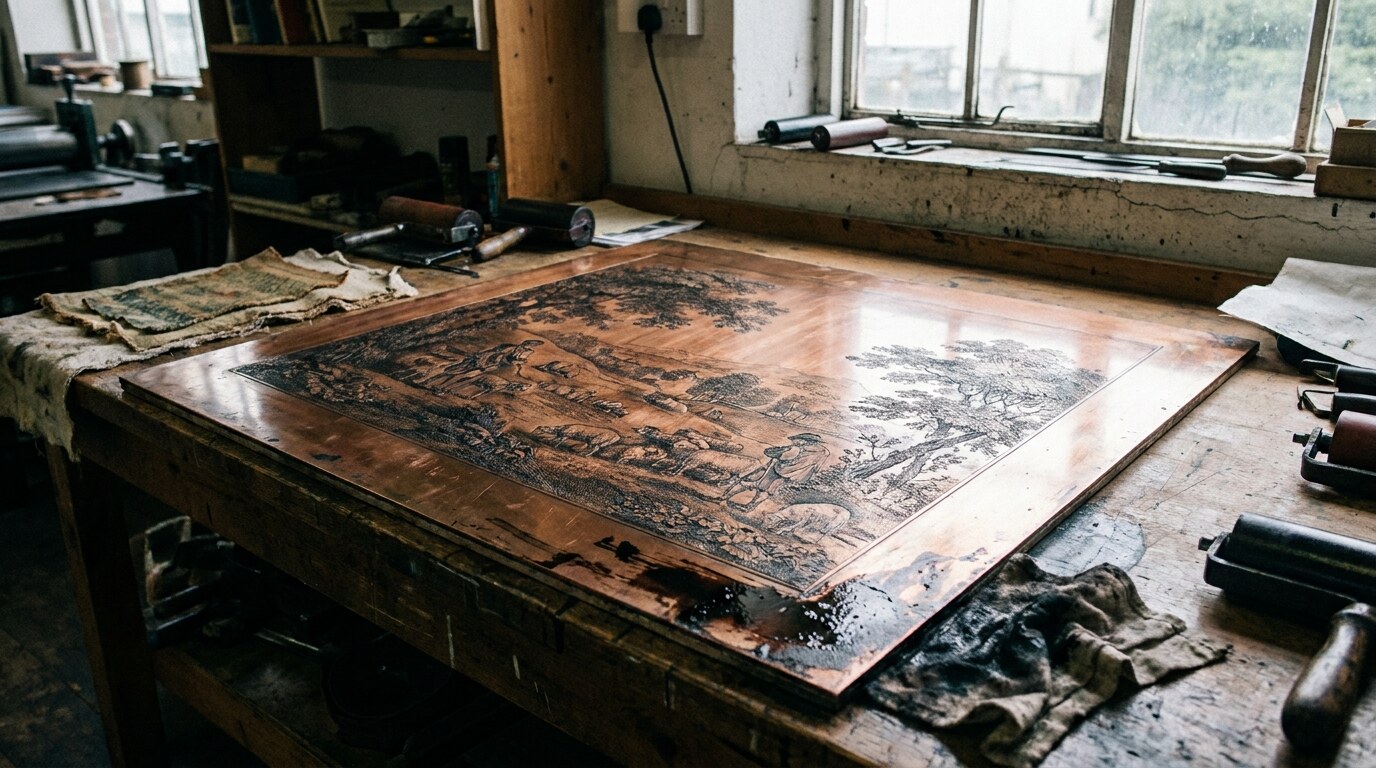
Toile de Jouy production used two successive techniques. Copperplate printing, the technique used for Oberkampf's 1760–1797 production, transferred ink from engraved copper plates to cotton in single panels of approximately 90 cm by 90 cm; copperplate-printed Toile shows fine engraved-line detail and unique panel-by-panel small variations. Roller printing, introduced at Jouy in 1797 and standard from approximately 1810, used continuous engraved cylinders to print bolt-length yardage; roller-printed Toile shows uniform pattern repeats and slightly less fine line detail. Authenticating period Toile by technique allows narrow-window dating: copperplate is 1760–1810, roller is 1810–1843 and after.
Iconography
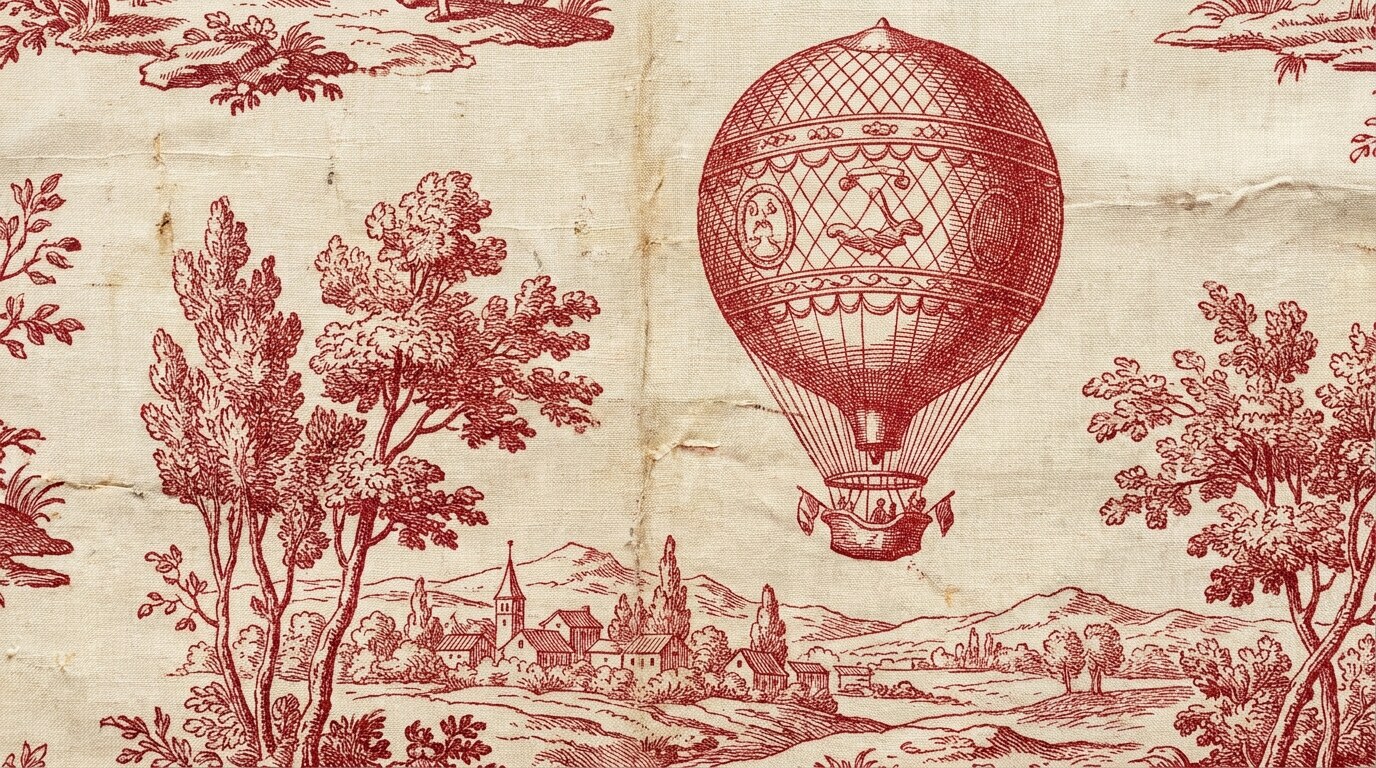
Five iconographic categories define the Oberkampf design programme. Pastoral scenes (shepherds and shepherdesses, after Boucher and Watteau) dominate the early production. Allegorical scenes (the Four Seasons, the Continents, the Ages of Man) provide the second category. Historical and current-events scenes ("La Liberté Américaine" 1783, "Le Ballon de Gonesse" 1784) document specific contemporary events. Exotic scenes (chinoiserie, "Indiennes") fold non-European motifs into Toile's vocabulary. Factory scenes (most famously Les Travaux de la Manufacture) self-reflexively depict the production process.
Five canonical patterns
| Pattern | Designer | Date | Subject |
|---|---|---|---|
| L'Hommage de l'Amérique à la France | Jean-Baptiste Huet | 1783 | French alliance with American colonies |
| Les Travaux de la Manufacture | Jean-Baptiste Huet | 1783–1785 | The Jouy factory itself |
| Le Ballon de Gonesse | Jean-Baptiste Huet | 1784 | Montgolfier brothers' first balloon |
| L'Offrande à l'Amour | Jean-Baptiste Huet | c. 1790 | Pastoral allegorical |
| Les Quatre Parties du Monde | Jean-Baptiste Huet | 1791 | Four continents allegorical |
The Musée de la Toile de Jouy collection
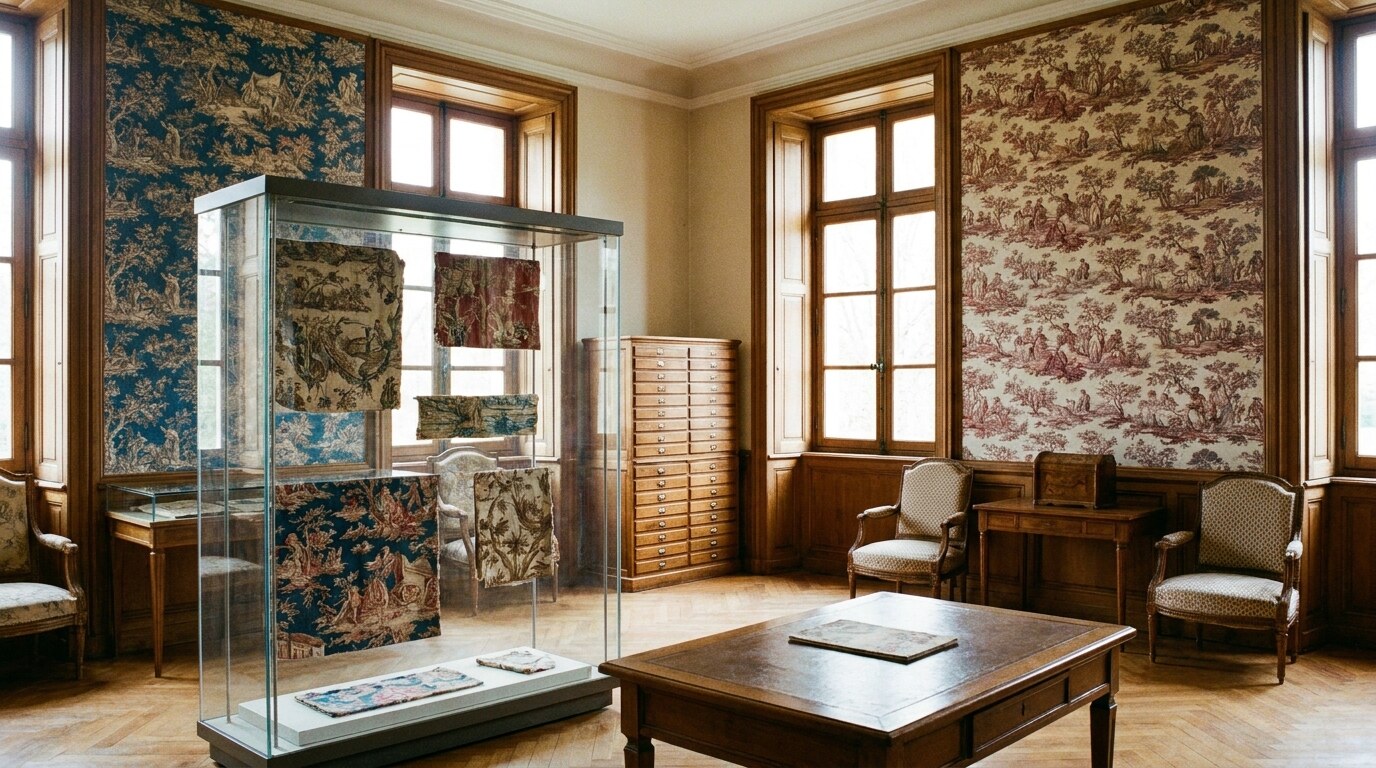
The Musée de la Toile de Jouy holds approximately 30,000 catalogued textile fragments and 50,000 archival documents at the Château de l'Eglantine, 54 rue Charles de Gaulle, Jouy-en-Josas, where the museum opened in 1977 in the former mansion of Oberkampf's grandson. The museum's research collection allows scholars and specifiers to verify pattern attribution, dating, and original colour palette against documented production. Photographic documentation of approximately 9,000 patterns is online at the museum's website.
Modern reissues and authentic reproduction
Three current producers reissue Oberkampf designs from period plates or archived references. Pierre Frey (Paris, founded 1935) holds licensing arrangements with the Musée de la Toile de Jouy for several authenticated reissues. Thibaut (founded 1886, New Jersey) carries American-market reissues. de Gournay commissions Toile-pattern hand-painted wallpapers at higher price points. Original 18th-century Toile de Jouy fabric remnants trade through textile dealers and at Christie's, Sotheby's, and Tajan Paris at typical prices of £180 to £1,200 per metre depending on length and condition.
The forward research question for this journal is the export trade of Oberkampf's Toile to Russia, Sweden, and the German states between 1770 and 1810, of which the museum's archive holds shipping ledgers but published transcription is partial.
References and further reading
- Musée de la Toile de Jouy.
- Pierre Frey.
- Thibaut.
- Victoria and Albert Museum, textile collection.
- The Met, Costume Institute textile collection.