
Chinoiserie: From the Pavillon Chinois to Hand-Painted Wallpaper Today
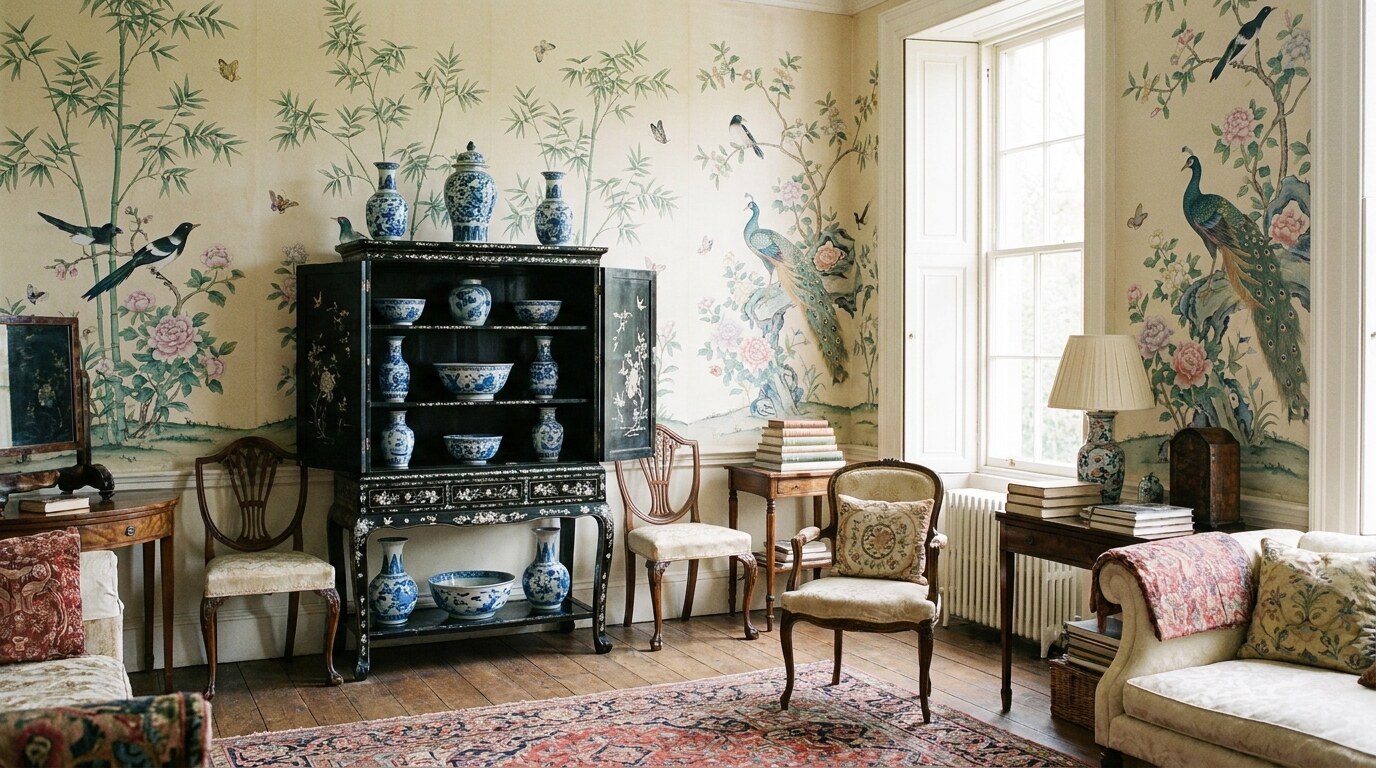
Chinoiserie is the European decorative response to Chinese export goods, developed continuously from the 1670s through the early 20th century in painted lacquer, hand-painted silk wallpaper, porcelain, japanned furniture, and pavilion architecture. The seminal commission was Louis Le Vau's Trianon de Porcelaine at Versailles (1670–1687); the surviving high points include the Pavillon Chinois at the Château de Chantilly (1735) and the Chinese Drawing Room at Brighton Pavilion (Frederick Crace and Robert Jones, 1817–1820). The style remains in active production today through hand-painted wallpaper houses including de Gournay (London, founded 1986) and Fromental (London, founded 2005).
A four-century timeline
Chinoiserie's four-century arc divides into four documented phases. The first phase (1670–1715) followed direct trade with China through the Dutch East India Company and produced Louis XIV's Trianon de Porcelaine (built 1670, demolished 1687) and Mary II's japanned cabinets at Hampton Court. The second phase (1715–1770), under Louis XV and the Régence, integrated Chinese motifs into Rococo decoration; François Boucher's painted designs for the Beauvais weaving workshops (1742–1745) supplied the visual canon. The third phase (1770–1830) reached its high points in British country-house China rooms (Saltram, Harewood, Stratfield Saye) and the Brighton Pavilion. The fourth phase (1830–1925) saw revival in Aesthetic Movement and Edwardian interiors, before declining during the modernist period (1925–1970) and recovering after 1970 through hand-painted wallpaper revival.
Five canonical interiors to study
The Royal Pavilion at Brighton, decorated 1815–1822 under John Nash, contains the most coherent surviving British chinoiserie interior, with the Chinese Drawing Room and the Music Room executed by Frederick Crace and Robert Jones at a documented cost of £155,000 (approximately £18 million in 2026 sterling). The Petit Salon Chinois at the Château de Chantilly (Petit Château, 1735) is the surviving small-scale Rococo high point. Hampton Court Palace's japanned closet to Mary II (commissioned 1690) preserves the earliest English-period chinoiserie interior. Saltram House (Devon) retains its Chinese Bedroom with hand-painted Chinese wallpaper installed c. 1770. Newhailes (East Lothian, Scotland, National Trust for Scotland) shows the rare survival of an 18th-century Chinese closet in a Scottish country house.
Painted wallpaper production today
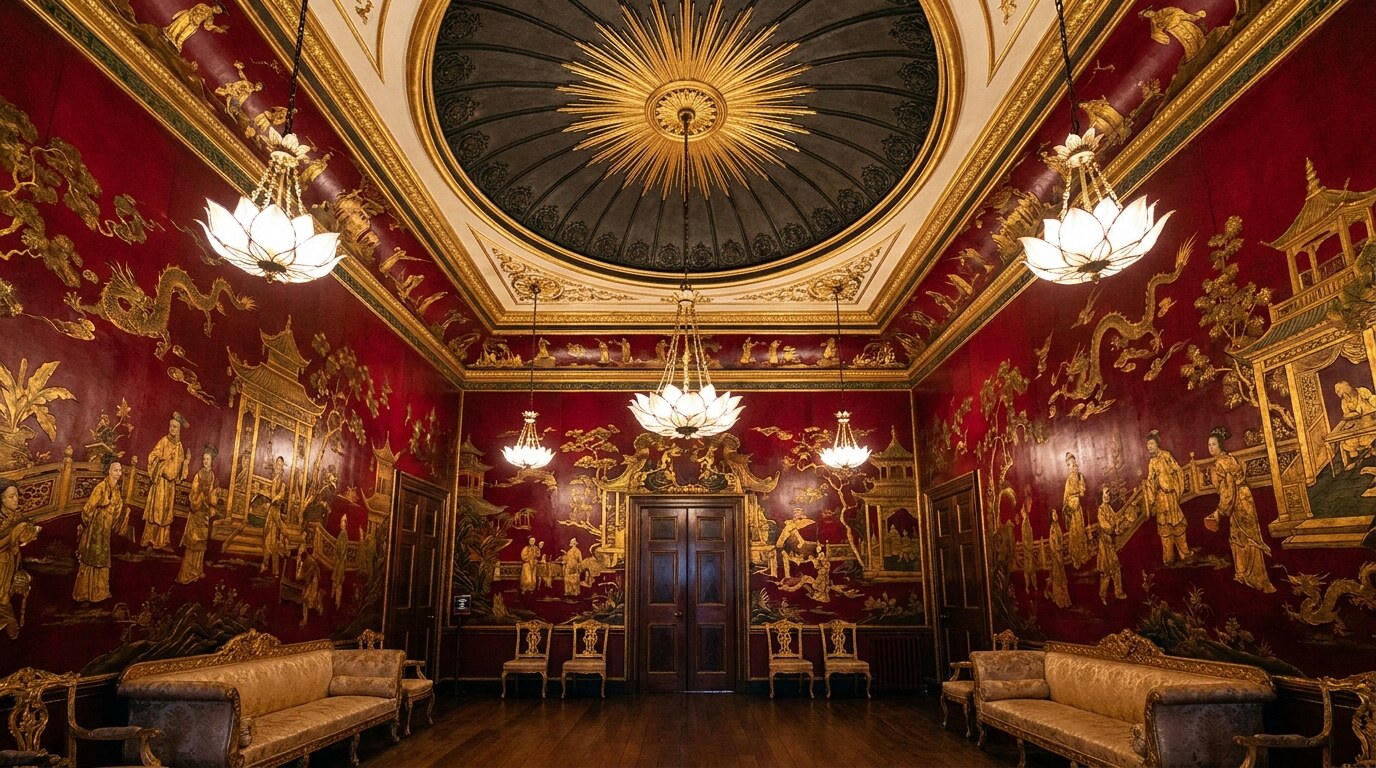
Three London houses produce most of the global hand-painted chinoiserie wallpaper sold in 2026. A bespoke hand-painted de Gournay chinoiserie wallpaper scheme on silk ground costs between £2,400 and £4,200 per panel of approximately 91 cm by 305 cm as of 2026, with a typical lead time of 14 to 18 weeks; the same house's cotton-ground production runs from £900 per panel. Fromental (founded 2005) produces hand-painted wallpapers in similar formats with prices ranging £900 to £3,200 per panel. Misha Handmade Wallpaper (Mumbai, founded 2009) supplies hand-painted panels at lower price points, from £450 per panel for cotton-ground production.
Chinoiserie furniture types
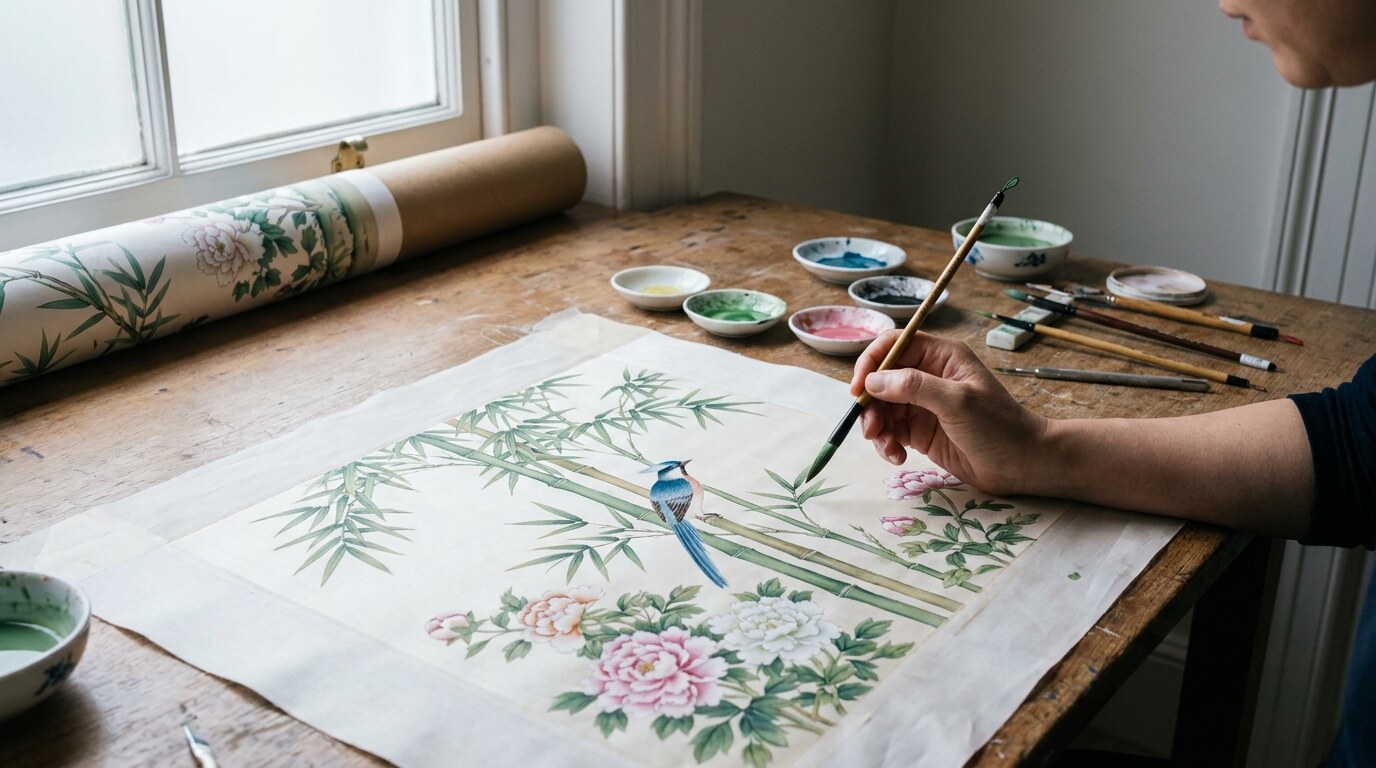
Four furniture types recur in classical chinoiserie schemes. Japanned cabinets (English production after 1670 imitating Asian lacquer) appear as fall-front secretaries, six-leg side cabinets, and small tea-tables, often with raised gilt decoration on a black or red ground. Fretwork chairs (Thomas Chippendale's Director, 1754, plate XXVI) carry pierced backs in geometric Chinese patterns. Pagoda-pediment cabinets and bookcases display tiered roof profiles with upturned eaves, a form that originated in Chippendale's pattern books and remained in production through the early 19th century. Lacquer screens (six- or eight-fold panels with figural decoration in raised gesso and leaf) were imported via Coromandel and copied in European workshops from approximately 1700.
Authentication of period vs revival
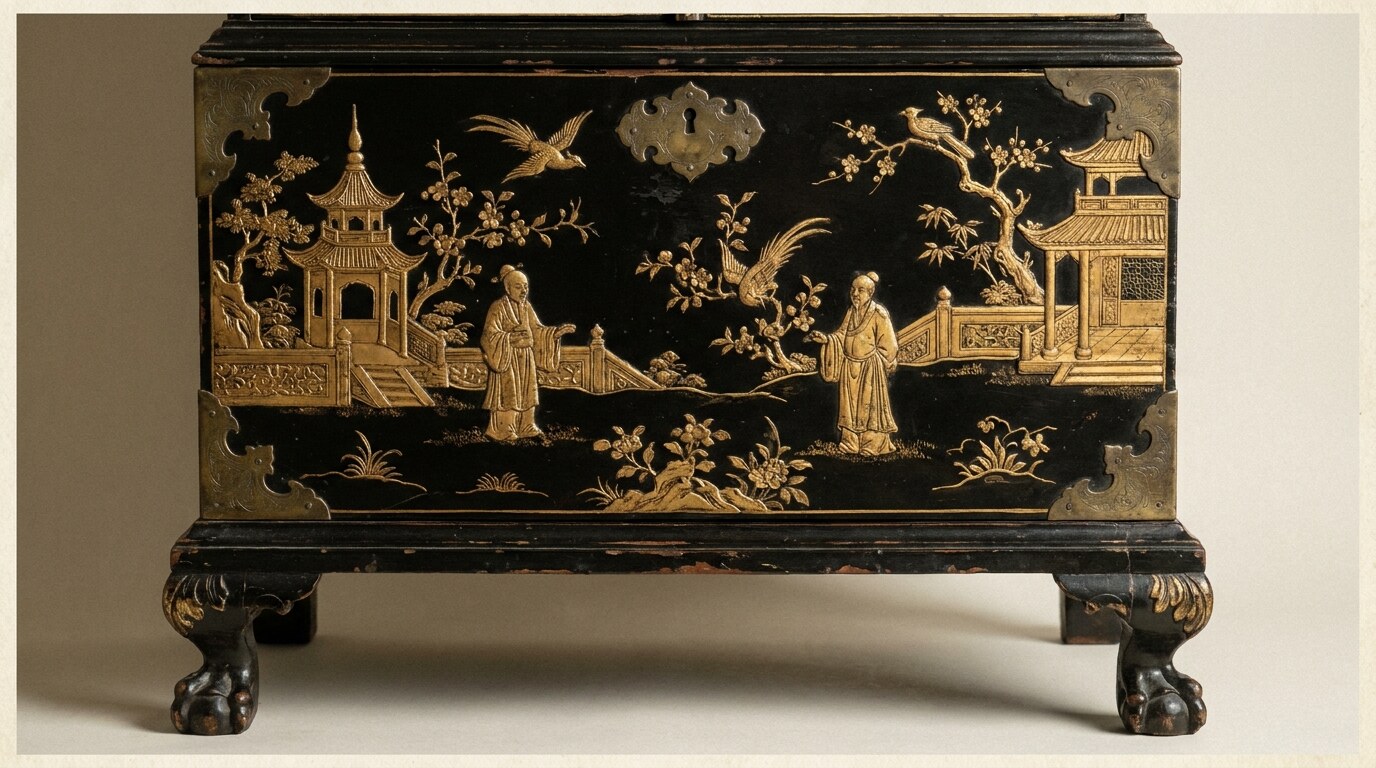
Period chinoiserie wallpaper (Chinese manufacture, exported via Canton 1740–1840) shows hand-painted detail on hand-laid mulberry-paper grounds, with seam joints visible at 30 to 40 cm intervals. Revival production after 1900 uses machine-laid Western paper grounds in 50 to 70 cm widths and screen-printed or hand-painted decoration at slightly different palette ranges. The British Museum's Asian Department and the Victoria and Albert Museum's Far Eastern Department both publish authentication notes; the V&A's online collection includes more than 600 catalogued period chinoiserie wallpaper fragments.
The forward research question for this journal is the inventory of pre-1750 painted Chinese wallpaper still in situ in British country houses, of which 23 are confirmed in published surveys but at least 10 more are believed to remain undocumented in private dwellings.
References and further reading
- Royal Pavilion Brighton.
- Château de Chantilly.
- Victoria and Albert Museum, chinoiserie wallpaper collection.
- de Gournay, London.
- Fromental, London.
- National Trust, Saltram House.